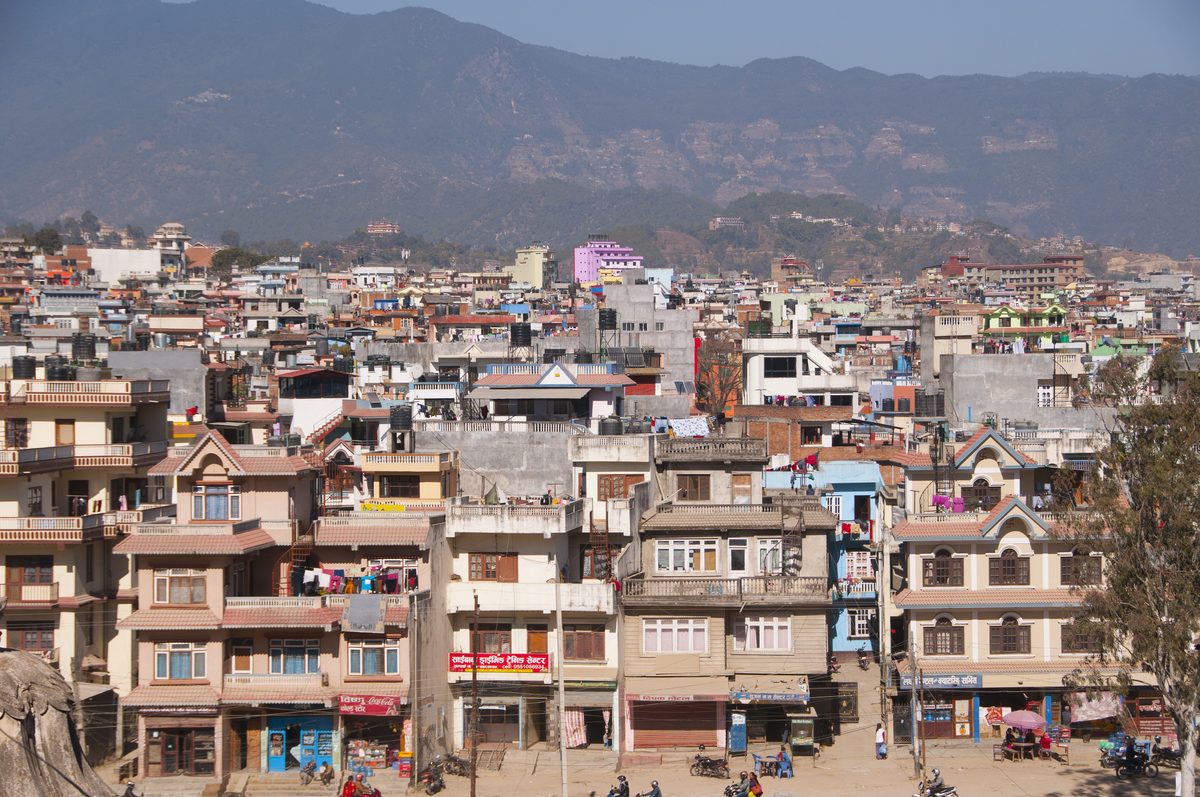
There is a moment, somewhere on the switchbacked road that climbs out of the Marsyangdi valley, when the noise simply stops. The horns of the highway fall away below you. The dust settles. And as the car crests the final ridge at 1,030 metres, a town appears that seems to have been lifted, whole and untouched, from a century that the rest of Nepal has long since left behind.
This is Bandipur. And if you have travelled to understand what the Himalayas felt like before the world arrived, this is where you will find it.
The Town That Time Chose to Keep
Most of Nepal's great destinations announce themselves. Everest demands your awe; Kathmandu overwhelms your senses; Pokhara sells you a sunrise. Bandipur does none of this. It simply exists — a single flagstone street, perhaps four hundred metres long, lined with the tall, slender townhouses of the Newar merchants who built their fortunes here two hundred years ago, when this ridge sat astride the great trade route between India and Tibet.
When the highway was cut through the valley floor in the 1970s, commerce abandoned the hilltop overnight. And in that abandonment lay Bandipur's salvation. While the rest of Nepal modernised, poured concrete, and strung its towns with wire, Bandipur was quietly forgotten — its latticed windows, its carved sansari shrines, its shuttered shopfronts left exactly as they were. What was once economic tragedy is now the rarest luxury of all: authenticity that no one had to reconstruct.
Today the main bazaar is closed to vehicles. You walk on stone worn smooth by generations. Bougainvillea spills from wooden balconies. An old man plays cards in a doorway beneath a lintel carved with peacocks. There is no traffic, no neon, no sense of anything being performed for your benefit. Bandipur is not a museum of Newari life. It is Newari life, still being lived — and you are simply, graciously, allowed to walk through it.
For the traveller who has grown weary of the curated and the commodified, this distinction is everything. At Elysian Himalaya we speak often of experiential wealth — the idea that the truest luxury is no longer about what you own but about what you are permitted to witness. Bandipur is experiential wealth in its purest form. You cannot buy your way into it. You can only arrive quietly, and pay attention.
Where Heritage Becomes the Address
Let us be clear about one thing, because discerning travellers deserve honesty: Bandipur has no international five-star chain, no glass-walled spa tower, no infinity pool advertised in a glossy brochure. And this is precisely the point.
What Bandipur offers instead is something the great hotel groups can never manufacture — the boutique heritage inn, born from the restoration of the very townhouses that give the ridge its soul. Behind a facade of hand-cut stone and carved timber, you will find a handful of rooms furnished with restraint and taste: brass fittings, handwoven dhaka textiles, deep windows that frame the Himalaya like living paintings. The finest of these properties were rescued from ruin by owners who understood that the goal was never to impose luxury upon Bandipur, but to reveal the luxury that was always latent in its craftsmanship.
Dinner is not a buffet but a conversation — organic vegetables from the terraced fields below, freshly milled millet, honey from the hillside, prepared by a family who will remember your name by the second evening. Mornings begin with the ridge wrapped in cloud and, as it burns away, the sudden, breathtaking revelation of the Annapurna and Manaslu massifs floating above the mist. There are hotels the world over that charge four figures a night for a fraction of this feeling.
This is the essence of what we build into every bespoke journey: the understanding that refinement is measured not in thread count but in the depth of a moment. A heritage inn in Bandipur, chosen and secured with care, becomes not a place you stay but a place you belong — however briefly.
The View from Gurungche and Thani Mai
Bandipur's ridge is a natural theatre, and its two great viewpoints are the seats from which the Himalaya perform.
Thani Mai Temple at Dawn
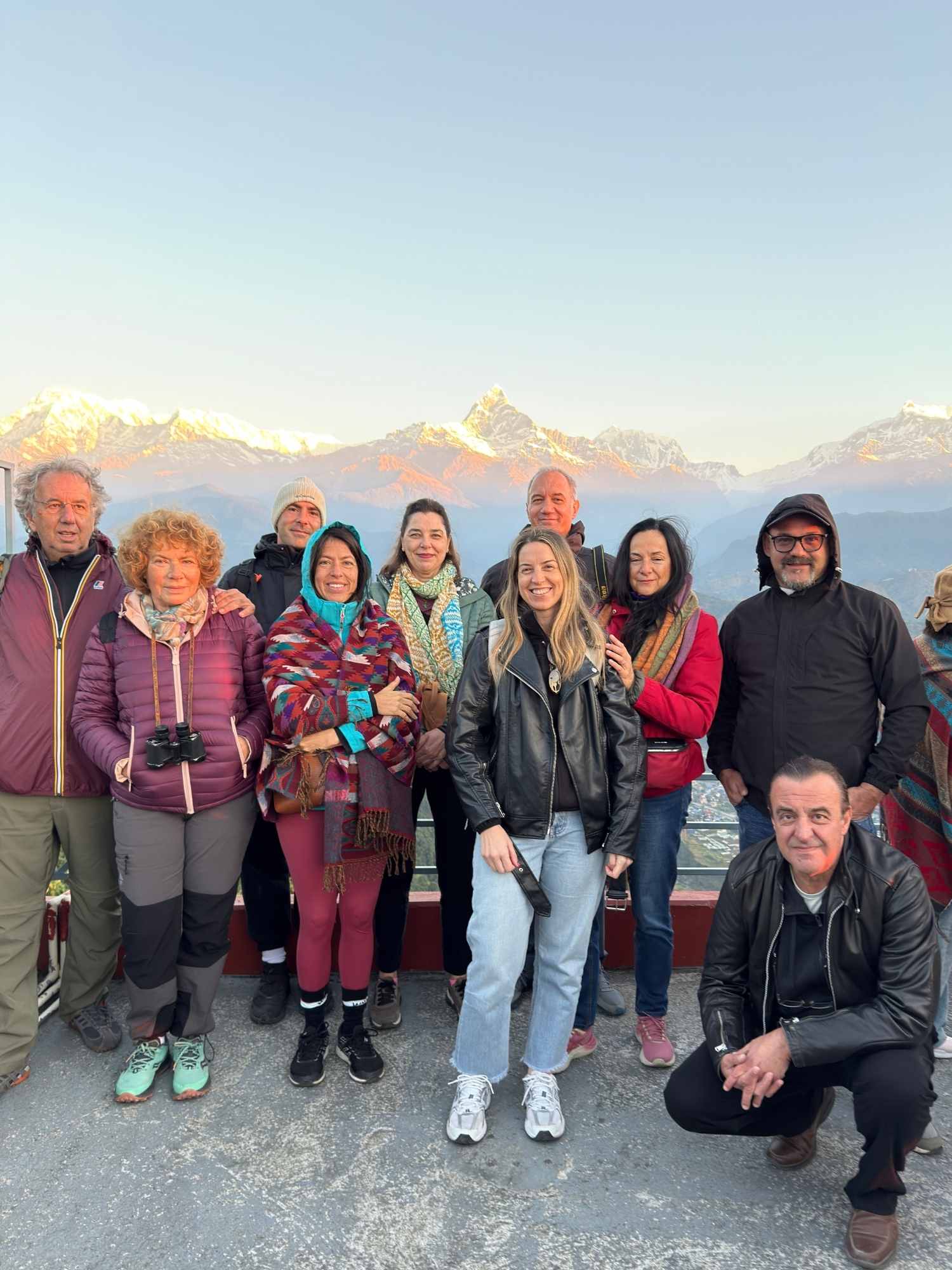
A twenty-minute climb through pine and rhododendron brings you, before first light, to the small temple of Thani Mai crowning the hill above the town. This is the single most rewarded early rising in central Nepal. As the sun lifts over the eastern ranges, an unbroken panorama ignites: Dhaulagiri, the Annapurnas, Machhapuchhre's fishtail spire, Manaslu, Ganesh Himal, and on the clearest mornings the distant white teeth of Langtang. Below you, Bandipur's rooftops emerge from a lake of valley cloud like an island. You will share the moment with a priest lighting butter lamps and, perhaps, no one else at all.
Gurungche Hill and the Silk-Cotton Trees
To the west, Gurungche Hill offers the sunset counterpart — a gentler walk to a promontory where ancient silk-cotton trees frame the valley and paragliders occasionally drift on the thermals. It is here, glass of local honey wine in hand, that most travellers understand why they came.
Beneath the Ridge: The Siddha Cave and the Silk Farm
Bandipur rewards the curious with worlds beneath and beside it.
A short descent leads to Siddha Gufa, the largest cave in Nepal and among the most significant in South Asia — a vast subterranean cathedral of stalactites and stalagmites, its chambers rising fifty metres overhead. Explored properly, with a private guide and proper light, it is an experience of genuine grandeur, entirely free of the crowds that would besiege such a place anywhere else in the world.
Nearby, the village of Ramkot preserves a Magar community and round-house architecture largely unchanged for centuries, while Bandipur's own silk farm and the terraced fields that tumble down its flanks offer an unhurried window into a rhythm of life that the modern world has almost entirely forgotten. These are not attractions in the transactional sense. They are invitations to slow down — and slowing down, in the end, is the one thing that money most struggles to buy.
Bandipur Within the Greater Journey
Bandipur's geography is its quiet genius. It sits, almost exactly, at the midpoint between Kathmandu and Pokhara — which makes it not a detour but a natural, civilised pause in the arc of any considered Nepal itinerary.
This is why we so often weave Bandipur into the fabric of a longer journey rather than treating it as a destination in isolation. After the temple-dense intensity of the Kathmandu Valley, the ridge offers a decompression — a day and a night in which the senses recover before the lakeside serenity of Pokhara. On our Classic journey, Bandipur becomes the reflective heart between two worlds. For those travelling on the Premium journey, we extend the stay, adding private guided walks to Ramkot and a candlelit dinner arranged on a heritage rooftop beneath the full sweep of the Himalaya.
And for the few who choose the Ultimate journey, we do what Bandipur's silent ridges make possible: we arrive not by road but by private helicopter, setting down on the valley floor with the whole panorama already ablaze, transforming a six-hour drive into a fifteen-minute revelation — and gifting the day's stolen hours back to the ridge itself.
When to Come, and How Long to Stay
Bandipur is at its most transcendent in the shoulder seasons. October and November deliver the crystalline post-monsoon air in which the mountains appear close enough to touch — the reward of the entire Himalayan year. March and April bring the rhododendron and the warm, hazy softness of spring, the hillsides in bloom. The monsoon months, though green and dramatic, veil the peaks; the deep winter is clear but cold on the exposed ridge.
As for duration: Bandipur is not a place to be conquered in an afternoon, and travellers who treat it as a photo stop leave having missed it entirely. Two nights is the minimum for the town to reveal its rhythm — one dawn at Thani Mai, one unhurried day among the lanes and the cave, one sunset at Gurungche, and the slow, essential evenings in between. Give it three, and Bandipur stops being somewhere you visited and becomes somewhere you carry.
The Deeper Reason to Go
We are, all of us, running out of unspoiled places. The corners of the world that have not been optimised, monetised, and photographed into cliché grow fewer each year. Bandipur is one of the last — and it survives not because it was protected by decree but because it was, for a while, simply left alone.
To travel here well is to participate in its quiet continuation: to stay in the inns that fund its restoration, to eat the food its farmers grow, to walk its streets with reverence rather than acquisition. This is the philosophy that underpins everything we do — a belief, which you can read more about in the story of our founder, that the finest journeys leave both the traveller and the place a little richer for the meeting.
Bandipur asks nothing of you but your attention. In return, it offers the rarest thing a journey can give: the sense of having stepped, however briefly, into a Nepal that the world forgot to change.
Begin Your Own Ascent
Every Elysian Himalaya journey is composed by hand, thread by thread, around the traveller it is made for — and Bandipur, for those who understand it, is one of the most quietly transformative threads we weave. If the idea of a traffic-free ridge, a heritage inn, and a Himalayan dawn shared with no one but a temple priest speaks to something in you, let us begin the conversation.
Design your bespoke Nepal journey with us, and discover why the connoisseurs of the Himalaya have always known to climb the hill.