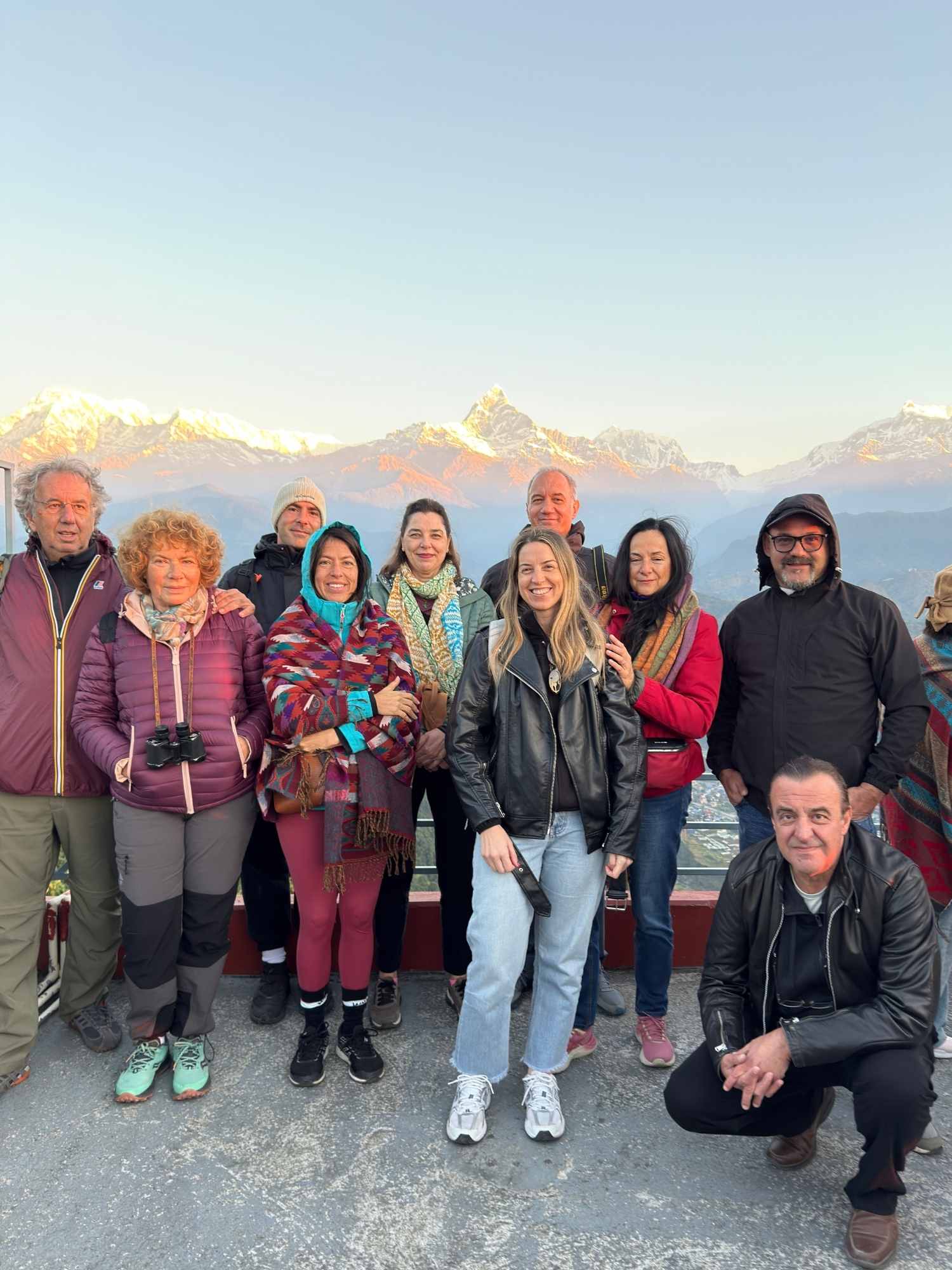
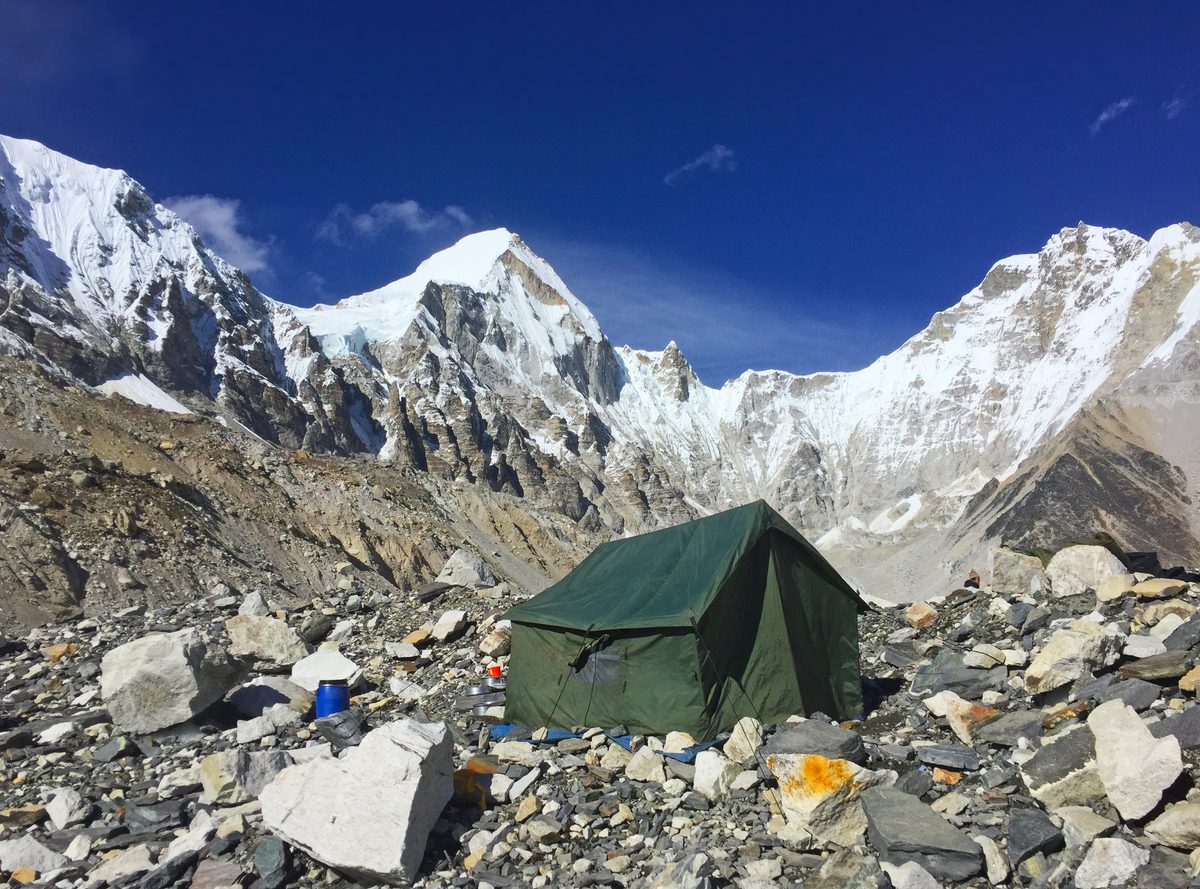
There is a moment on the Dhaulagiri Circuit that I have never been able to describe adequately to anyone who has not stood there. It comes on the morning you leave Dhaulagiri Base Camp, somewhere around six o'clock, when the light has not yet reached the valley floor but has already ignited the north-east ridge above you — eight thousand one hundred and sixty-seven metres of ice turning the colour of a struck match while you are still standing in blue shadow, breath freezing on your collar, holding a cup of tea that will go cold in ninety seconds.
Nobody speaks. Not because it is a rule, but because there is genuinely nothing to say.
I have designed journeys across every corner of this country — the forbidden kingdoms of the north, the sub-tropical jungles of the Terai, the sacred lakes at the top of the world. The Dhaulagiri Circuit is the one I recommend least often and love most fiercely. It is not the most beautiful trek in Nepal. It is not the most famous. It is simply the most complete — a crossing that begins in banana groves at eight hundred metres and ends in the apple orchards of Mustang, having taken you over two passes above five thousand metres, across a live glacier, and through eleven consecutive days in which the only shelter is the one your team carries on its back.
This article is about how that journey is done properly. Which is to say: how a route with no hotels, no lodges and no road becomes one of the most refined experiences we offer.
Why the Dhaulagiri Circuit Is Unlike Any Other Trek in Nepal
Every well-known Himalayan trek in Nepal shares one quiet advantage: infrastructure. On the Everest and Annapurna routes, a village appears every few hours. There are beds, kitchens, a kettle, a solar panel, a neighbour. Even on the remote journeys we design in Dolpo and Limi, there are settlements — thin, scattered, ancient, but settlements.
The Dhaulagiri Circuit has almost none of this. Beyond the village of Boghara, roughly four days in, human habitation simply stops. What follows is a week and a half of uninhabited gorge, moraine, glacier and high desert. There is no road to walk out on. There is no teahouse to retreat to. The valley narrows into a slot so steep that in places the trail is a series of cut steps above a river you can hear but cannot see.
This is the reason the trek is rated among the hardest in the country, and it is also the reason it remains genuinely uncrowded in an era when very little in Nepal does. In a strong autumn season, the Everest Base Camp trail carries thousands of people. The Dhaulagiri Circuit carries a few hundred. Some days you will pass nobody at all.
The Mountain That Was Briefly the Highest on Earth
The name comes from Sanskrit — dhavala giri, the dazzling white mountain — and for thirty years in the nineteenth century, European surveyors believed it to be the highest point on the planet. It was later demoted to seventh, at 8,167 metres, but the mistake is easy to forgive. Dhaulagiri I rises with almost no foothills to soften it. Stand in the Kali Gandaki valley and you are looking at seven thousand metres of vertical relief in a single sweep of the eye, with Annapurna I doing the same thing on the opposite side. The gorge between them is the deepest on earth.
It was first climbed in 1960 by a Swiss-Austrian expedition, and it has kept a reputation ever since as a mountain that does not forgive casualness. We are not climbing it. But we are walking a full circle around it, at close quarters, and the mountain sets the terms of that walk entirely.
The Route: From Banana Groves to Mustang, Across Two High Passes
The classic crossing runs west to east: from Beni in the Myagdi district, up the Myagdi Khola, around the northern flank of the massif, and down into the Kali Gandaki at Marpha. Fifteen to eighteen days on foot, depending on how much acclimatisation we build in — and we build in more than most.
Days 1 to 4: The Green Approach
You begin low. Genuinely low — around eight hundred and thirty metres, in air that is warm and thick and smells of cut rice. The first days pass through Babiyachaur, Dharapani and Muri: Magar villages of ochre mud walls and slate roofs, buffalo in the lanes, children walking to school along the trail you are walking up. Terraced fields climb the hillsides in shelves so precise they look drawn. Millet, maize, cardamom.
It is beautiful, and it is deliberately gentle, and it is doing important work: these days are your engine room. By the time you reach Boghara you have gained meaningful altitude without noticing it, and your body has begun the adaptation that will decide whether French Pass is a triumph or a misery ten days from now.
Days 5 to 8: Into the Gorge and Onto the Ice
Somewhere after Boghara the character of the journey changes completely. The valley closes in. The trail begins to climb through dense, dripping rhododendron and bamboo forest, crossing landslide scars on paths our team re-cuts each season. This is the technical heart of the approach — steep, exposed in places, and utterly without villages.
You camp at Dobang, then at Italian Base Camp (3,660 metres), then at Glacier Camp (around 4,200 metres), where the treeline is long behind you and the Chhonbardan Glacier becomes your road. Walking on a glacier is a peculiar sensation the first time: the ground is grey rubble, but it groans and shifts, and there is running water somewhere beneath your boots.
Dhaulagiri Base Camp sits at 4,740 metres, on moraine directly beneath the north face. We schedule a full rest day here. Not as a courtesy — as physiology. And also, frankly, because it is one of the great amphitheatres of the Himalaya, and to arrive and leave the next morning would be a kind of vandalism.
Days 9 to 11: French Pass and the Hidden Valley
French Pass, 5,360 metres, is the crux and the summit of the whole undertaking. It is a long, cold, methodical climb — usually begun before dawn, usually into wind. The last hundred metres take an hour. And then you are over, and the view opens onto something that genuinely does not look like the same planet: the Hidden Valley, a high, dry, silent basin at around five thousand metres, ringed by peaks, with no trees, no water in autumn, no life at all.
We camp there. It is one of the highest and most exposed camps in commercial Himalayan trekking, and it is unforgettable — a night of absolute silence and a sky so crowded with stars that constellations become hard to pick out.
Days 12 to 15: Dhampus Pass and the Descent into Mustang
Dhampus Pass, around 5,240 metres, is the gentler of the two, and from it the entire Annapurna range stands up in front of you like a wall. Then comes the descent — long, knee-punishing, exhilarating — down through Yak Kharka into the Kali Gandaki, and into Marpha: whitewashed Thakali village, flagstone lanes, apple orchards, the smell of brandy distilling in stone cellars.
The contrast is the point. You come off a glacier and eleven days of tents, and you sit in a courtyard in Mustang with a glass of apple brandy and warm bread, and you are, temporarily, the most contented human being alive. We usually build in two nights here, and from Jomsom you fly out — or, on our Ultimate journeys, a private helicopter takes you directly over the gorge you have just spent two weeks inside.
What "Luxury" Actually Means on a Trek With No Hotels
Here is where I must be honest with you, because the alternative is a disappointed guest at 4,700 metres, which serves nobody.
There is no five-star lodge on the Dhaulagiri Circuit. There is no boutique property, no spa, no suite with a view. Any company that implies otherwise is selling you something that does not exist. The mountain has not been developed and, with any luck, will not be.
What exists instead is something I would argue is rarer: a fully self-contained expedition built to a standard almost nobody applies to trekking. On this route, luxury is not marble. It is competence.
- A private crew, sized properly. Sirdar, licensed guide, dedicated expedition cook plus kitchen assistants, and a porter team scaled to carry real comfort rather than the bare minimum. Nobody in your party carries more than a day pack.
- Sleeping systems that actually work at 5,000 metres. Four-season expedition tents pitched by people who pitch them for a living, insulated mats layered to defeat ground cold, and down bags rated well below the temperatures we expect — not to them.
- A dining tent, a table, and chairs with backs. This sounds trivial. On day nine, at five thousand metres, sitting upright at a table to eat a hot three-course dinner is the single greatest luxury in the Himalaya.
- Food that has no business being that good. Our expedition cooks produce soups, fresh bread, momos, dal bhat, pasta and cake from a kerosene stove in a canvas kitchen. Fresh ingredients are resupplied as far up the valley as animals can reach.
- A private toilet tent and hot washing water each evening. Twice daily on the lower, warmer sections.
- Medical seriousness. Pulse oximetry every evening, a comprehensive high-altitude kit, supplementary oxygen and a portable altitude chamber carried on the crossing itself, satellite communications throughout, and pre-arranged helicopter evacuation cover. This is not decoration; it is the reason the trek is safe to do at all.
- Time. The most expensive thing we give you. We run longer itineraries than the market standard because acclimatisation is the difference between a summit day you remember and one you endure.
That is the honest shape of luxury here, and it is why this trek belongs in our Premium and Ultimate tiers rather than the Classic one. It cannot be done cheaply and done well.
How Hard Is the Dhaulagiri Circuit, Really?
It is one of the two or three most demanding trekking routes in Nepal. Specifically:
- Two passes above 5,000 metres in three days, with a camp at roughly 5,000 metres between them.
- Maximum altitude of 5,360 metres at French Pass.
- Glacier travel on the Chhonbardan Glacier, requiring crampons or microspikes and, in some conditions, rope work.
- Seven to eight hours of walking daily, with several days of nine or more.
- No exit points and no roads for around ten days. Once you commit past Italian Base Camp, the only ways out are forward, back, or by helicopter.
You do not need mountaineering experience. You do need genuine hill fitness, previous experience above 4,000 metres, and the temperament to be comfortable when you are cold and a long way from anywhere. If you have completed a Himalayan trek before and want the next thing — this is emphatically the next thing.
When to Go
Two windows, and they are not equal.
| Season | Months | Conditions | Our view |
|---|---|---|---|
| Post-monsoon | Late September to mid-November | Clearest air of the year, stable weather, cold nights, snow-free passes early in the window | The season we recommend |
| Pre-monsoon | April to mid-May | Warmer days, rhododendron in full colour, more residual snow on the passes, hazier views | Excellent, with a snow caveat |
Winter closes the passes entirely. The monsoon makes the gorge section genuinely dangerous — landslides, leeches, invisible mountains. We do not run this trek outside the two windows above, and I would be suspicious of anyone who offers to.
What It Costs
A properly crewed private Dhaulagiri crossing is a serious undertaking, and the cost reflects the fact that everything — every tent, every kilo of rice, every cylinder of oxygen — is carried in and out on human and animal backs.
As an indication, our private Dhaulagiri journeys begin in the region of €9,500 per person for a small group at Premium level, and rise from there depending on party size, the length of the acclimatisation programme, and whether you add helicopter support or a private Mustang extension at either end. Smaller parties cost more per person, not less — a two-person crossing requires almost the same crew as a six-person one.
What that figure buys is not luxury in the resort sense. It buys the version of this trek in which nothing goes wrong that could have been prevented.
Who This Journey Is For
Not everyone. I turn people away from this route more often than from any other in our portfolio, and I consider that part of the job.
It is for the traveller who has already done the famous things and found them slightly too easy to arrange. Who wants to be somewhere that cannot be reached by upgrading. Who understands that the value of an experience is not always proportional to its comfort, and who would rather sit in a canvas dining tent beneath an eight-thousand-metre face than in the best suite in Kathmandu.
I designed this crossing, walked it, and still consider it the truest thing we do. It is not tourism. Nothing on the Dhaulagiri Circuit is arranged for your benefit, which is precisely why standing in the Hidden Valley at dawn will rearrange something in you that no hotel ever has.
That is what we mean when we talk about experiential wealth. Not what you were given — what you were changed by. You can read more about why I build journeys this way if you would like to understand the thinking behind it.
Design Your Dhaulagiri
We run a small number of Dhaulagiri crossings each year, exclusively as private departures, and the autumn window fills a long way in advance. If the seventh-highest mountain on earth has been sitting somewhere in the back of your mind, the conversation should start now rather than next spring.
Tell me what kind of traveller you are and how much time you have, and I will tell you honestly whether this is your journey — and if it is, I will design it around you, line by line.
Begin designing your journey — or explore the rest of what Nepal can be when it is planned properly.