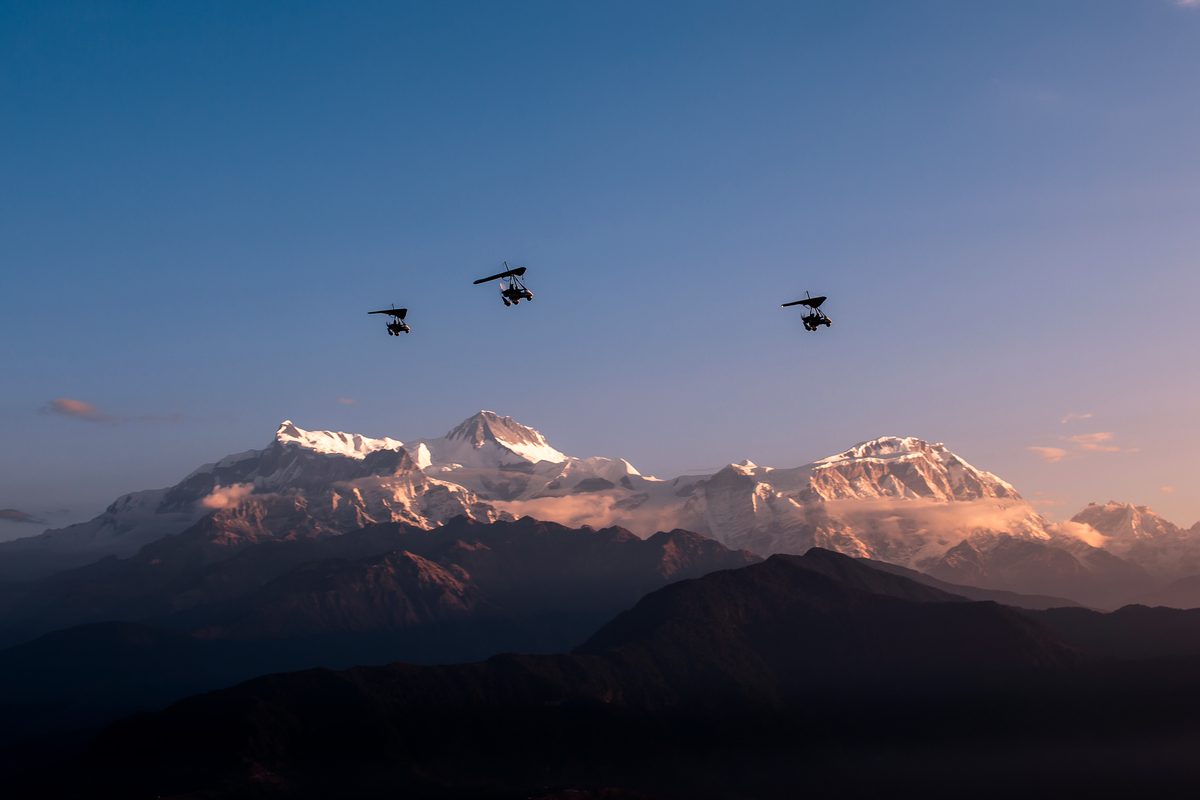
There is a particular silence that exists only at 3,880 metres. It is not the absence of sound — it is the absence of the world. The cities below are still asleep. The cloud sea hovers somewhere around your knees. And in front of you, no further than a long thought across the Khumbu Valley, the south face of Everest catches the first light of the day in a slow, deliberate ignition. Pink first. Then gold. Then, briefly, the colour of something molten and ancient.
You are holding a porcelain cup of Himalayan coffee. The pastries are still warm. A waiter in a dark waistcoat is asking, with the impossibly soft Sherpa politeness that exists nowhere else, whether you would prefer your eggs prepared in the European style this morning.
This is the Everest helicopter breakfast. And it is, by any honest measure, one of the most extraordinary hours a human being can purchase on this planet.
Why This Single Morning Has Become Nepal's Defining Luxury Ritual
In a country that offers helicopter tours, private treks, sacred ceremonies and Himalayan lodges in the kind of profusion that makes choice difficult, one experience has quietly become the signature — the moment that defines what experiential wealth in Nepal actually means.
The reason is geometric. To reach the south face of Everest by any traditional route takes a fortnight of preparation, acclimatisation, and physical labour that most discerning travellers will quite reasonably decline. To reach it by private helicopter takes a single dawn. To reach it, land at altitude, and have breakfast served on white linen with the mountain itself in your peripheral vision — that requires something rarer still: an operator who has refined the choreography of the morning to the exact tempo of how light moves across the Khumbu range.
That choreography is what we have spent years cultivating at Elysian Himalaya. Because what looks, from the outside, like simply "a helicopter and a meal" is in fact a series of dozens of micro-decisions — about timing, about pilots, about lodges, about menus, about silence — each one of which determines whether the morning becomes a memory or simply a photograph.
The Choreography of the Hour
The Elysian Himalaya Everest breakfast begins, properly, the evening before. You sleep in your suite at a curated Kathmandu property — typically Dwarika's, or the Hyatt Regency's residences, or one of our private heritage homes — with a 4:45 a.m. wake-up service arranged by your dedicated travel director.
By 5:30 a.m. you are at the private aviation terminal at Tribhuvan, where there is no queue, no security theatre, no waiting room. A senior captain — these flights are entrusted only to pilots with more than 5,000 hours of Himalayan time — walks you to the aircraft personally and briefs you on the route. The helicopter is yours alone. Not yours plus three strangers. Yours.
The flight rises east of Kathmandu in the soft, lavender hour before the city wakes. You climb gradually — the Sherpa cliché of "ascending into the gods" begins to feel less metaphorical with each minute — past Namche Bazaar, past Tengboche Monastery, past the first visible glimpse of Ama Dablam standing like a perfectly cut piece of jewellery against the morning. The pilot will tilt the helicopter, gently, to give you the angle that the photographers want. He has done it ten thousand times. He will not say anything; he will simply give you the angle, because he understands.
At 6:30 a.m., as the world below is still gathering itself, you land at Kala Patthar viewpoint at 5,545 metres — a brief, oxygen-thin moment for photographs at the closest point to Everest you can reach without climbing it. You step out for no more than ten or fifteen minutes. The cold is sharp and clean. The mountain is very near.
And then, the helicopter takes you back down — only slightly — to the place where breakfast is waiting.
The Two Possible Tables
There are essentially two locations at which a serious operator can serve you the breakfast itself, and the choice between them is the single most important decision of the morning.
The Everest View Hotel, at Syangboche, sits at 3,880 metres and holds — entirely without exaggeration — the Guinness record as the highest-altitude hotel on earth. It is the classic table. Its terrace looks directly across the valley to Everest, Lhotse, Nuptse and Ama Dablam in a single sweeping panorama. The hotel is Japanese-designed, quiet, austere in the proper sense — meaning that nothing in the room competes with what is outside it. This is where most of the world has its Everest breakfast. Kongde Lodge, perched at 4,250 metres on the opposite ridgeline, is the connoisseur's table. It is harder to reach, requires more refined helicopter handling, and is significantly less populated — meaning that the silence is more nearly total. The view, because of the angle, is arguably more dramatic, because Everest rises across the Khumbu basin in full architectural elevation rather than partial profile. We tend to favour Kongde for honeymooners, for travellers who have done the Everest View previously, and for those whose definition of luxury includes the certainty that no one else is also taking photographs.At either, the breakfast itself is unhurried, and that unhurriedness is the point.
What Is Actually on the Table
This is not a hotel breakfast buffet at altitude. It is a curated tasting menu adapted, deliberately, to what the body can absorb above 3,800 metres without complaint.
The bread arrives first — fresh-baked the same morning, often a slow-leavened sourdough that has travelled, improbably, from a Kathmandu boulangerie tucked into insulated containers. Eggs are made to order, prepared in whatever style you prefer — though there is something about a perfectly soft poached egg at this altitude that feels almost defiant. There are pancakes, if you wish — the Sherpa-made buckwheat ones are, in our private opinion, better than the European wheat versions, though we will of course serve whichever you prefer.
Yak cheese, served in slim portions, gives the meal its sense of place. Honey from the Annapurna hillsides — extracted from cliff combs by the legendary Gurung honey hunters — is offered as a small ceremonial flourish, accompanying butter from local highland herds. Coffee is from the Nepali Tatopani region, lighter and more floral than the Indian beans most travellers expect.
Tea, of course, is masala chai — brewed in the proper Himalayan tradition, dense with cardamom and clove, served scalding hot in handle-less cups that warm your fingers in the thin air.
The menu adapts to your dietary preferences in advance. We have served vegan breakfasts, gluten-free breakfasts, low-altitude-protein-rich breakfasts for travellers concerned about acclimatisation. The kitchen — both at Everest View and at Kongde — receives your preferences forty-eight hours before the flight and prepares accordingly.
The Quiet Hour That Follows
The breakfast itself is leisurely. We allocate ninety minutes — though the actual sitting often stretches longer, because no one in the history of this experience has ever asked to leave early.
You will find yourself looking up between courses, repeatedly, at the mountain. You will photograph less than you expected — at some point, the camera comes down and stays down. You will speak less than you expected. You may, depending on your temperament, find your eyes welling up at some unexpected moment — there is something about being served a hot coffee in a porcelain cup with Everest in your line of sight that disarms even the most measured travellers.
This is, properly understood, the moment the trip pays for itself. Not on the flight up, when the adrenaline is doing the work, but here — at the table, in the silence, when the body has stopped reacting and started absorbing.
Why Most Operators Get This Wrong
It would be unfair not to address the most common failure mode of the Everest breakfast experience, because it is endemic in the market: the shared flight, the group breakfast, the rushed two hours.
A great many helicopter operators in Kathmandu sell the Everest breakfast as a per-seat product. Four or five strangers are loaded into the same aircraft, sit through the same flight, land at Syangboche together, and are seated together in a larger dining room with whoever else booked that morning. The breakfast becomes a buffet. The conversation around you is in three languages. The terrace is full. The photographs include other people's heads.
This is not the Everest breakfast. This is an Everest meal, and the difference is the difference between a private chef and a hotel buffet. Both are food. Only one is an occasion.
The Elysian Himalaya version is, without exception, a private charter — your aircraft, your captain, your table, your morning. There are no shared seats, no other groups at the lodge during your sitting, no compromise on the silence. We are inflexible on this for a single reason: anything else is not what we sell.
How It Fits Into a Larger Journey
The Everest helicopter breakfast can be done as a single dawn within a longer Nepal journey — and this is, in our experience, the proper way to do it.
For our Premium Journey travellers, the breakfast is typically positioned on day three or four, after a Kathmandu cultural immersion and a Pokhara interlude — meaning that by the time you reach Everest, your eye has been trained, your altitude tolerance has begun to settle, and the experience lands with the resonance it deserves.
For our Ultimate Journey clients, the Everest breakfast is paired with a separate private helicopter day to Upper Mustang, creating what is, by some margin, the most extravagant double-helicopter experience available in Asia. Two dawns. Two mountain kingdoms. Two breakfasts you will remember for the rest of your life.
For travellers on a tighter timeline, we can also build the Everest breakfast into a five-night Nepal stay — though we always counsel that a longer immersion serves the experience better. You can read more about how we design a journey from scratch for clients who arrive with only a sense of the kind of morning they want.
The Practical Details
When to go. The best months are late September through November, and then March through early May. The morning skies in these windows are reliably clear, the visibility is mathematically optimal, and the temperatures at altitude are bearable for an outdoor terrace breakfast. December and January are possible but require flexibility — Himalayan weather is honest, and a flight occasionally needs to be postponed by twenty-four hours, which our travel directors handle without disturbing your wider itinerary. Monsoon months — June through early September — we will not attempt the flight at all. The altitude question. You will be at 5,545 metres briefly at Kala Patthar, and at 3,880 or 4,250 metres for the breakfast itself. Every Elysian Himalaya helicopter carries supplementary oxygen, and our medical protocol is conservative — we ask travellers with cardiac or respiratory conditions to consult their physician before booking, and we adapt the itinerary accordingly. Most healthy adults experience nothing more than a mild light-headedness for the first ten minutes; for some, even that is absent. The cost. The honest range, for a properly private Everest breakfast experience with Elysian Himalaya, is €4,500 to €8,500 for a group of two to five travellers, depending on aircraft, lodge selection, and seasonal pricing. This is the helicopter, the captain, the landing fees, the breakfast, the photography concierge, and the discreet logistical apparatus around the morning. We do not, on principle, sell this as a per-seat product. You can find shared seat versions in the market for €1,200 to €2,000 per person; they are a different experience entirely. What to wear. The terrace at Everest View and Kongde Lodge is cold. We provide curated outerwear — cashmere-lined parkas, technical thermals, gloves — so you can travel light and still be photographed beautifully. Most clients arrive in their journey wardrobe and dress into our morning kit at the lodge.A Word About Why We Built This Brand Around Mornings Like This
Greek travellers, in particular, understand a certain kind of beauty — the beauty that asks you to be quiet. We are not, as a people, surprised by the sublime; we grew up around it. What we are sometimes surprised by is how cleanly the Himalayas deliver it.
When I began designing Elysian Himalaya, the question I held in mind was simple. What does luxury actually feel like when you are far from home — not what does it look like, but what does it feel like, in the body, at the moment it is happening? And the answer, over a hundred bespoke journeys, has been remarkably consistent. It feels like an hour where the only thing being asked of you is to look. To eat slowly. To be exactly where you are.
The Everest helicopter breakfast is the most distilled version of that idea that we know how to deliver. It is not the longest experience we offer. It is not the most expensive. But it is, for almost every client, the moment around which the rest of the trip organises itself in memory — the morning everyone goes home telling their friends about.
If that is the kind of morning you have been quietly waiting to have, we would be honoured to design it for you. The first conversation about your journey costs nothing and commits to nothing. We begin, always, with how you want to feel — not what you want to see. Tell us about the journey you have been imagining.
The mountain is waiting. The pilots are ready. Breakfast is, as the Sherpas would say, already being prepared.