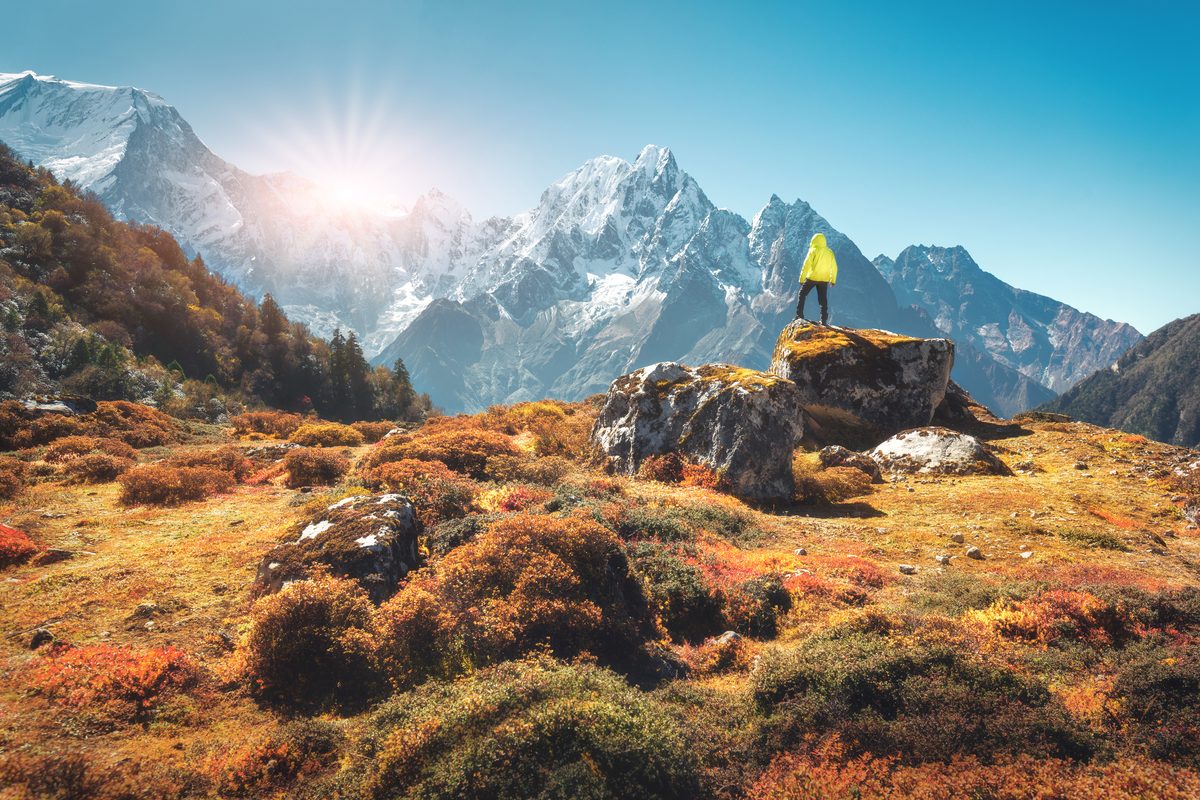
There is a particular kind of traveller who has spent a lifetime quietly imagining the moment they first see Everest — not from the window of an aircraft, nor in a photograph, but standing on solid Himalayan ground with the mountain rising before them, impossibly vast, almost indecently beautiful. And there is a quieter truth that often accompanies that dream: they do not, in fact, wish to walk for two weeks to earn it. They do not wish to sleep in unheated rooms at altitude, to queue for a shared bathroom at four thousand metres, to arrive at the great amphitheatre of the Khumbu depleted rather than transformed.
For these travellers — and there are far more of them than the trekking industry likes to admit — the Everest View Trek is not a compromise. It is the answer.
This is the Khumbu distilled to its most sublime essence: the towering presence of Everest, Lhotse, Nuptse and the heart-stopping pyramid of Ama Dablam; the spinning prayer wheels of Tengboche; the woodsmoke and warmth of the Sherpa homeland — all experienced not as an ordeal of endurance, but as a journey of unhurried grandeur. At Elysian Himalaya, we have come to think of it as the connoisseur's Everest: less about how far you walk, and entirely about what you allow yourself to feel.
What the Everest View Trek Actually Is
The Everest View Trek is the shorter, gentler sibling of the famous march to Everest Base Camp. Rather than pressing on for ten or more days to a rocky moraine where the mountain itself is, ironically, hidden from view, this journey takes you to the legendary vantage points of the lower Khumbu — Namche Bazaar, the Everest View Hotel ridge, Khumjung, and the spiritual heart of the region at Tengboche Monastery.
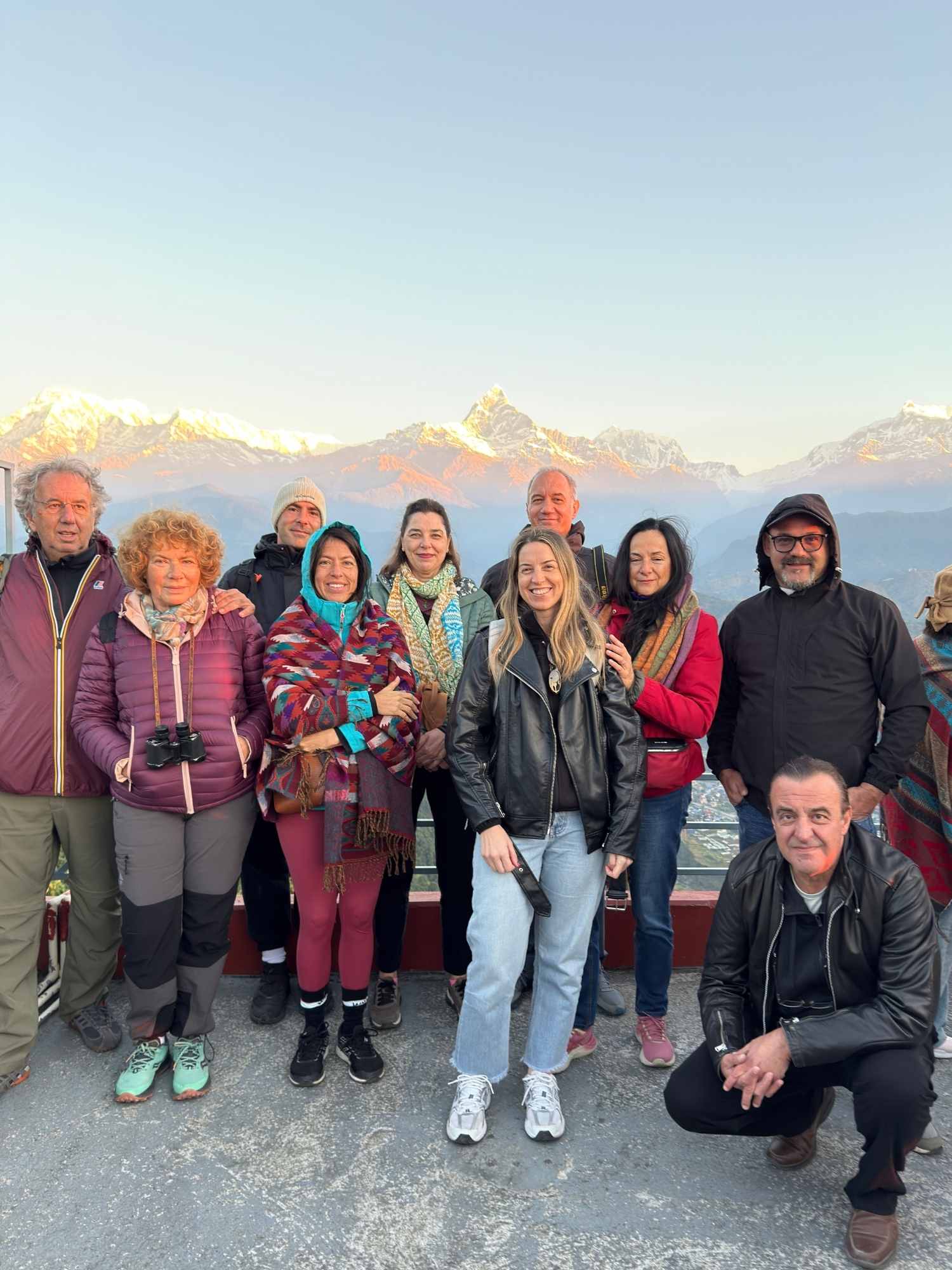
Here is the secret the seasoned Himalayan traveller already knows: the most magnificent views of Everest are not from Base Camp at all. They are from precisely the places this trek unfolds. From the ridge above Namche, from the terrace at Syangboche, from the meadows of Tengboche, Everest reveals itself in full theatrical splendour, flanked by its great companions. You arrive at altitudes of around 3,800 to 3,900 metres — high enough to feel the thin, clean air and the proximity of giants, yet low enough that the body adapts gracefully and the experience remains one of pleasure rather than survival.
A typical itinerary unfolds over five to seven days of walking, bookended by the famous flight into Lukla — itself one of the most thrilling arrivals in all of travel. For those who wish to dispense with even that drama, a private helicopter transfer transforms the journey entirely, and it is here that the word luxury begins to mean something specific.
Who This Journey Is For
This is the Himalayas for the discerning rather than the merely adventurous. It suits the couple celebrating a milestone, the parent introducing a teenage child to the mountains, the executive with one precious week and no appetite for hardship, the traveller in their sixties or seventies whose spirit far outpaces their knees. It is, above all, for those who understand that the measure of a great journey is not the suffering it demands but the wonder it delivers.
Redefining "Luxury" at the Roof of the World
It would be easy — and lazy — to imagine that luxury at altitude simply means a softer bed. The reality, as we practise it, is far more considered. True luxury on the Everest View Trek is the quiet engineering of effortlessness around an experience that is, by its nature, raw and elemental. It is the art of removing every friction so that nothing stands between you and the mountain.
Consider the difference a private helicopter makes. Rather than risking the notorious weather delays at Lukla — where flights are routinely grounded for days — you lift off from Kathmandu in clear conditions and arrive in the Khumbu within the hour, the Himalayas unfurling beneath you in a single, cinematic sweep. This is not merely faster. It is a wholly different emotional register, one of anticipation and awe rather than anxiety. Our Premium journeys are built around exactly this kind of intelligent sequencing, where time and comfort are treated as the true currencies of the experience.
Accommodation, too, has been quietly transformed in recent years. The Khumbu now offers genuinely refined mountain lodges — the kind with heated suites, deep soaking baths, fine linens, and dining rooms where the cuisine has graduated far beyond the dal bhat and instant noodles of the backpacker era. Imagine returning from an afternoon's gentle walk to a crackling fire, a glass of something warming, and a window framing Ama Dablam at dusk as the snow turns rose-gold. This is not roughing it. This is arriving.
The Things That Cannot Be Bought, Only Arranged
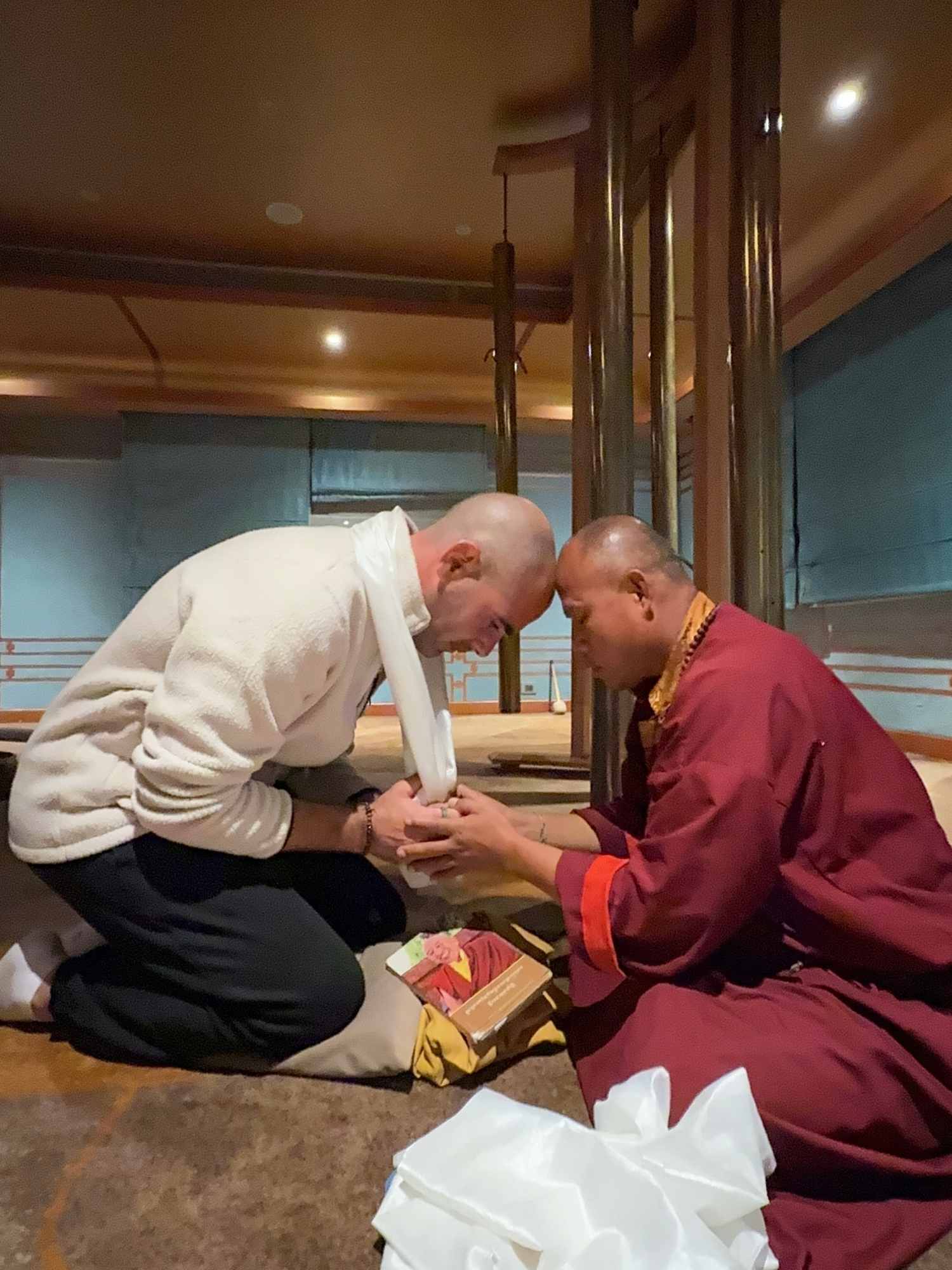
The deepest luxury, however, is rarely material. It is access. It is the private audience with a senior monk at Tengboche, arranged through relationships built over years. It is the Sherpa guide who is not an employee but a friend, whose family has lived in these valleys for generations, and who opens doors that remain firmly closed to the package tour. It is the freedom to pause when the light is perfect, to linger over breakfast when the peaks are clear, to never once be hurried by a fixed group itinerary. This is the philosophy of experiential wealth that sits at the centre of everything we create — the understanding that the most precious things a journey can offer are not products but moments, and that moments must be designed.
The Heart of the Journey: Namche, Khumjung and Tengboche
Namche Bazaar — The Sherpa Capital
No description quite prepares you for Namche. Built in a horseshoe of terraces against a mountain wall, this is the bustling, beating heart of the Sherpa world — a town of bakeries and trading posts, monasteries and cafés, where yak trains still clatter through the lanes and where the modern and the ancient coexist with perfect ease. We build in a full day here, not merely for acclimatisation but for pleasure: time to wander, to visit the Sherpa Culture Museum, to drink a genuinely excellent coffee with one of the most spectacular mountain backdrops on earth.
The Everest View Hotel — The Famous Vantage
A gentle morning's walk above Namche brings you to the ridge at Syangboche and the legendary Everest View Hotel, long celebrated as one of the highest-placed hotels in the world. From its terrace, the panorama is almost too much to absorb at once: Everest, Lhotse, Nuptse, Thamserku and the unforgettable Ama Dablam, all arrayed before you like a private gallery of the world's greatest peaks. To sit here with a pot of tea as the clouds part is, for many of our travellers, the single defining memory of their entire journey.
Khumjung — The Village Beneath the Sacred Peak
Below the ridge lies Khumjung, a serene Sherpa village beneath the holy peak of Khumbila, with its emerald-roofed school founded by Sir Edmund Hillary and its monastery that famously claims to hold a yeti scalp. Here the rhythm of authentic Sherpa life continues much as it has for centuries, and a visit — unhurried, respectful, genuinely curious — offers the kind of cultural intimacy that no amount of money can manufacture, only relationship can.
Tengboche — The Spiritual Summit
If the Everest View Trek has a soul, it resides at Tengboche. Perched on a saddle at 3,867 metres, the great monastery here is the most important in the Khumbu, and the view from its courtyard — Ama Dablam soaring on one side, the Everest massif on the other — is among the most sacred and stirring in the Himalayas. To attend the monks' morning or evening prayers, the deep chanting and resonant horns echoing against the peaks, is to touch something that pre-dates and outlasts all of us. It is the emotional and spiritual climax of the journey, and it asks nothing of you but presence.
When to Go, and How Long to Stay
The Everest View Trek is at its most glorious in two windows. Spring (March to May) brings blooming rhododendron forests along the lower trails and lengthening, milder days. Autumn (late September to November) delivers the crystalline visibility that draws photographers and connoisseurs alike — the post-monsoon air scrubbed to perfect clarity, the peaks rendered in almost hyperreal definition. Our detailed thinking on this is set out in our guide to the best time to visit Nepal in luxury, but for this particular journey, autumn is, if forced to choose, the editor's pick.
As for duration: the trek itself can be savoured in as few as five days of walking, which means the entire experience — Kathmandu arrival, the Khumbu, and a graceful return — fits comfortably within a single elegant week. For those who wish to weave in a Kathmandu Valley cultural immersion or a Pokhara interlude, our destinations come together into a seamless whole. This compactness is precisely what makes the Everest View Trek so quietly brilliant: it offers the full grandeur of the Everest region to those whose calendars, or constitutions, cannot accommodate a fortnight in the mountains.
The Elysian Difference
There is no shortage of operators willing to sell you an Everest View Trek. What we offer is something categorically different. Every Elysian journey is designed personally — not pulled from a catalogue, but composed around you, your pace, your curiosities, and the particular kind of transformation you are seeking. We do not run groups. We do not cut corners on the things that matter and gild the things that do not. We build relationships in these valleys that translate, for you, into access, warmth, and an authenticity that mass tourism simply cannot reach.
Our Classic journeys bring this region within reach with impeccable taste and genuine refinement, while our Ultimate journeys layer in private helicopter access, the very finest lodges, and the kind of bespoke touches — a private dinner staged at a viewpoint, a heli-landing at a remote monastery, a personal audience arranged through years of trust — that define the summit of what Himalayan travel can be. To understand why we do this the way we do, we invite you to read about the founder and the Greek-to-Nepal story that gave rise to it all.
Your Himalayas Await
The Everest View Trek is proof of something we have always believed: that the greatest experiences in life need not be the hardest. You can stand before the highest mountain on earth, feel the thin air of the Sherpa homeland in your lungs, hear the horns of Tengboche echo across the valley — and do so in a state of grace rather than exhaustion. This is not a lesser Everest. It is, for many, the truer one.
If the mountain has been calling to you — quietly, perhaps for years — then perhaps it is time to answer. Allow us to design a journey around you that is unhurried, personal, and unforgettable; one composed entirely around the way you wish to feel when you finally stand face to face with the roof of the world.
Begin designing your bespoke Everest View journey →