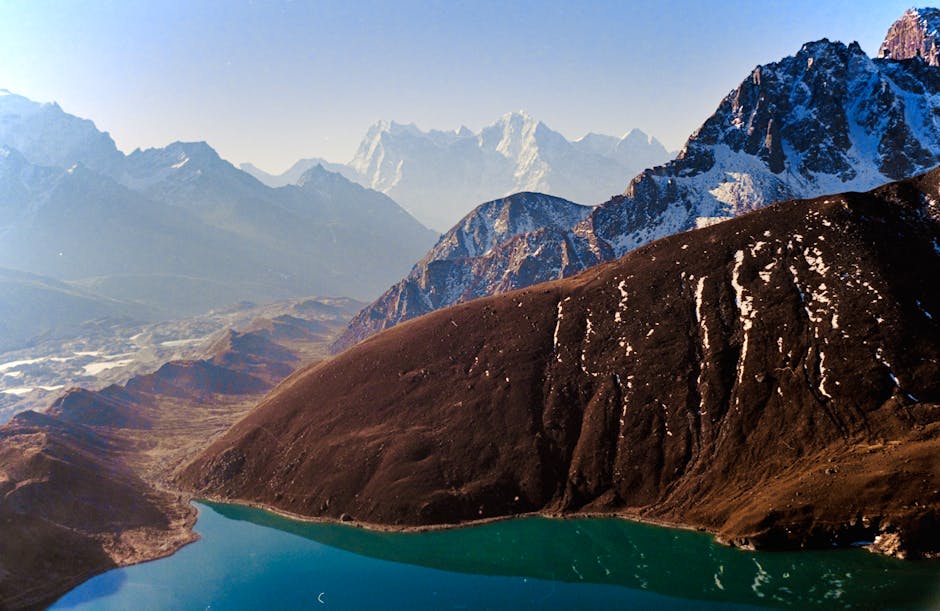
There is a moment, somewhere around midday on the third day of climbing, when the trail crests a moraine ridge and the world simply opens. Below, set into a basin of glacial rubble and ochre cliffs, lies a lake so impossibly turquoise it looks painted onto the landscape. Behind it: another lake. And another. Six in total, climbing the valley in a strand of jewels, the highest freshwater lake system on the planet. Above them, four of the world's six tallest mountains — Everest, Lhotse, Makalu and Cho Oyu — stand in a single, unbroken horizon.
This is Gokyo. And almost no one is here.
While the Everest Base Camp trail, just one valley to the east, has long since become a march of high-altitude tourism — gear porters in single file, queues at viewpoints, lodges booked six months out — the Gokyo Valley remains the Khumbu's best-kept secret. A handful of trekkers each day. A pace that feels human. And a panorama that, for those who have stood on both, is widely considered the most beautiful in all of Nepal.
The Gokyo Lakes luxury trek is, in many ways, the journey Everest used to be: rare, contemplative, transformative. With the right outfit, the right pace, and the right understanding of what luxury means at 5,000 metres — it is also one of the most extraordinary journeys you will ever undertake.
Why Gokyo Has Become the Connoisseur's Everest
When permit fees for climbing Everest itself rose from $11,000 to $15,000 this season, it was simply the loudest signal of a broader shift. The classic Everest Base Camp trek now sees more than 50,000 trekkers per year. Lukla airstrip — the gateway — is one of the most congested mountain entry points in the world. The lodges along the EBC trail have grown competent at handling volume; what they have lost, in the process, is intimacy.
Gokyo, by contrast, sits on a parallel valley that the great majority of trekkers simply never enter. The numbers tell the story: where the EBC trail will see hundreds of trekkers in a single high-season day, Gokyo might see fifteen. The lodges are smaller. The villages — Phortse, Dole, Machhermo, Gokyo itself — retain the texture of Sherpa life as it was lived a generation ago. There is no congestion. There is no spectacle of other trekkers. There is, instead, silence — the particular silence of high alpine basins where the loudest sound is your own breath.
For the discerning traveller, this matters. Luxury at altitude is not about thread counts or wine lists — it is, fundamentally, about what you encounter and how. The Gokyo Lakes luxury trek delivers an experience that simply cannot be purchased on the EBC trail, no matter how much one spends: solitude in a landscape of staggering scale.
The Geography of the Sublime
The Gokyo Valley sits in the heart of Sagarmatha National Park, a UNESCO World Heritage site that encompasses the Khumbu region of the Solukhumbu district. Geographically, it runs north-south along the western edge of the Khumbu, separated from the Everest Base Camp valley by a single, formidable ridge — the Cho La Pass at 5,420 metres.
The valley's signature feature is the chain of six glacial lakes — known in Sherpa as the Dudh Pokhari, "the milk pond," referring to the highest and largest of them. Fed by the meltwater of the Ngozumpa Glacier (Nepal's longest, at nineteen kilometres), the lakes occupy a series of moraine basins climbing from roughly 4,700 to 5,000 metres. Their colour — a saturated milky turquoise that shifts through cyan, jade, and steel-grey with the angle of the light — is a function of glacial rock flour suspended in the water, the same mineral phenomenon that gives the lakes of New Zealand's Mount Cook and Patagonia's Torres del Paine their otherworldly hue.
The viewpoint that has made Gokyo legendary is Gokyo Ri — a 5,357-metre summit accessible by a steep but non-technical scramble from the lakeside village. From its summit, on a clear morning, one stands at the centre of an extraordinary panorama: Everest, Lhotse, Makalu and Cho Oyu in a single sweep, with the Ngozumpa Glacier spilling down the valley below like a frozen river of stone. There are few places on earth where four eight-thousand-metre peaks can be seen simultaneously. This is one of them. For our travellers, we time the ascent for sunrise — the moment when the first light strikes Everest's summit pyramid and the lakes below shift from indigo to fire.
The Cho La Crossing: For Those Who Want Both
For travellers who wish to see both Gokyo and Everest Base Camp in a single journey — and who have the time and acclimatisation to do so properly — there is one route that elevates the trek into something extraordinary: the Cho La Pass crossing.
The Cho La is a glaciated col at 5,420 metres that connects the Gokyo Valley to the Khumbu Valley. The crossing — typically completed in a single long day from Dragnag to Dzongla — involves a steep moraine ascent, a section of glacier travel (crampons, ropework, and a guide trained in glacier crossings are essential), and a precipitous descent down a ridge of broken granite. It is the only true mountain pass on this circuit, and it transforms the trek from a valley walk into an alpine traverse.
For the right traveller — fit, well-acclimatised, with the right support — the Cho La crossing is the single most spectacular day in the Khumbu. The view from the pass, with the Gokyo Valley falling away westward and the spires of Lobuche, Cholatse, and the Khumbu range rising eastward, is the high point of any Himalayan journey. With a private guide, two porters, and proper equipment, what would be a serious undertaking for an independent trekker becomes a finely calibrated experience.
What Luxury Means at Five Thousand Metres
The phrase "luxury trek" is, on its face, a paradox. There is no truffle service at 5,000 metres. No marble bath. No five-star kitchen brigade. What there is, when it is done properly, is something more rare: an experience engineered around comfort, safety, and depth — without the friction that defines independent trekking.
For our Gokyo travellers, this means several things.
Private flights into Lukla. The commercial flights from Kathmandu are notoriously weather-dependent and frequently cancelled, sometimes for days. A private helicopter to Lukla — or the recently opened option of Ramechhap-Lukla — eliminates the uncertainty that derails so many Himalayan itineraries. For travellers on a fixed timeline, this is not a luxury; it is the entire trip. Lodges chosen, not assumed. The Khumbu now offers a small number of genuinely refined mountain lodges — Yeti Mountain Home, Mountain Lodges of Nepal, and a handful of independent properties — that combine traditional Sherpa hospitality with the standards of a serious hotel. Heated rooms. Down duvets. Hot showers (a rarity above 4,000 metres). En-suite bathrooms at the lower elevations. These are not luxury hotels by Kathmandu standards. They are, however, transformational compared to a standard tea house bunk room. A single private guide. A dedicated chef. The Khumbu's Sherpa guides are among the finest mountain professionals in the world. For our travellers, we work only with guides who have ten years of experience minimum, who speak excellent English, and who carry the cultural fluency to open doors that closed itineraries cannot reach — invitations to monasteries, conversations with elders, a private audience with a Rinpoche. A private chef accompanies the journey from Namche onwards, sourcing fresh produce daily and cooking food that respects altitude-appropriate nutrition while remaining recognisable as a meal. Pace as the central luxury. The single greatest predictor of a successful high-altitude trek is the willingness to go slowly. Standard EBC itineraries push hard — twelve days, two rest days — and most altitude problems on the trail can be traced directly to the schedule. Our Gokyo itineraries run sixteen to twenty days, with built-in flexibility, multiple acclimatisation days, and the freedom to add a night wherever a traveller wishes to linger. This is the most important luxury of all.Designing the Journey
For a Gokyo Lakes luxury journey, we typically design around a sixteen- to eighteen-day arc. The first two days are reserved for Kathmandu — the Boudhanath stupa at dawn, a private monastery visit, a meal with one of the city's senior chefs. Day three is the helicopter to Lukla and a walk to Phakding. From there, the rhythm becomes Himalayan: short days, long lunches, mornings spent climbing into ever-thinner air.
Namche Bazaar at 3,440 metres is the first major stop — two nights for acclimatisation, with a side hike to the Everest View Hotel for the first sight of Everest itself. Then the route diverges: instead of bearing east towards Tengboche and the EBC trail, the Gokyo route turns north, climbing through Phortse and Dole into the parallel valley. Days six through ten move slowly up the lakes: first lake, second lake, third lake — where the village of Gokyo sits — and then, on a designated rest day, an ascent of Gokyo Ri before dawn.
For travellers who wish to extend, day eleven crosses the Cho La pass into the Khumbu Valley. Days twelve and thirteen reach Everest Base Camp itself and Kala Patthar, the iconic 5,545-metre viewpoint above EBC. Day fourteen is a helicopter extraction directly from Gorakshep or Pheriche back to Kathmandu — eliminating the four-day walk-out that, for most travellers at the end of a hard trek, is the part of the journey they remember least fondly.
This is the architecture. The texture — what makes one journey unforgettable and another merely impressive — comes from a hundred small decisions made in the field. Whether to add a rest day in Machhermo. Whether to push for the second sunrise on Gokyo Ri or accept that the weather has decided otherwise. Whether to spend the afternoon at the third lake or to walk further to the fourth. These are decisions our guides make in conversation with our travellers, day by day. It is what we mean when we say we design journeys, not itineraries.
When to Go
The Gokyo trek operates on a tighter weather window than EBC. The valley faces north and west, which means it loses sunlight earlier in the afternoon and holds snow longer. The optimal windows are mid-September to mid-November (post-monsoon, the most spectacular visibility of the year) and mid-March to mid-May (pre-monsoon, with rhododendron forests in bloom at the lower elevations and stable weather above).
Winter trekking is possible — December and January offer the most dramatic clarity in the Khumbu — but requires serious cold-weather provisioning, and the Cho La crossing is rarely viable. We do not recommend July or August: the monsoon arrives in full, visibility collapses, and the route becomes treacherous.
For travellers building a longer Nepal journey, Gokyo pairs naturally with a luxury Kathmandu Valley exploration at the front end, and a few days in Pokhara or the Annapurna foothills at the back. For those wishing to extend the helicopter experience, a side trip to the Upper Mustang Kingdom can be incorporated into the return leg.
The Question of Difficulty
Gokyo is not a technical trek. There is no rope work, no high-altitude camp, no glacier ascent — provided one avoids the Cho La pass. The terrain is, throughout, a well-graded trail of rock, soil and occasional stone steps. The challenge is altitude.
The trail climbs from 2,800 metres at Lukla to 5,357 at Gokyo Ri — a nearly 2,600-metre gain across the course of the trek. Above 4,000 metres, every traveller experiences some degree of altitude effect — shortness of breath, mild headaches, fragmented sleep — and a small minority experience more serious symptoms. The single greatest defence is pace. With a sixteen-to-eighteen-day itinerary, supplemental oxygen on standby, and a guide trained in altitude assessment, the trek is well within reach of any reasonably fit adult between thirty and seventy who has trained adequately in the months prior.
We will speak frankly with every traveller about fitness, training, and medical considerations before confirming a Gokyo journey. Those for whom altitude is genuinely contraindicated — uncontrolled blood pressure, recent cardiac events, certain pulmonary conditions — we direct gently toward our lower-altitude Premium and Classic journeys, which deliver Himalayan grandeur at altitudes the body manages without question.
Why Now
The window during which Gokyo remains as it is — uncrowded, intimate, almost private — is narrowing. The same forces that transformed EBC over the past fifteen years are now moving westward. New lodges are being built. The trail is appearing more often in international magazines. The Sherpa families who have hosted travellers in their tea houses for two generations are beginning to plan for the next wave.
For the traveller who wishes to walk the Gokyo Valley while it still feels like a discovery rather than a destination, the moment is now. In ten years, perhaps less, this trek will be a different journey. The lakes will not have changed. The mountains will not have moved. But the experience of solitude in their presence — of standing on Gokyo Ri at dawn and seeing no other human in any direction — is a finite resource. It is, in a real sense, the rarest luxury Nepal still offers.
If the Gokyo Lakes luxury trek belongs in your story — whether as a stand-alone Himalayan immersion or as the high point of a longer Nepal journey — we would be honoured to design it for you. Every traveller who walks this valley with us comes back changed. We have come to understand that this is not a function of altitude, or of distance, or of the lakes themselves — though all of these matter. It is a function of what happens when a person, with nothing to do and nowhere to rush, sits beside one of the highest freshwater lakes in the world and watches the light move across mountains that have not changed in fifty million years.
This is what we mean by experiential wealth. And this — perhaps more than any other journey in our portfolio — is where it lives.
For an introduction to the way we work, you may wish to read more about Dimitrios and the philosophy behind Elysian Himalaya. When you are ready, we are here to begin the conversation.