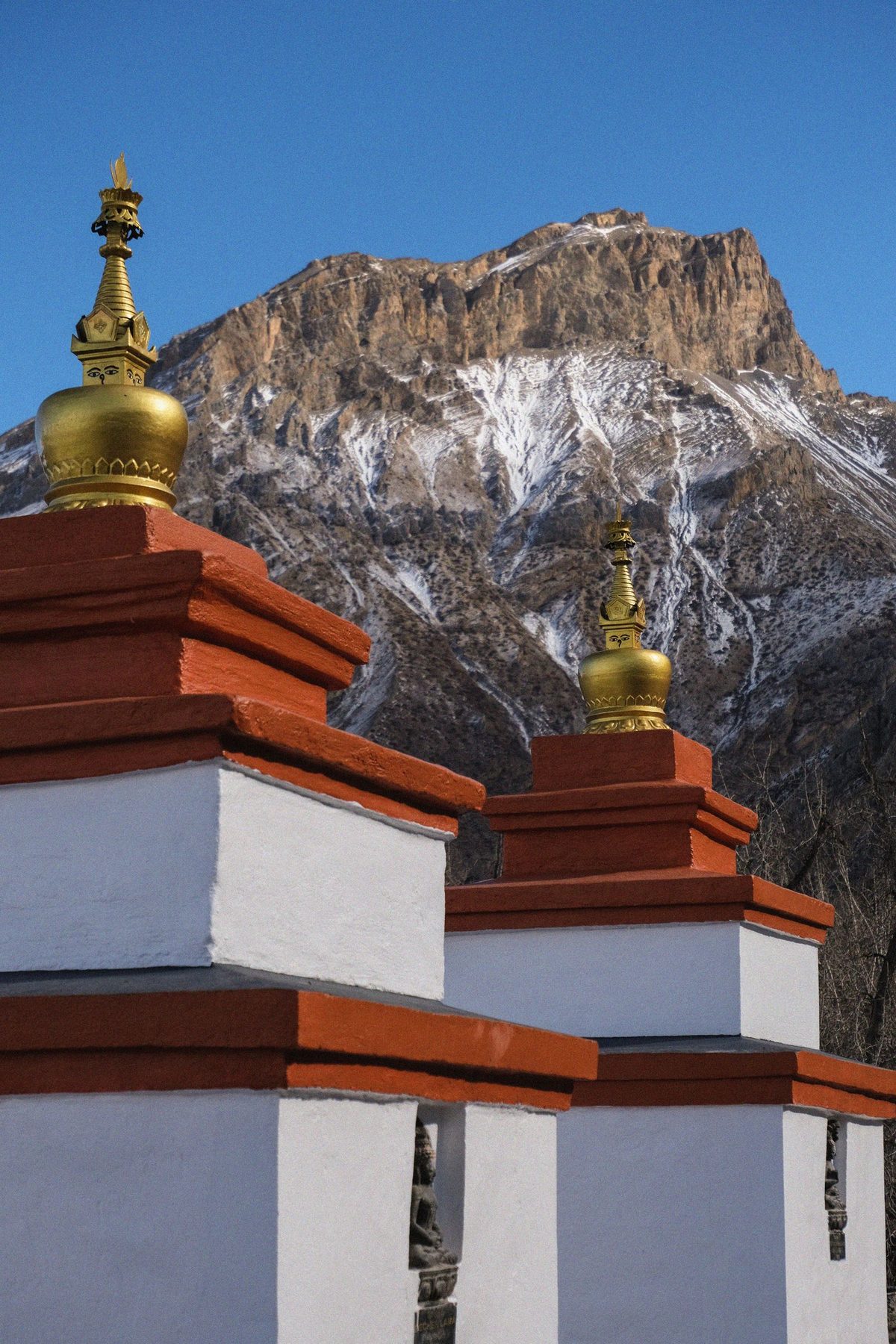
There is a word in Sanskrit that has no clean translation into English. Mukti. We reach for "liberation," or "release," or "salvation," and each of them is true and each of them is incomplete. It is the letting go of the thing that has held you — the shedding of a weight you did not know you were carrying until the moment it was gone. Muktinath is named for it. The Place of Liberation. And in more than two decades of designing journeys through the Himalayas, I have watched it earn the name again and again, in the faces of people who arrived as one version of themselves and walked back to the helicopter as another.
This is not a claim I make lightly. I am, by temperament and by trade, a sceptic of the transformational promises that the travel industry sells so cheaply. But Muktinath is not a marketing conceit. It is a real place, at 3,710 metres, in the rain-shadow desert of Lower Mustang, where the green world of Nepal ends and the high Tibetan plateau begins. For Hindus it is one of the 108 Divya Desams — the sacred abodes of Vishnu — and one of only a handful found outside India. For Tibetan Buddhists it is Chumig Gyatsa, the Hundred Waters, a site blessed by Guru Rinpoche himself. Two of the world's great spiritual traditions, meeting at a single spring on the roof of the world. There are not many places like it left.
Where the Himalayas Become a Desert
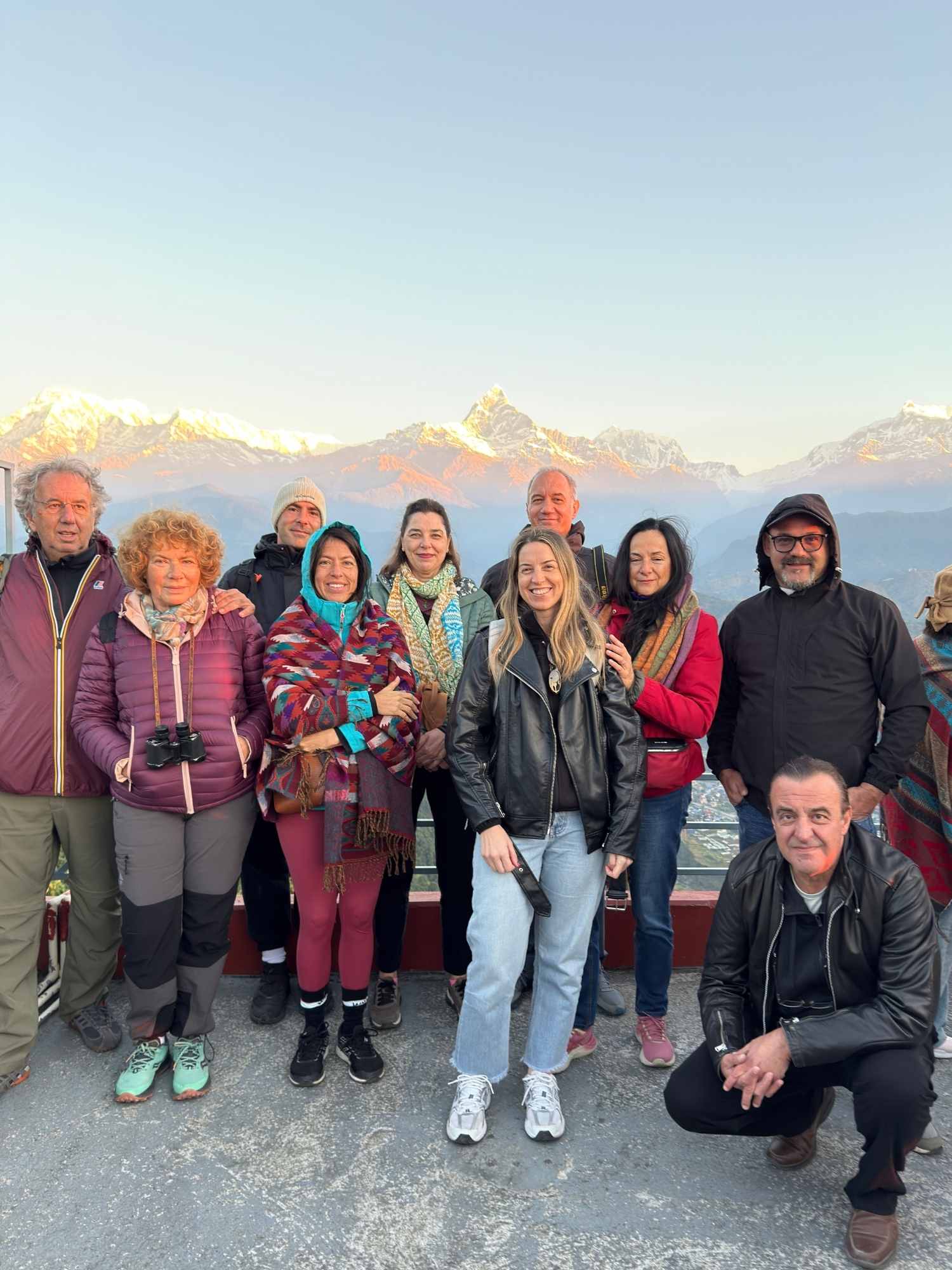
To understand Muktinath, you must first understand where it sits. Most travellers imagine Nepal as a country of emerald terraces and cloud forests, and much of it is. But Mustang lies in the wind-shadow of the Annapurna and Dhaulagiri massifs — two peaks above eight thousand metres that wring the monsoon dry before it can pass. What remains, on the far side, is a landscape that looks less like Nepal than like the high Andes or the Tibetan steppe: eroded cliffs in rust and amber, wind-carved canyons, villages the colour of the earth they are built from, and above it all, the impossible white wall of the Himalayas.
It is one of the most cinematic terrains on earth, and for the traveller arriving by helicopter, the transition is sudden and total. One moment you are over the forested foothills; the next, the world opens into ochre and bone and endless sky. I have flown this route more times than I can count, and it has never once become ordinary.
For those drawn to this raw, high-altitude beauty, Muktinath is often the spiritual heart of a wider journey through the region — one that our Premium journey is designed to reveal in full, unhurried comfort.
The Temple of Eternal Flame and Holy Water
Muktinath's power lies in a rare and quiet miracle — one you can see with your own eyes.
Behind the main pagoda-style temple dedicated to Vishnu, in a small Buddhist gompa, a natural flame burns from the rock. It is fed by natural gas seeping through the stone, and it has burned, by tradition, for longer than any record can measure. What makes it extraordinary is that in places the flame burns over water — earth, fire, and water coexisting in a single sacred hearth. To the pilgrims who come here, this is not geology. It is the presence of the divine made visible, the reconciliation of opposites that most of us spend our lives believing cannot be reconciled.
Then there are the waters. Around the temple's rear wall runs a curved stone arcade set with 108 spouts, each carved in the shape of a bull's head, each pouring a thread of glacial meltwater so cold it takes the breath. The number 108 is sacred across the Dharmic traditions — the beads of a mala, the names of the divine. Devout pilgrims bathe beneath every one of them, then immerse themselves in the two kunda pools before the shrine. It is said that to do so washes away the accumulated karma of lifetimes.
You need not be a believer to feel the weight of it. I have brought guests here of every faith and of none, and I have watched the most rational among them stand very still beneath those spouts, water streaming, and go quiet in a way they could not quite explain afterward. That silence is the real souvenir of Muktinath.
What "Mukti" Means for the Modern Traveller
The pilgrims who have walked to Muktinath for two millennia came seeking release from the cycle of death and rebirth. The traveller who arrives today is rarely carrying that particular burden. But almost everyone is carrying something — a grief, a decision, a season of exhaustion, a question they have not had the stillness to hear themselves ask.
This is where the idea of experiential wealth becomes concrete rather than abstract. The truest luxury Muktinath offers is not the helicopter or the suite. It is permission — permission to set something down. The altitude, the thin clear air, the absurd beauty of the place, the ancient ritual asking nothing of you but presence: together they create a rare condition in which the mind finally falls quiet. What you do with that quiet is your own. But I have never known anyone to come away from it unchanged.
The Journey, Reimagined
For centuries, reaching Muktinath was an act of profound endurance. Pilgrims walked for weeks from the Indian plains, up through the Kali Gandaki gorge — the deepest in the world — enduring altitude, weather, and the sheer physical cost of the Himalayas. That difficulty was the point. The suffering was the offering.
We hold a different, and I think no less sincere, philosophy. The sacredness of Muktinath does not diminish because you arrive rested rather than ruined. If anything, arriving with a clear body and an unclouded mind allows you to receive the place more fully. Modern access has not cheapened the pilgrimage; it has simply removed the obstacles that once stood between the traveller and the moment of arrival.
Arriving by Private Helicopter
The most refined way to reach Muktinath is by private helicopter, lifting off from Pokhara or Kathmandu in the still air of early morning — the only hours when the mountain winds permit safe flight. The journey itself is part of the pilgrimage: forty-five minutes threading between Annapurna and Dhaulagiri, over the Kali Gandaki carving its ancient line through the deepest gorge on earth, the peaks so close you feel you could reach out and touch the ice.
The helicopter sets down near Ranipauwa, a short ascent below the temple. You arrive with the whole day ahead of you and none of the depletion that the overland route exacts. There is time to walk the shrine slowly, to sit with the flame, to let the altitude and the silence do their work — and still return to a fine hotel by evening. For those who wish to weave Muktinath into the ultimate expression of Himalayan travel, our Ultimate journey places the private helicopter at the very heart of the experience.
For the Traveller Who Wishes to Walk
Some guests, rightly, want the ground beneath their feet. For them we design a gentler, more contemplative approach — a few unhurried days through Lower Mustang, staying in the finest lodges the region offers, walking the apple-orchard villages of Marpha and the medieval alleys of Kagbeni where the trail to the Forbidden Kingdom begins. This is pilgrimage at a human pace, with none of the hardship the old pilgrims endured. Our Classic journey is built precisely for travellers who want to feel the land unfold slowly beneath them, one footstep at a time.
When to Make the Pilgrimage
Muktinath rewards the traveller who chooses the season with care. Because Mustang sits in the Himalayan rain-shadow, it remains largely accessible even during the summer monsoon that closes much of Nepal — a rare and valuable quirk for those whose calendars are inflexible.
- Spring (March to May) brings the clearest mountain air of the year and, lower down, the wild rhododendron in bloom. It is, in my view, the most beautiful window of all.
- Autumn (late September to November) offers crystalline skies and the most stable flying conditions, coinciding with Nepal's great festival season — a moment of extraordinary cultural richness.
- Summer (June to August) is the counter-intuitive secret: while the rest of Nepal disappears into cloud, Mustang stays open and dry, its light hard and clean.
- Winter (December to February) is starkly beautiful and profoundly quiet, though the cold at altitude is serious and some days the flights cannot go.
For a fuller reckoning of how the seasons shape a Himalayan journey, our writing on designing a journey around the rhythm of the mountains goes deeper still.
More Than a Temple: The World Around Muktinath
A journey defined by a single destination, however sacred, is a journey only half-made. What gives the Muktinath pilgrimage its resonance is the world that surrounds it — a landscape of villages and monasteries that have kept the old Tibetan-Buddhist culture alive in a way that has largely vanished across the border.
There is Kagbeni, the ochre-walled village at the mouth of the Upper Mustang trail, where prayer wheels turn in narrow lanes and a fifteenth-century monastery watches over the confluence of rivers. There is Marpha, famed across Nepal for its apple orchards and the brandy they yield, its whitewashed houses immaculate against the dust. There is Jomsom, the region's windswept gateway, and beyond it the whole hidden kingdom of Upper Mustang, where a walled capital and cave monasteries hold secrets we are only beginning to understand. Muktinath is the sacred anchor, but the region around it is a world unto itself, and to explore it fully is to understand why Mustang has captivated travellers and pilgrims alike for a thousand years. You can survey the full breadth of it among our destinations.
The Elysian Difference
Anyone can book a helicopter to Muktinath; a dozen operators in Kathmandu will sell you a seat. What we offer is something else entirely — the difference between visiting a place and being received by it.
Every journey we design is personal. I have spent years cultivating relationships with the finest pilots, the most knowledgeable local guides, the monastery custodians who can open a door that remains closed to the day-tripper. When we bring a guest to Muktinath, they do not arrive as a tourist processed through a site; they arrive as a guest whose comfort, safety, and inner experience have been considered in advance, down to the smallest detail. The itinerary bends to you — your pace, your interests, your questions, your faith or your lack of it. Nothing is templated, because a pilgrimage cannot be.
This is the essence of what we mean by experiential wealth. Not the accumulation of destinations, but the depth of a single one, fully inhabited. I designed this company because I believe the rarest thing a person of means can buy is not another possession but a genuine moment of transformation — and that such moments cannot be mass-produced. You can read more about why I built Elysian Himalaya this way on our founder's page.
The Place of Liberation Is Waiting
There is a particular quality to the light at Muktinath in the late morning, when the sun clears the ridge and falls across the temple courtyard, and the water in the 108 spouts catches it and throws it back in a hundred silver threads. In that light, with the eternal flame burning behind you and the great white wall of the Himalayas filling the whole of the sky, it becomes very easy to understand why people have walked for a thousand years to stand exactly here.
I cannot promise you mukti. No one can; it is not a thing that can be given. But I can promise you the conditions in which it becomes possible — the altitude, the silence, the ancient ritual, the beauty that undoes you — arranged with a care that lets you forget everything except the moment you are standing in. That is the whole of what we do, and it is everything.
If something in you has been waiting to be set down, the Place of Liberation is waiting too. Let us design your journey to Muktinath — a pilgrimage shaped entirely around you, and around whatever it is you have come to the mountains to find.