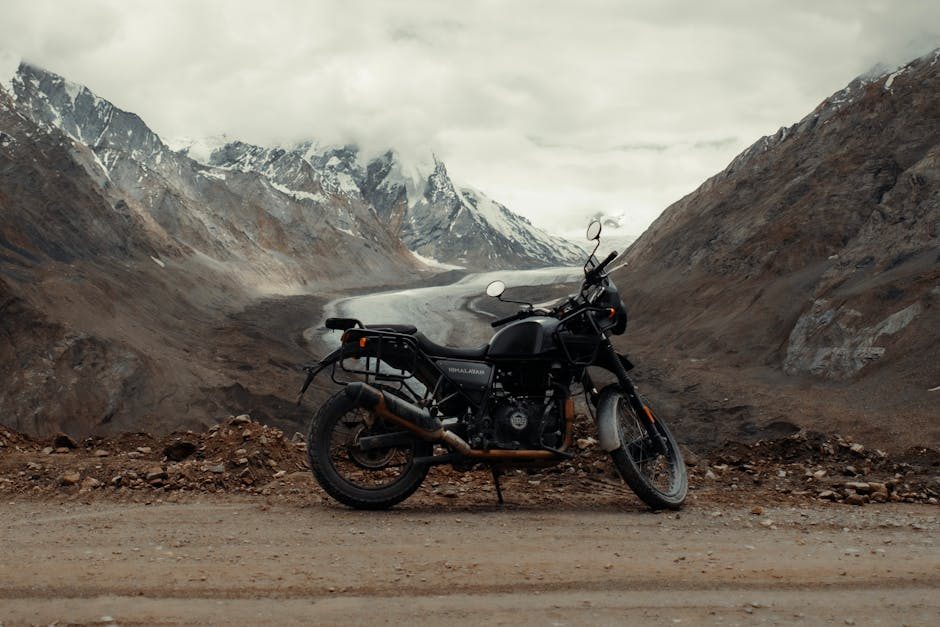
There is a moment, somewhere past the village of Chele, when the wind catches the prayer flags on a high pass and the Royal Enfield beneath you settles into its rhythm — a steady, unhurried pulse, the way a horse settles into a long ride. The Annapurna massif is to your right. Dhaulagiri, white and impossibly close, is behind you. Ahead, the road climbs into a landscape the colour of old bronze, scored by canyons and dotted with mud-brick villages that look exactly as they did when Marco Polo's contemporaries were still drawing maps with sea monsters in the margins.
This is Mustang by motorcycle. And it is not, as the internet sometimes suggests, a backpacker's stunt or a budget rite of passage. Done properly — with the right machine, the right support team, and the right places to lay your head at night — it is one of the most extraordinary luxury adventures available anywhere in the world. It is also one of the very few that cannot be faked. You either ride the road or you do not. The mountains decide.
For travellers who have already collected the obvious trophies — the African safari, the Antarctic expedition, the Patagonian helicopter drop — Upper Mustang on two wheels offers something quieter and far rarer. It offers solitude in a place that has barely been touched by mass tourism, framed by hospitality that is genuinely warm rather than rehearsed. This is not adventure for adventure's sake. It is adventure for the sake of feeling, properly and without filter, what it means to move through one of the last truly hidden corners of Asia.
Why Mustang Is the Ride of a Lifetime
Upper Mustang sits in the rain shadow of the Annapurna and Dhaulagiri ranges, which is the geographical reason it looks the way it does. The monsoon clouds that drench the rest of Nepal exhaust themselves on the southern slopes of those giants, and what arrives in Mustang is dry, thin, brilliantly clear air. The result is a landscape that feels closer to Tibet or Ladakh than to the green terraced hills most travellers associate with Nepal. Ochre cliffs. Eroded canyons that look as though Georgia O'Keeffe painted them. Sky-blue prayer flags strung above whitewashed chortens. And on a clear morning, the kind of light that makes photographers stop the convoy simply to stand still for a minute.
For nearly five hundred years, this was the independent Kingdom of Lo, ruled by its own line of kings from the walled capital of Lo Manthang. The kingdom was officially absorbed into Nepal in 2008, but its monastic traditions, its language, its dress, and its rhythms remain almost untouched. Foreign visitors were not permitted at all until 1992, and even today numbers are restricted by a special permit system. Roughly the same number of people now visit Mustang in a year as visit a single popular Italian hill town in a single afternoon. That is not an exaggeration. That is the point.
A motorcycle is, paradoxically, the most respectful way to cross this landscape. It is quieter than a 4x4 convoy, smaller in footprint, and crucially, it allows you to feel the road. Mustang is a place that rewards being met on its own terms — the smell of juniper smoke from a kitchen chimney, the sound of a hand-cranked prayer wheel in a village square, the sudden coolness of a poplar grove after hours in the sun. None of these reach you through tinted glass. All of them reach you through an open visor.
The Machine: Why It Has to Be a Royal Enfield Himalayan
There is a romance to choosing the right tool for the right journey, and on this particular journey there is really only one answer. The Royal Enfield Himalayan was designed, from the ground up, for exactly this terrain. A long-stroke single-cylinder engine that produces its torque low and early — exactly what you want when you are climbing a switchback at 3,800 metres and the air is thin enough that even your lungs are protesting. A long-travel suspension that swallows the worst of the rocky sections without asking your spine to compensate. An upright riding position that lets you scan the road and the scenery without a backache by sundown.
The Himalayan is not the fastest motorcycle in the world. It does not need to be. Mustang is not a road for speed; it is a road for presence. The bike's slightly old-school character — the unhurried beat, the mechanical honesty, the way it lets you hear the wind — is precisely what makes it the right companion. For guests who prefer something more substantial, BMW GS 310 and KTM Adventure 390 machines can be specified, but in our experience even the most seasoned riders end the journey reluctant to give the Himalayan back. There is something about it that fits the place.
Every machine on an Elysian Premium Journey is freshly serviced, fitted with new tyres, and accompanied by a backup vehicle carrying tools, spares, and oxygen — because while the experience should feel adventurous, the safety architecture beneath it must be invisible and absolute.
The Route: From Pokhara to the Walled City of Lo Manthang
A typical luxury Mustang motorcycle journey unfolds over nine to twelve days, depending on how much time you wish to spend in the high villages and how the weather behaves. The classical routing begins in Pokhara, the lakeside city in central Nepal that is the gateway to the entire Annapurna region. From there, the road climbs steadily north through Beni and Tatopani, past the deepest river gorge in the world — the Kali Gandaki, which cuts between Annapurna and Dhaulagiri to create a vertical drop greater than that of the Grand Canyon.
The first proper riding day takes you to Marpha, an apple-growing village of whitewashed stone houses arranged along a single cobbled street, where the local distillery has been producing apple brandy since the 1960s. From Marpha, the road climbs into Lower Mustang, through the windswept town of Jomsom and into the desert landscape that announces, unmistakably, that you have crossed a geographical and cultural threshold. By the time you reach Kagbeni, the green of Nepal is behind you. Ahead is the Tibetan Plateau in miniature.
The Upper Mustang permit zone begins at Kagbeni, and from this point the road becomes both more spectacular and more demanding. There are river crossings — proper ones, with water sometimes above the wheel hubs — and there are passes that climb above 4,000 metres. You ride through villages with names that sound like incantations: Chele, Samar, Ghiling, Tsarang. You pass cliff-cut caves where ascetics meditated a thousand years ago, some of them still containing fragments of frescoes that predate the Renaissance.
The destination, of course, is Lo Manthang itself — the walled medieval capital of the former kingdom, sitting on a windy plateau at 3,840 metres. Fewer than 250 families live inside the walls. The royal palace, recently restored, still stands. The four great monasteries hold thangkas and bronzes that would be the prize of any major museum, and they are still in active religious use. Walking through Lo Manthang at dawn, when the light catches the white walls and the smoke is rising from the kitchen fires, is an experience that genuinely justifies the word transcendent.
The Choreography of a Luxury Ride
What separates a true luxury motorcycle journey from a budget tour is not the bike. It is everything around the bike.
It is a lead rider who knows every corner of the route by name and has done it thirty, forty, sometimes a hundred times. It is a doctor on call by satellite phone, with oxygen and altitude medication in the support vehicle. It is a chef who has flown ahead to the lodge where you will sleep tonight, and who has been on the phone with your dietician at home about whether you prefer the trout grilled or pan-seared. It is the moment when you arrive after a long ride, dust-caked and exhilarated, and someone wordlessly hands you a hot lemon tea while another draws a bath.
It is also the small, almost invisible decisions about timing — the kind that only experience teaches. When to set off at dawn to cross a river before the snowmelt raises it above the wheel hubs. When to pause for an hour because a wind is coming down off the Mustang plateau and a wind in Mustang is not a metaphor. When to sit and have a long lunch in a village square because the light at three in the afternoon will be unrepeatable.
The Elysian design philosophy holds that the goal of luxury travel is not to insulate you from the place. The goal is to remove every friction that does not belong to the experience itself, so that the experience itself can land on you with full force. The cold morning air is part of Mustang. The hot bath at the end of the day is not friction; it is restoration. We design every journey to know the difference.
Where You Sleep: Lodges, Heritage Houses, and the New Mustang Hospitality
For years, the question of where to stay in Upper Mustang was the limiting factor on luxury travel into the region. The traditional teahouses that line the trekking and motorcycle route are warm, hospitable, and often beautifully situated — but they were not designed for travellers expecting hand-knotted Tibetan rugs and a hot shower at 4,000 metres.
That has begun to change, quietly, and in a way that is faithful to the architecture of the region. Restored heritage houses in Marpha and Kagbeni now offer rooms that combine traditional Tibetan craftsmanship with discreet modern comfort: down duvets, underfloor heating in the bathrooms, locally woven textiles, and at least one suite with a view that you will think about for years. In Lo Manthang itself, a small heritage residence inside the city walls — converted from a centuries-old aristocratic family home — is the choice for travellers who want the rare experience of sleeping inside a medieval Tibetan capital.
These are not international five-star hotels, and that is precisely their charm. The water pressure is honest. The hospitality is real. And the next morning, when you walk out into the cold air with the smell of juniper smoke around you, the dissonance between bedroom and landscape is almost zero.
For our Ultimate Journey guests, the experience is enhanced further by a private helicopter that meets you in Lo Manthang and lifts you out across the Annapurna sanctuary on the return — turning a long ride home into a thirty-minute flight over some of the most dramatic mountain scenery on earth. It is the kind of touch that does not interrupt the adventure. It crowns it.
Best Time to Ride
The riding season in Upper Mustang is shorter than most travellers expect, and choosing the right window matters enormously to the quality of the experience. The classical seasons are March to early June and September to November. Within those windows, the high spring (late April to mid-May) offers the rare combination of clear skies, mild daytime temperatures, and the wild flowering of the high desert — apricot blossom in the lower valleys, tiny alpine flowers above 3,500 metres.
October is the most popular month, and for good reason: the air is at its clearest, the light at its most photographic, and the great Tibetan festivals of the post-harvest season are in full swing. We strongly recommend booking eighteen months in advance for an October ride; the best lodges and the best lead riders are committed early.
The shoulder months — early March, early June, late November — can be magnificent for travellers who prize empty roads above optimal weather. They can also be unforgiving. We will tell you honestly which window suits the kind of trip you have in mind.
Who This Journey Is For (and Who It Isn't)
A Mustang motorcycle journey is not the right adventure for everyone, and we are direct with prospective guests about this. You do not need to be a competitive rider — most of our guests are intermediate weekend riders with a few years of experience on tarmac and some confidence on light gravel. But you do need to be comfortable on a motorcycle for four to six hours a day, to be in reasonable physical condition for altitudes between 2,800 and 4,200 metres, and to be prepared for genuinely changeable mountain weather.
What you do need, more than anything, is the right disposition. This is a journey that rewards travellers who are happy to be moved by a landscape rather than to conquer it. Who can sit on a stone wall at 4,000 metres for an hour without reaching for a phone. Who understand that the most extraordinary moments in mountain travel are usually unscheduled. The bike is the means. The mountains are the meaning.
If that sounds like you — and you are also the kind of traveller who would like dinner waiting and a hot bath running when the day is done — then Upper Mustang is among the most rewarding destinations on the planet.
A Final Word from the Road
The first time I rode into Lo Manthang, the wind dropped about ten minutes before we reached the walls, and the late afternoon light went the colour of beaten gold. We turned off the engines outside the gate and pushed the bikes through. A small monastery bell was ringing somewhere inside the city. Three children ran past us laughing in a language I did not understand. A monk in maroon robes nodded to us, the same way you might nod to anyone who has come a long way.
That is the moment I always think about when I am asked why we put so much care into designing this journey. It is not because Mustang is dramatic, although it is. It is because Mustang is real — a place that has not been arranged for the visitor's convenience, and that asks something of you in return for what it gives. The motorcycle, the lodges, the team, the timing — every choice we make is in service of the smallest moment imaginable: that quiet pause at the gate of an ancient walled city, with the engine ticking as it cools, and the realisation that you have ridden, properly and on your own two wheels, into one of the last great hidden places on earth.
If you would like to begin a conversation about a Mustang journey of your own — whether a classical fortnight or a more elaborate itinerary that pairs the ride with helicopter access to the high sanctuaries — we would be delighted to design the journey with you, personally. Every itinerary is built from a blank page, in conversation with the traveller, by the founder of Elysian Himalaya.
The road is waiting. The bike is ready. And Lo Manthang, walled and golden and almost impossibly old, has not moved an inch in five hundred years.