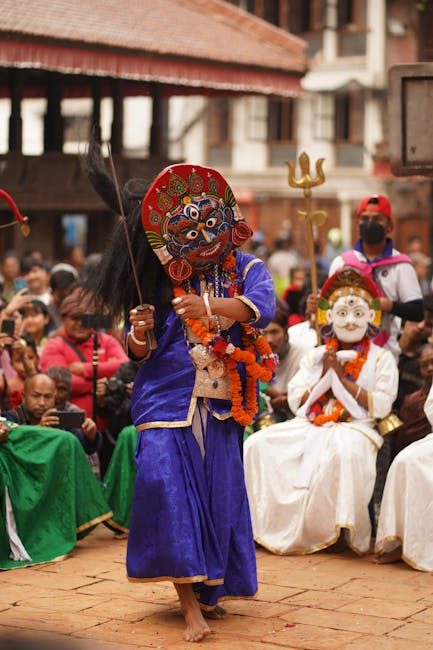
There is a moment in Kathmandu, on the fourth evening of Indra Jatra, when the wooden chariot of the living goddess Kumari emerges from her house and the entire city seems to hold its breath. The drums stop. The street — packed so densely you cannot lift an arm — falls into a hush that lasts perhaps three seconds. Then the sound returns, louder than before, and you realise you have just witnessed something that has happened in this exact square, at this exact hour, for more than three hundred years.
This is the particular genius of Nepal's festivals. They are not reconstructions staged for visitors. They are not curated heritage performances. They are the actual, living liturgy of a civilisation that never broke — and they are astonishingly difficult to experience well. The streets are impossible. The vantages are taken. The timing is inscrutable to outsiders. And the truly transformative moments — the private blessings, the household rituals, the quiet instants behind the public spectacle — are invisible to anyone without the right introductions.
This guide is for the traveller who understands that the answer is not to avoid Nepal during festival season. The answer is to design a journey that lets you witness these sacred spectacles from the one place they are meant to be witnessed — close enough to hear the priest's whispered Sanskrit, far enough from the crush to actually see.
Why Nepal's Festivals Belong on the Luxury Traveller's Calendar
There is a hierarchy of cultural experiences available to the well-travelled guest. At the bottom: staged folk performances in hotel lobbies. A rung higher: organised festival tours in coaches. Higher still: well-timed independent travel that happens to coincide with a major celebration.
What Elysian Himalaya designs sits in an entirely separate category — and it is the only category that delivers the full weight of what a Nepali festival actually is. Because the truth that most travel operators will not tell you is this: public festival photography is the thinnest layer of what these days contain. The real festival happens in courtyards you cannot enter, temples that are closed to outsiders, and households where you must be invited. Ninety-five per cent of a traveller's festival experience is, by default, invisible.
Bespoke luxury travel in Nepal is not about better hotels during these weeks. It is about dissolving the barrier between outside and inside — between watching a culture and being briefly, reverently, welcomed into it.
The Festival Calendar That Matters in 2026
Nepal has over fifty recognised festivals across the year. Perhaps twelve justify reorganising a journey around. Six are unmissable for the luxury traveller seeking genuine cultural immersion.
Spring: The Quiet Power of Buddha Jayanti (1 May 2026)
Of all the festivals in the Nepali year, Buddha Jayanti — the celebration of the Buddha's birth, enlightenment, and death, all marked on the full moon of May — is the most underrated for the discerning traveller. It draws the fewest crowds. It demands the least logistical engineering. And it offers access to two of the most spiritually significant sites in the Buddhist world: Lumbini, where Siddhartha Gautama was born, and Boudhanath, the vast stupa around which Tibetan Buddhism reconstituted itself after 1959.
On the morning of Buddha Jayanti, the kora around Boudhanath becomes a river of maroon and crimson — monks from every Tibetan lineage walking in the same direction, lighting the same butter lamps, reciting the same mantras their teachers' teachers recited. A well-placed rooftop terrace at the Hyatt Regency Boudha or the Boudha Stupa View Restaurant transforms this from a dense, impenetrable scene into something closer to a slow, extraordinary ballet.
In Lumbini, the experience is quieter still. The sacred garden — where the Buddha's mother, Queen Maya Devi, is said to have given birth in 563 BCE — is filled with pilgrims at dawn. A private guide with access to the back entrance of the Maya Devi Temple can deliver you into the central sanctum before the main crowd arrives, giving you twenty unbroken minutes at the marker stone itself. We build entire Ultimate journeys around this single morning.
Autumn: The Great Festivals of the Kathmandu Valley
If Buddha Jayanti is the jewel for the contemplative traveller, September through November is the jewel for everyone else. Four of Nepal's greatest festivals fall within these ten weeks, and the weather — post-monsoon, pre-winter — is simply the most beautiful the Himalayas ever manage.
Indra Jatra (25 September 2026) is Kathmandu's street festival in its most operatic form. For eight days, Durbar Square transforms into an open-air stage: masked dancers in the guise of gods, the slow procession of the Kumari's chariot, the raising of a sixty-foot wooden lingo pole crafted from a single tree. The Kumari — a prepubescent girl selected through rigorous astrological and physical criteria and worshipped as a living incarnation of the goddess Taleju — appears publicly only during this festival. For the eleven minutes her chariot rolls past, the photograph you will take is one of the most extraordinary images anyone can bring home from Asia. The challenge is the crowd density: the square becomes genuinely unsafe for anyone not staying in one of the three or four properties with private rooftop access. We reserve these spaces months in advance. Dashain (17–31 October 2026) is the great family festival — Nepal's equivalent of Diwali in India, Chinese New Year, and Christmas folded into a single fifteen-day arc. Across the country, goddess Durga is worshipped, elders give tika (a mixture of yoghurt, rice, and vermilion) to their juniors, and entire extended families reunite. This is not a street festival in the sense of Indra Jatra — much of it happens indoors. Which is precisely why luxury travel changes everything during Dashain. With the right introductions, we can arrange a private invitation to a household tika ceremony in a Newar family compound in Patan, a kite-flying afternoon on the terrace of a private heritage home in Bhaktapur, or the celebratory feast of mutton curry and homemade raksi at a traditional farmhouse in the Kathmandu Valley. These are the festival moments that never appear in any photograph, because no photograph has ever been taken. Tihar (6–10 November 2026) is the festival of lights, and it is the visual masterpiece of the Nepali year. For five nights, every home in the country is outlined in oil lamps and marigold garlands. On the final night — Bhai Tika — sisters mark the foreheads of their brothers with seven-coloured tika and the streets of every town glow softly orange from dusk until the small hours. This is the festival for photographers, for romantics, for honeymooners. A Premium journey timed for Tihar places you in a restored Rana palace in Kathmandu with the city's entire skyline flickering below your balcony.The Hidden Gems
Bisket Jatra (14–15 April) — Bhaktapur's own new year, centred on the dangerous and thrilling tug-of-war between two massive chariots. Almost unknown to Western visitors. Genuinely private, genuinely authentic, and timed to coincide with the end of the spring trekking season. Teej (14 September 2026) — The women's festival, centred on Pashupatinath Temple. An ocean of red saris streaming toward the temple at dawn. A photograph that will remain in your family for generations. Holi (2–3 March 2026) — The festival of colours, arriving first in the Kathmandu Valley and a day later in the Terai plains. Not for the traveller who fears dye on their cashmere. Spectacular for those who welcome it.What Luxury Actually Buys You in Nepal During Festivals
It is important to be precise here, because the word "luxury" has been so thoroughly diluted by mass tourism that it often now means nothing more than a marble bathroom. Genuine luxury in Nepal during festival season means four specific things, none of which can be purchased piecemeal.
Access that cannot be bought at the door. The rooftop terrace at the Harati Temple with a direct sightline onto the Kumari chariot procession. The inner courtyard of the Nasal Chowk in Hanuman Dhoka, closed to the public for most of Indra Jatra. The invitation to a private household tika during Dashain. These are not ticketed experiences. They are the product of fifteen years of relationships, quietly maintained. A Nepali guide who is not a tour guide. There is an enormous difference between the licensed guide who can explain what you are looking at and the cultural insider who can explain what you are feeling. Our lead cultural hosts in the Kathmandu Valley are scholars, priests' sons, heritage restorers — people who grew up inside these rituals and can translate not just the Sanskrit but the silence. Logistics that vanish. Festival days in Kathmandu collapse the city's already fragile infrastructure. Streets close without warning. Vehicles cannot reach the old city. A journey designed well has already pre-positioned you before any of this matters, and withdraws you to your sanctuary — a Dwarika's suite, a private villa, a Bhaktapur heritage home — before the evening crowds make return impossible. The private moment after the public moment. This is, to my mind, the highest thing luxury travel can offer. After the Kumari has passed and the crowds have dispersed, a quiet courtyard. A single Newar singer. A glass of aged raksi. Fifteen minutes of silence with the drums still echoing in the stone. This is what people mean when they say a journey changed them. It is never the public spectacle. It is always what came immediately after.How to Plan a Festival-Centred Journey
The first rule: start earlier than you think necessary. The best rooftops, the most skilled cultural hosts, and the finest private homes for Dashain and Tihar are frequently reserved a full year in advance. A journey timed for Indra Jatra 2026 should have been initiated no later than February 2026. A Dashain journey for October 2027 should be designed now.
The second rule: do not build the journey around the festival alone. A seven-day visit timed for three days of Indra Jatra, with the remaining four spent in the quiet of Pokhara, the silence of Bandipur, and the wildlife of Chitwan, is vastly more restorative than a fourteen-day continuous festival itinerary. Nepal's sensory intensity during festival season is considerable. Luxury travel knows when to pause.
The third rule: trust the designer over the algorithm. Festival travel is the one domain in which online research is actively harmful. The festivals are complex. The schedules shift according to astrological calculations. The "best places to see" that appear in travel blogs are usually the most overcrowded. A proper bespoke designer will often route you to an entirely different location than the one you expected — and it will be the right one.
A Closing Thought
I have spent more than a decade in Nepal, and I have seen perhaps forty major festivals. I remember two in particular. The first was my first Tihar — I was not a client's designer then, only a young traveller, and I was invited into a Newar family home in Kirtipur for Bhai Tika. The second was Indra Jatra, 2023, on a rooftop I had finally secured after three years of trying, with a retired professor of Nepali art history beside me explaining, moment by moment, what we were watching.
Both of these were the product of relationships, of patience, and of being in precisely the right place at precisely the right moment. The first was luck. The second was design.
For the traveller who has the means, the curiosity, and the instinct to witness something genuinely extraordinary, Nepal's festivals are not a category of cultural tourism. They are the single most concentrated expression of Himalayan civilisation you can experience — and they are vanishingly brief. Indra Jatra lasts eight days. Buddha Jayanti is a single morning. Dashain's most profound moments are measured in minutes, not hours.
They deserve, and reward, a journey designed with the same care the festivals themselves are prepared with.
To begin designing your own festival-centred journey through Nepal, visit Elysian Himalaya's Design Journey. Availability for autumn 2026 — Indra Jatra, Dashain, Tihar — is already limited.