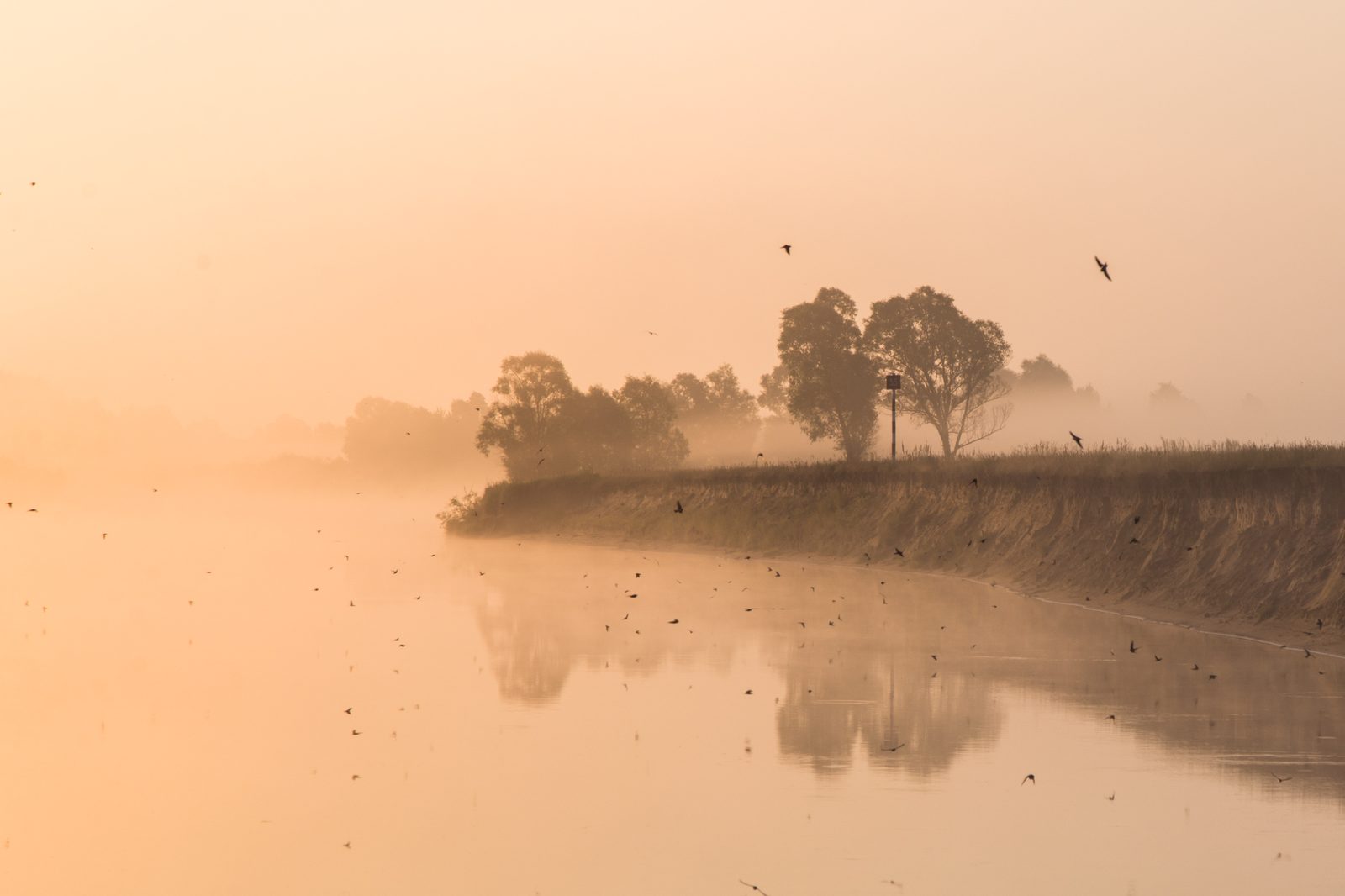
The first thing that surprises people is the sound.
You are standing on an embankment above the Sapta Koshi at ten minutes past six in the morning, in December, with a cup of coffee going cold in your hand because you have forgotten it entirely. The river below is not really a river here — it is a floodplain, a braided sheet of silver channels and sandbars stretching further than you can see, with mist lying on it like something poured. And the noise coming off that water is not birdsong. It is a low, continuous, structural roar: tens of thousands of ducks and geese and waders talking at once, the way a stadium sounds from outside.
Somewhere in the middle of it, your guide lifts a hand — not urgently — and says, quietly, Pallas's fish eagle, left of the dead tree.
That is the moment people write to me about afterwards. Not the species count. The sound.
This is the case for the Nepal luxury birdwatching tour, and I want to make it properly, because it is one of the most extraordinary journeys this country offers and almost nobody outside a small circle of serious birders knows it exists.
Why Nepal Is One of the Great Birding Countries on Earth
Here is the statistic that reframes everything. Nepal occupies roughly one-tenth of one percent of the world's land surface. It holds close to nine hundred recorded bird species — something in the region of eight percent of every bird species on the planet.
That density is not luck. It is geometry.
Nepal is the only country on earth where you can travel from sixty metres above sea level to nearly nine thousand in a horizontal distance of less than two hundred kilometres. Stack the habitats that implies — subtropical floodplain grassland, sal forest, subtropical broadleaf, temperate oak and rhododendron, subalpine fir, alpine meadow, high desert — and you have compressed the ecological range of a continent into a country the size of Greece. Each of those bands holds a different community of birds, and the transitions between them are exactly where diversity spikes.
Then add the second factor: Nepal sits directly beneath the Central Asian Flyway. Every autumn, birds that have bred in Siberia, Mongolia and the Tibetan plateau move south — and the Himalaya stands in the way. Some go around. Some, famously, go over. Bar-headed geese cross the range at altitudes that would render an unacclimatised human unconscious in minutes, and they do it in a single night's flight. When those flocks come down onto the Koshi floodplain in November, they have just flown over the highest mountains on earth to reach you.
You are not visiting a good birding destination. You are standing at a junction.
Koshi Tappu: The Heart of the Journey
If a Nepal birding journey has a centre of gravity, it is Koshi Tappu Wildlife Reserve, in the far south-east of the country.
It is small — around 175 square kilometres — and it looks, on a map, unremarkable: a stretch of wetland on either side of the Koshi River where it emerges from the hills onto the plain. It was designated a Ramsar site of international importance in 1987, and more than four hundred and eighty species have been recorded within it. There are places in the world with longer lists. There are very few where you can approach that many in a morning's walk along a barrage.
What makes Koshi extraordinary is that it is wetland — and wetland is where the numbers are. Reedbeds, marsh, open water, sandbar, wet grassland: each one a different address. In winter, the reserve fills with migrants — bar-headed geese in their thousands, ruddy shelduck, an enormous assembly of ducks and waders, spoonbills, storks, and the raptors that follow them down. Pallas's fish eagle and the greater spotted eagle both winter here, and both are birds that stop conversation.
And then there are the residents that draw specialists from three continents. The swamp francolin, a grassland bird with a shrinking global range, is reliable here in a way it is almost nowhere else. The Bengal florican — one of the rarest bustards on earth, of which perhaps a few hundred adults remain in the wild — persists in the grasslands of Nepal's protected areas. The greater adjutant, an enormous and improbable stork that looks assembled from spare parts, turns up on the floodplain. Koshi is also the last refuge in Nepal of the wild water buffalo, the arna — several hundred animals, and the reason the reserve exists at all.
The practical reality is straightforward. You fly from Kathmandu to Biratnagar in under an hour, then drive ninety minutes east. Mornings are spent on the embankment and in the grassland; a dugout canoe drifts you down the channels in the late afternoon when the light goes copper and the egrets come in to roost. It is not physically demanding in any sense. It is simply early.
The Rest of the Circuit
Koshi alone is a superb four-day journey. But the reason to build a proper itinerary is that Nepal's altitudinal banding lets you collect entirely separate avifaunas in a single trip, without ever repeating yourself.
Chitwan and Bardia — the forest and grassland layer
The lowland national parks give you what wetland cannot: the great forest birds. Giant hornbills labouring overhead like something prehistoric. Paradise flycatchers trailing white ribbons through the understorey. Kingfishers in four or five species along the Rapti and the Karnali. Bardia, further west and far less visited, adds genuine wilderness and a serious chance of a tiger crossing the path while you are looking at something else entirely. Both of these regions are covered more fully across our destinations, and both integrate naturally into a birding itinerary because the lodges are already of a standard that requires no apology.
The Kathmandu Valley rim — the mid-hill layer
You do not have to leave the valley to bird seriously. Phulchowki, the forested hill rising to 2,760 metres on the valley's southern edge, has an extraordinary list for a day trip from a five-star hotel — several hundred species have been recorded on that single mountain, and the road runs most of the way up it. Shivapuri, to the north, is where you go for the spiny babbler, Nepal's only endemic bird: a skulking, unglamorous, deeply satisfying species that exists nowhere else on earth and was considered lost for a century until it was rediscovered in 1948.
The high country — the alpine layer
Above the treeline, the list shortens and the quality rises. Himalayan monal — the danphe, Nepal's national bird, a creature that looks as though it were designed by someone who had been told to use every colour — displays on the slopes above three thousand metres in Langtang and the Annapurnas. Blood pheasants, snow pigeons, grandalas moving in flocks like drifting blue smoke, lammergeiers riding the thermals along a ridge at eye level. This layer pairs naturally with a walking itinerary or a helicopter day, and it is where the birding journey stops being an expedition and starts being simply the finest place you have ever had lunch.
When to Go — and This Genuinely Matters
Birding is the one form of travel where the calendar is not a preference. It is the whole itinerary.
Late October to February is the wetland season, and it is the reason to come. The migrants are in, the numbers on the Koshi are at their peak, the air is dry and clear, and the mid-hill forests are comfortable. December and January are the finest weeks of the year at Koshi Tappu. The lowlands are warm by day and genuinely cold at dawn — dress for it and it is perfect. March to mid-April is the second great window, with a different character entirely. This is breeding season: birds are in full plumage, singing, and therefore findable. The rhododendron forests of the mid-hills are in bloom, which is a spectacle in itself, and the high-altitude species are displaying. Fewer wintering waterbirds, far more song. If you want the Himalayan layer at its best, come now — and read our season-by-season guide before you fix dates. May and early June are hot in the lowlands and largely wasted there, but the high country is still excellent. Mid-June to September is the monsoon. I do not design birding journeys in it. The grasslands are impassable, the leeches are enthusiastic, and the light is poor. There is one exception, as always: Upper Mustang sits in the rain shadow and stays dry, and it holds a genuinely different high-desert avifauna. It is a specialist's answer to a specialist's problem.What "Luxury" Actually Means Here
I want to be honest about a tension in this journey, because it is real and pretending otherwise would be insulting.
For decades, birding in Nepal was a hair-shirt activity. The accommodation nearest Koshi Tappu has historically been simple, and the people who came were prepared to accept that in exchange for the list. What has changed — and what makes this the right moment for the journey — is that the rest of the country has caught up completely. You can now sleep in genuine heritage luxury in Kathmandu, in properties of international standard in Chitwan and Bardia, and in a well-run tented camp at Koshi that is comfortable, private and appropriate rather than merely tolerable.
But the luxury that actually determines the quality of a birding journey is not thread count. It is these five things, in order:
The guide. This is ninety percent of it. A genuinely expert Nepali ornithologist — someone who knows the calls, knows where the florican was displaying last week, and can pick a wintering eagle out of a heat shimmer at eight hundred metres — is the difference between a hundred and twenty species and two hundred and forty. There are perhaps a dozen such people in the country. We work with them. Exclusivity of the vehicle and the boat. You stop when you want to stop. You wait. Birding in a shared group is birding on someone else's schedule, and the birds do not care about the schedule. Timing control. The right hour at the right place is worth more than any other single input. That means a private itinerary that can move a day when the weather turns, and a lodge that will serve you breakfast at five without a discussion. Optics and comfort in the field. Proper scopes, a tripod that works, a hide when a hide is needed, hot chai brought to the embankment at seven. Small things that determine whether you are still concentrating at nine. Rest that is actually restful. You are up at half past four, repeatedly. The single most underrated luxury on this journey is a genuinely excellent bed and a long afternoon.This is the architecture we build into our Premium journeys, and when a client wants the high-altitude layer added by helicopter rather than on foot, into the Ultimate.
What It Costs
A serious, well-run private birding journey of ten to twelve nights — Kathmandu Valley, Koshi Tappu, Chitwan or Bardia, with a specialist ornithologist guide throughout, all internal flights, private vehicles and boats, and the best available accommodation in each location — typically falls between €5,500 and €9,500 per person, excluding international flights, based on two travelling together.
A shorter Koshi-focused journey of six or seven nights sits closer to €3,500 to €5,000. Add a helicopter day into the high country for the alpine species, or full exclusive use of a camp, and the figure moves accordingly. A gentler, culture-and-birds itinerary in the mid-hills built around the valley rim and Chitwan starts lower still and works beautifully as an extension to our Classic journey.
What you should not do is economise on the guide. It is the one line in the budget where the saving is directly and immediately visible in the experience.
A Note on Why This Journey Moves People
I did not come to Nepal as a birder. I came as a Greek who could not entirely explain what he was looking for, and I found something here that took years to name. But I have now stood on the Koshi embankment at dawn with perhaps thirty different clients, and the pattern is unmistakable.
Birding does something to attention that almost nothing else in modern life does. It requires you to be silent, still and completely present for hours at a stretch, with no possibility of multitasking, in the service of something that owes you nothing and will not perform on request. People arrive thinking they have come to see birds. They leave having remembered how to look at anything at all.
That is what we mean when we talk about experiential wealth. Not the rarity of the species. The quality of the hour. If you would like to understand why I build journeys this way, my story is here.
Begin
The migration comes down over the Himalaya in late October and the Koshi fills within a fortnight. If you want the wetlands at their absolute peak, that means December or January, and it means securing the right guide well in advance — there really are only a handful of them, and the serious birding operations book them a year out.
Whether you are a lifelong lister chasing the swamp francolin, or someone who simply suspects that a week of dawns on a Himalayan floodplain might be the most restorative thing they do this decade, I would be glad to design the journey personally. Every itinerary I create begins with a conversation, not a catalogue.
Let us begin designing yours — and I will have the coffee waiting on the embankment, going cold, exactly as it should.