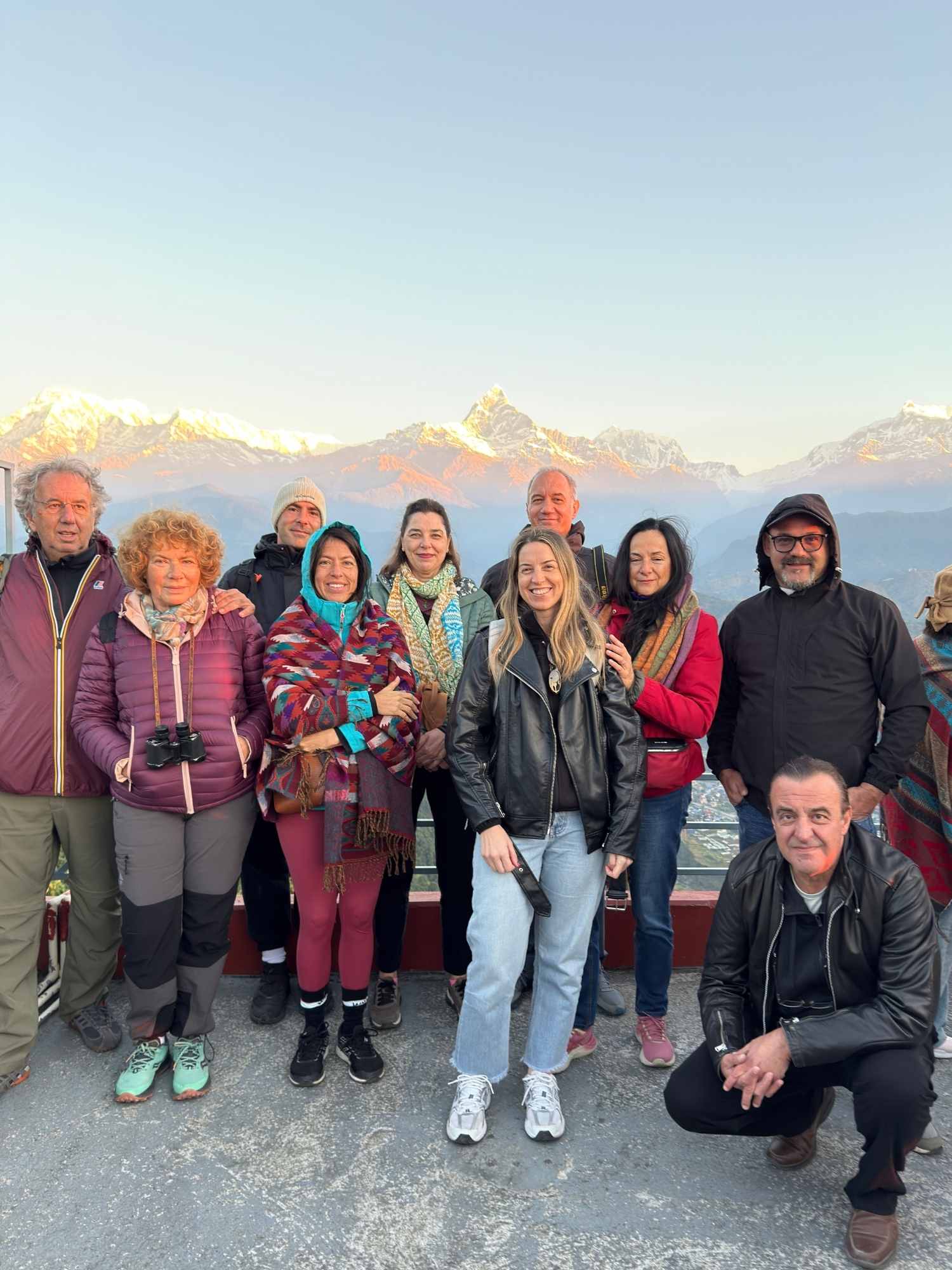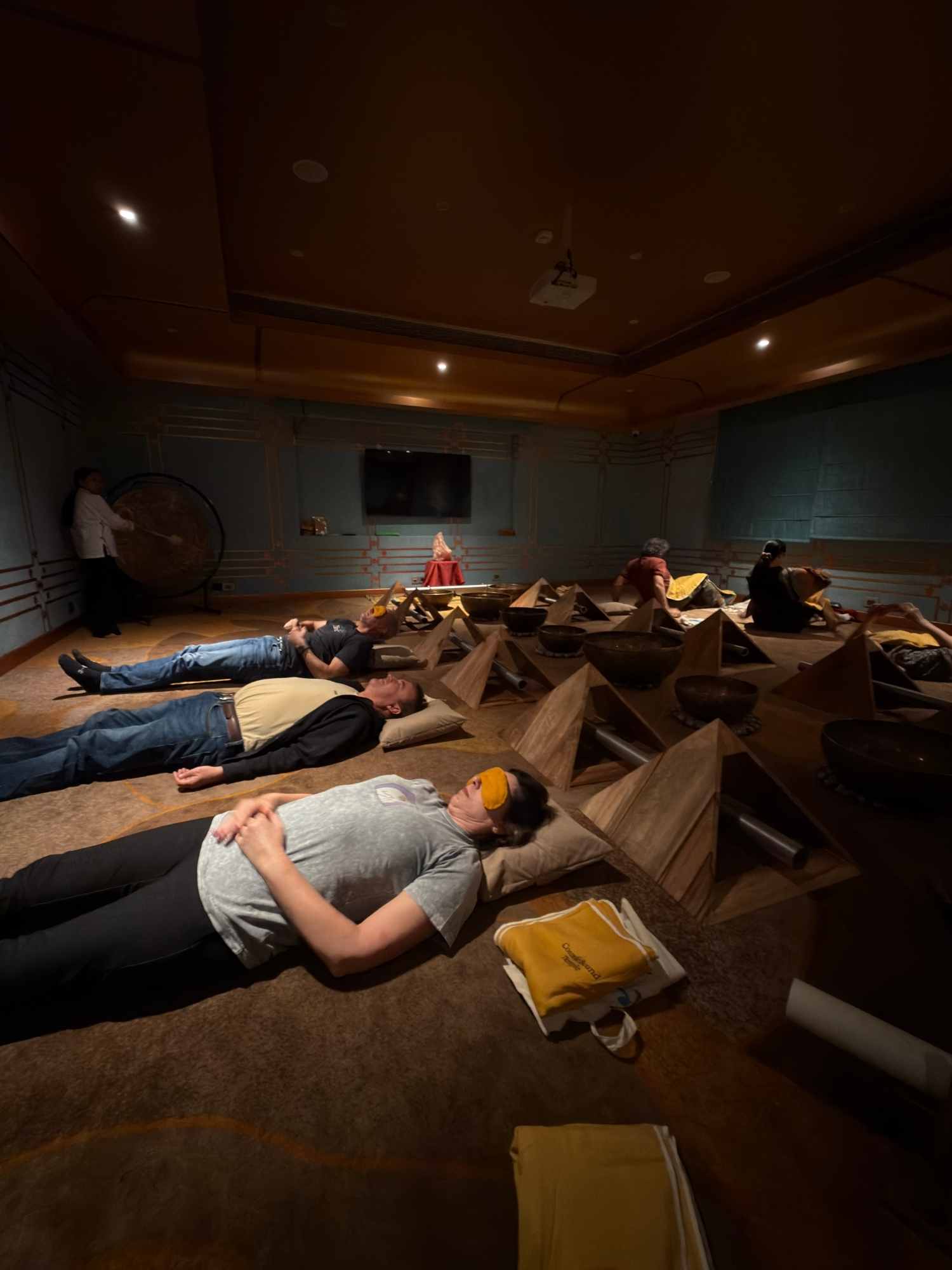
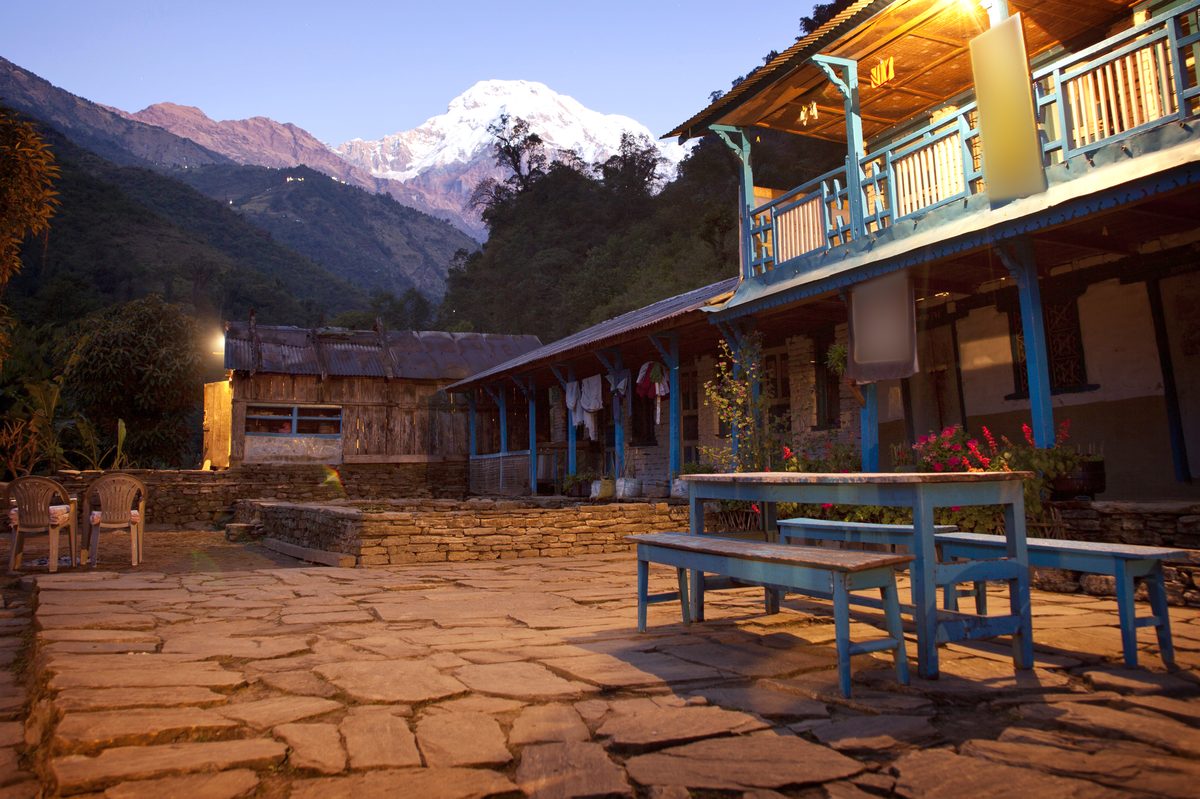
There is a moment on the second morning that I have now watched happen more times than I can count, and it never loses its power. The team has arrived — twelve people, perhaps sixteen, senior enough that their calendars are managed by someone else and full enough that they arrived exhausted and faintly sceptical. They have done Mykonos. They have done the château outside Bordeaux. They have sat through the ropes course and the facilitator with the flip chart.
And then, at around six in the morning at 2,800 metres, the cloud that has been sitting in the valley all night simply drops away, and the Annapurna massif is standing there — vast, silent, indifferent, seven thousand metres of it — as though it had been waiting for them to stop talking.
Nobody says anything. That is the point. And in the four days that follow, that same group will have the most honest strategic conversation they have had in years.
This is the case for the Nepal luxury corporate retreat, and it has very little to do with scenery.
Why Nepal, and Why Now
For most of the last two decades, the executive retreat market has been an arms race of comfort. Better wine lists, better spas, better thread counts — a competition that Tuscany, Provence and the Amalfi coast will always win, because they invented it. What that market has largely failed to deliver is the thing leadership teams actually need and almost never get: a genuine interruption of pattern.
Nepal offers something the European estate cannot. It offers scale. Not the scale of a large property, but the scale of a landscape that makes the quarterly forecast look accurately small for the first time in years. There is a well-documented psychological effect to standing before something vastly larger than yourself — a measurable softening of ego, a widening of time horizon, an increased willingness to cooperate. Executives describe it, imprecisely but consistently, as "perspective." It is the single most requested and least deliverable outcome of every offsite ever commissioned.
Nepal delivers it before lunch on day one.
The second reason is more prosaic, and it is the reason 2026 has become the inflection year. The infrastructure has finally caught up with the ambition. A decade ago, a serious Himalayan retreat meant a real trade-off between the experience and the standards a board-level group expects. That trade-off has now largely disappeared. Nepal's finest properties — heritage hotels in the Kathmandu Valley with Michelin recognition, architect-designed mountain lodges in Mustang built from local stone in traditional Thakali style, wellness sanctuaries on the valley rim at Dhulikhel — deliver an international standard of comfort without the international sameness. You are not staying in a hotel that could be anywhere. You are staying somewhere that could only be here.
What a Himalayan Retreat Actually Does to a Team
I want to be precise about this, because the wellness industry has done enormous damage to the language and it is easy to sound like a brochure.
It removes the hierarchy of the room
Put a leadership team around a boardroom table and the seating chart writes the conversation before anyone speaks. Put the same team walking single-file along a ridge trail for three hours, where the order shuffles naturally and the CFO ends up beside the newest regional director because that is simply who was there, and something structural changes. The best strategic disclosures I have witnessed on these journeys have almost all happened while walking, sideways, without eye contact. There is a reason for this. Difficult truths are easier to speak when you are not being watched across a table.
It resets the clock
The Himalaya operates on a schedule that has nothing to do with yours. You leave at first light because the peaks are clear at first light and shrouded by eleven. You stop when the weather says stop. Within forty-eight hours, a group accustomed to fifteen-minute calendar increments has been re-tuned to a completely different tempo — and this, more than any exercise, is what allows long-horizon thinking to return.
It creates shared reference points that survive the flight home
Every retreat promises "bonding" and most deliver an anecdote about the karaoke. What a Himalayan journey produces is different in kind: a small number of genuinely significant shared experiences that become permanent internal shorthand. A team that has stood together at Poon Hill at dawn, or flown the Everest corridor at sunrise, has a common reference that will still be doing work in that organisation three years later.
The Four Formats That Work
Not every team should do the same journey, and the most common mistake I see is an ambitious itinerary imposed on a group that needed something else entirely. In practice, four formats cover almost every serious brief.
The Executive Immersion — 4 to 5 nights
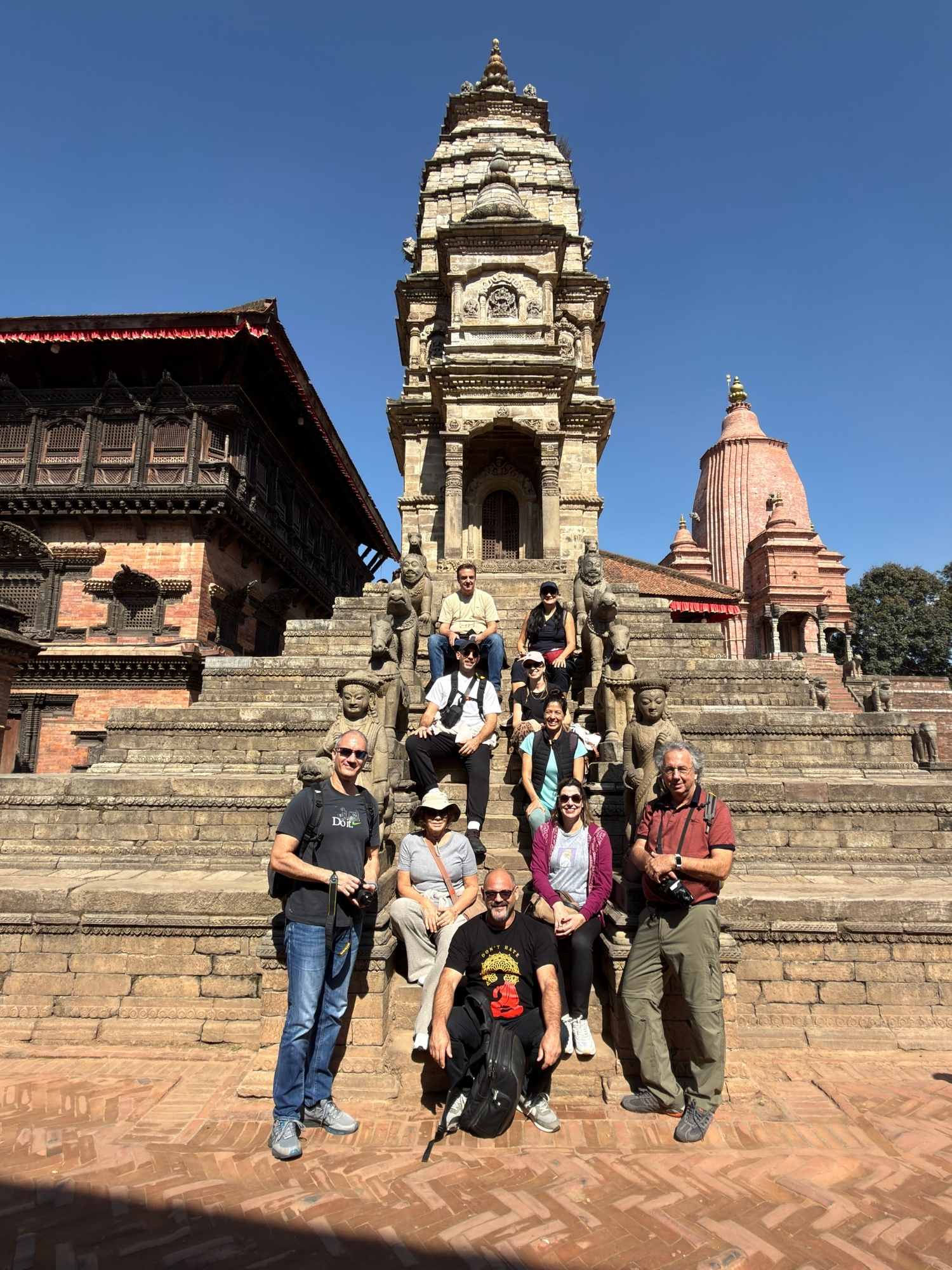
The most requested and, for most groups, the correct answer. Base in the Kathmandu Valley in a heritage property, with structured working sessions in the mornings and cultural immersion in the afternoons: Bhaktapur explored privately after the crowds have gone, a private audience with a Newari master craftsman, dinner in a restored farmhouse courtyard. One helicopter day into the mountains as the emotional centrepiece. It is the shortest format that still produces genuine change, and it works for groups of ten to thirty. Much of its architecture is drawn from our Classic journey.
The Mustang Leadership Retreat — 6 to 7 nights
For smaller senior groups — eight to fourteen — who want the full interruption. Fly to Jomsom, base in the ancient kingdom of Mustang at a lodge built into the hillside above the Kali Gandaki gorge, and let the sheer strangeness of the trans-Himalayan landscape do the work. This is the format for the team facing a genuine inflection point: a merger, a succession, a strategic pivot that requires people to think in a way they have not before. It draws directly on the architecture of our Ultimate journeys, including private helicopter access.
The Reward Journey — 5 to 8 nights
Distinct in purpose. This is not a working retreat; it is recognition — top performers, a founding team after an exit, a partner group marking an anniversary. Here the itinerary should be generous rather than demanding: the Everest mountain flight, a night at a lodge above Pokhara with the Annapurnas filling the window, a jungle interlude in Chitwan or Bardia. No sessions, no deliverables. The message is the itinerary. Our Premium journeys are typically the starting point.
The Founder or Board Sabbatical — 3 to 10 nights
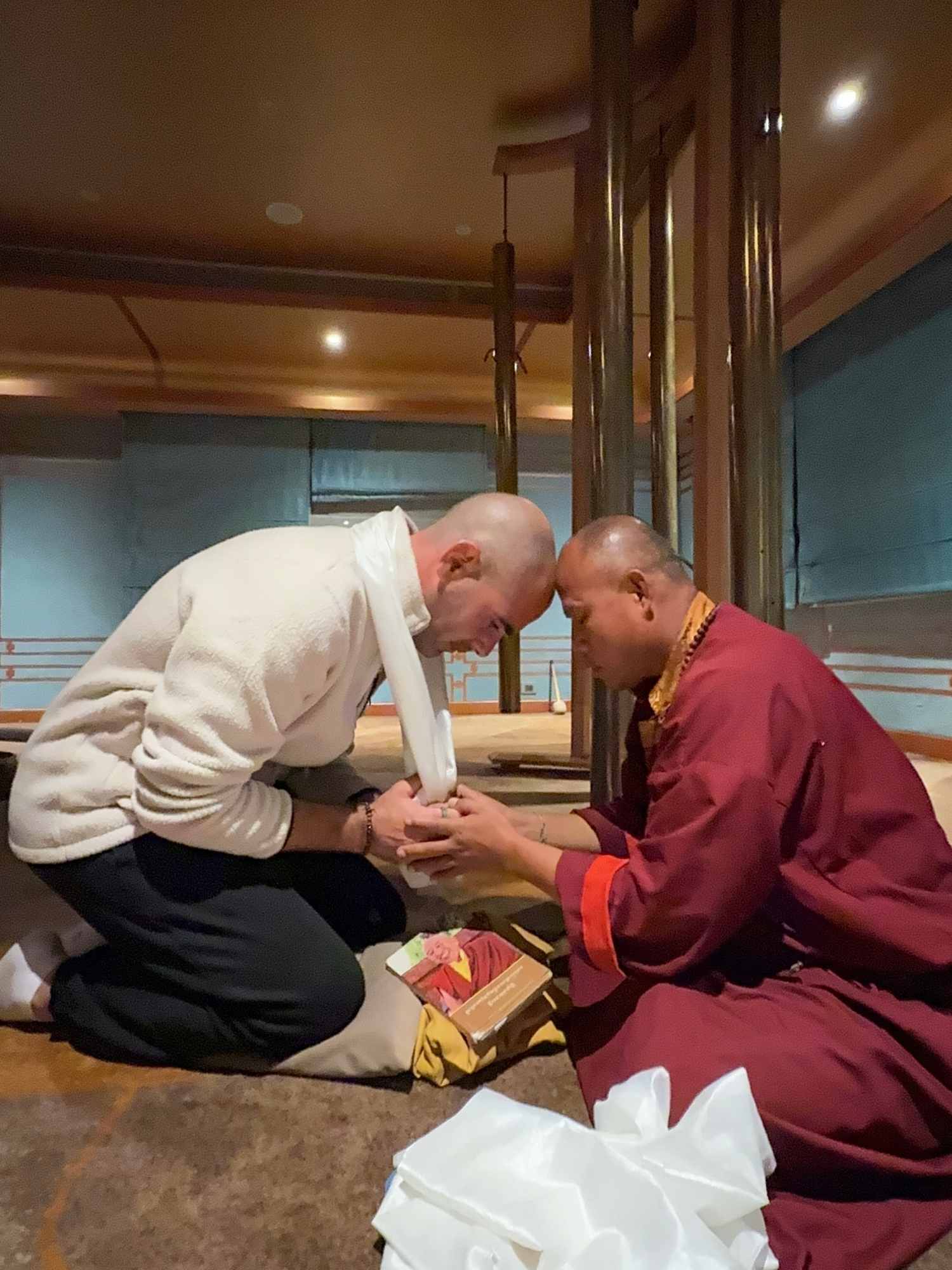
The smallest and, in some ways, the most consequential. One or two people, often a founder or a chair, at a genuine crossroads. Complete privacy, a monastery stay if wanted, long unstructured days, and a guide who understands when to speak and when not to. I design very few of these each year, and they tend to be the journeys people write to me about a decade later.
Choosing the Season — This Is Not Negotiable
More retreats are compromised by poor timing than by any other factor, and it is entirely avoidable.
October to early December is the finest window in the calendar. The monsoon has washed the atmosphere clean, the peaks stand in near-permanent clarity, and the temperature at working altitudes is close to perfect. If your retreat has a fixed and immovable date, make it here. March to mid-April is the second window and has its own particular argument: the rhododendron forests are in bloom, the light is softer, and the trails are quieter than in autumn. Slightly more atmospheric haze, marginally less certainty on the peaks — but a beautiful and reliable choice. Late December to February is the connoisseur's season for valley-based programmes. Crystalline air, snow on the ridgelines, almost no other visitors, and materially better rates on the finest properties. Higher-altitude components need careful design, but for an executive immersion based in the Kathmandu Valley it is superb. June to September — the monsoon — I will not design a corporate retreat in. The peaks are hidden more often than not, mountain flights are unreliable, and the single greatest asset of the journey becomes a matter of luck. The exception is Upper Mustang, which sits in the Himalayan rain shadow and remains largely dry through the summer. If your fiscal calendar forces a July retreat, Mustang is the answer, and it is a genuinely good one. You will find more on how the regions differ across our destinations.What It Costs, Honestly
Serious planners want a number, and vagueness here helps nobody.
For a group of twelve to twenty, a well-executed Nepal corporate retreat of five to six nights — finest available properties on exclusive-use or near-exclusive terms, private ground transport throughout, dedicated guides, all cultural access arranged privately, full meal programme, and one helicopter or mountain-flight day — typically falls between €4,500 and €8,500 per person, excluding international flights. Add private helicopter charter as a recurring rather than singular element, or full exclusive use of a premium mountain lodge, and the upper figure rises accordingly.
The comparison worth making is not against a Nepal package tour. It is against the equivalent five-night retreat at a comparable standard in Tuscany, the Swiss Alps or Kenya — where the same group will spend a similar amount and return with a considerably more ordinary story. The value proposition of Nepal is not that it is inexpensive. It is that at the same price point, nothing else is remotely as memorable.
The Practical Architecture Nobody Talks About
The things that quietly determine whether a retreat succeeds are rarely the things that appear on the itinerary.
Altitude discipline. Any programme going above 3,000 metres must be built with acclimatisation designed in, not hoped for. A single participant with altitude sickness reshapes the entire group's experience. This is a design decision made months in advance. Connectivity, deliberately managed. Most groups want a working session in the morning and genuine disconnection thereafter — which requires knowing exactly where reliable connectivity exists and where it does not, and building the schedule around that map rather than discovering it in the field. Weather contingency, pre-built. Mountain flights and helicopter days are weather-dependent. A serious retreat has the alternative already designed, booked and ready — so a clouded morning becomes a change of plan rather than a hole in the programme. Dietary and medical preparedness. At this level it is assumed, but at altitude and at distance from a city it requires real planning, including evacuation cover for every participant as a matter of course. A single point of accountability on the ground. Not a call centre in another time zone. One person, present, who can make decisions.The Reason I Build These Journeys
I am Greek. I came to Nepal for reasons I could not fully articulate at the time and stayed for reasons that became clear only slowly. What I found here was not an escape from the world of business — I had spent long enough in it — but a corrective to it. A place where the questions get bigger and the noise gets smaller.
That is what I try to build for the teams who come here. Not a change of venue. A change of altitude, in every sense. If you would like to know more about why I do this work the way I do, my story is here.
The Nepal luxury corporate retreat is not a trend, and it is certainly not an upgrade on the château. It is a different instrument entirely — one for teams who have run out of road with the conventional offsite and suspect, correctly, that the problem was never the wine list.
If you are planning a leadership retreat, an executive immersion or a reward journey for 2026 or 2027, I would be glad to design it personally. Every journey we create begins with a conversation, not a catalogue. Let us begin designing yours — and give your team the one thing no boardroom has ever managed to provide.