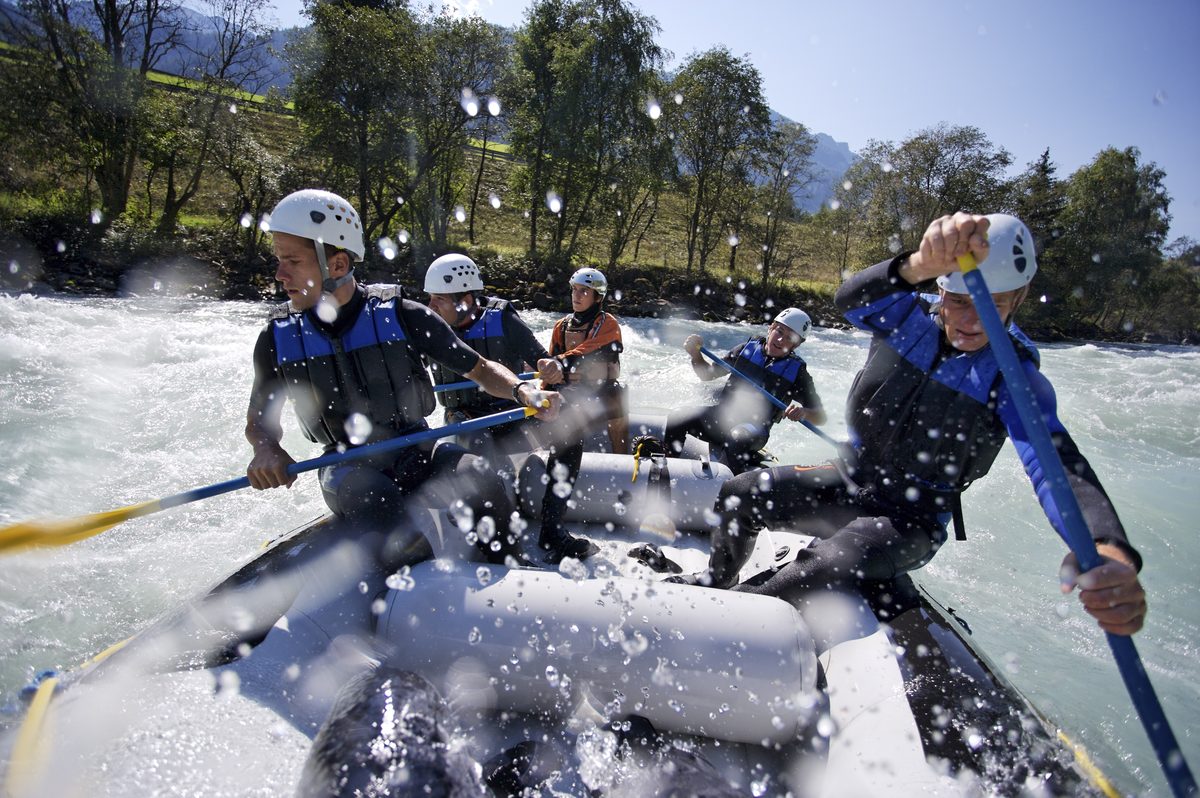
There is a particular silence that arrives at dusk on a Himalayan river. The rapids you wrestled through an hour ago have softened into a low, continuous hush. The canyon walls hold the last of the light. Somewhere downstream a fish breaks the surface, and the sound carries for what feels like a mile. You are sitting on a beach of pale sand that no road touches, that no map names, that perhaps a few hundred people will see this entire year — and a member of your private crew is handing you a glass of something cold and well-chosen while the cook coaxes dinner from a fire of driftwood.
This is Nepal that almost no one knows. Not the Nepal of mountain lodges and helicopter landings, magnificent as those are, but the Nepal that lives at the bottom of its valleys, in the arteries of meltwater that have been carving these mountains since before the mountains were mountains. To travel it by river is to experience the country the way water does — from the inside, at its own pace, on a current that cannot be hurried or negotiated with.
Why the Rivers Are the Last Frontier of Luxury Nepal
For two decades, the conversation about high-end travel in Nepal has orbited the same handful of experiences: the trek to Everest, the suites of Kathmandu, the forbidden allure of Upper Mustang. These are extraordinary, and we design them with great devotion. But there is a reason the rivers have remained the connoisseur's secret, and it is not that they are lesser. It is that they are harder.
A luxury river expedition cannot be assembled from a brochure. It demands a private team that can read whitewater the way a sommelier reads a vintage. It demands gear and logistics carried entirely by raft, since there are no villages to resupply from and no vehicles that can reach you. It demands a chef willing to produce genuinely beautiful food from a kitchen that is rebuilt on a new beach every single evening. Most operators simply will not do this. The few who can are not selling a holiday — they are composing an expedition, and the difference is everything.
What you receive in return is the rarest commodity in modern travel: genuine solitude in a landscape of overwhelming grandeur. No crowds. No itinerary imposed by hotel check-in times. Only the river, the canyon, your companions, and a level of attentive service that feels almost improbable given how far you are from anywhere. This is the essence of what we call experiential wealth — not the accumulation of comfort, but the acquisition of moments that cannot be bought in any other form.
The Great Rivers of Nepal
Nepal is drained by three great river systems, each fed by the snows of the highest mountains on earth. Choosing among them is less a matter of difficulty than of character — each river has a temperament, a story, a particular gift it offers the traveller willing to meet it.
The Karnali — Nepal's Wildest Water
In the far west, beyond the reach of the well-trodden routes, the Karnali carves through some of the most remote wilderness in the entire Himalaya. This is the connoisseur's river: an expedition of around a week that begins with a journey simply to reach the put-in, through forests where leopard and the occasional tiger still move unseen. The whitewater is exhilarating without being reckless, the canyons are cathedral-deep, and the sense of remoteness is total. For the traveller who has already stood at Everest's feet and wants something genuinely few others have done, the Karnali is the answer. It is the centrepiece of our most ambitious water itineraries within the Ultimate journey.
The Sun Kosi — The River of Gold
Flowing east across the breadth of the country, the Sun Kosi — "river of gold" — is perhaps the most complete river journey in Nepal. Over the course of eight or nine days it carries you from the green middle hills down through ever-deepening gorges, offering a procession of magnificent rapids interspersed with long, tranquil stretches where the only sound is the dip of the guide's oar. You camp on white sand beaches each night, watch the landscape transform from terraced farmland to subtropical jungle, and arrive, at the end, having crossed a meaningful portion of an entire country under your own momentum. It is, quite simply, one of the world's great expeditionary river trips.
The Tamur — Remote Grandeur in the East
For those drawn to the shadow of Kanchenjunga, the Tamur offers a beginning unlike any other: the expedition often opens with a short trek through Limbu villages and rhododendron forest before you even touch the water. What follows is steeper, more continuous whitewater than the Sun Kosi, in a setting of extraordinary eastern-Himalayan beauty. It rewards the traveller who wants their river to feel earned.
Gentler Waters — The Trishuli and Seti
Not every river journey must be an expedition. For families, for those new to whitewater, or for travellers who wish to fold a day or two of river time into a broader itinerary, the Trishuli and the Seti near Pokhara offer warm, forgiving water and astonishing scenery without the multi-day commitment. We frequently weave these into our Classic journey for guests who want to taste the rivers before, perhaps, returning one day for the full expedition.
What "Luxury" Actually Means on a Wild River
The word luxury is too often a synonym for marble and thread-count. On a Himalayan river, where there is neither, it means something far more interesting — and far more difficult to deliver.
A Private Team, Composed for You
Everything begins with people. Your expedition is led by river guides with decades of experience on these specific waters — the kind of knowledge that cannot be taught quickly and cannot be faked. Alongside them travels a support crew whose entire purpose is your comfort and safety: a dedicated camp team, a chef, and a ratio of staff to guests that would be considered extravagant on land and is simply non-negotiable on water. You are never one of forty. You are, often, one of two or four. The importance of the right people is something we have written about at length in the context of private guiding, and on a river it matters more than anywhere.
Camps That Rise From the Sand
Each evening, a beach becomes a temporary estate. Spacious walk-in tents with proper beds and linens. A dining canopy with real chairs and a table laid with care. Hot water heated over the fire and carried to you. A separate, scrupulously managed facilities tent. And, always, the fire itself — the ancient gravity that pulls a small group of people together under more stars than most will see in a lifetime. The camp is struck each morning and rebuilt each evening, leaving nothing behind. This is luxury defined not by permanence but by grace.
A Table in the Wilderness
The food on a well-run river expedition is a genuine astonishment. Fresh ingredients, kept cool and carried entirely by raft, are transformed into multi-course meals that would not embarrass a city restaurant — eaten with sand beneath your feet and a canyon wall glowing pink above you. Wine and spirits, chosen in advance to your taste, appear at exactly the right moment. The contrast between the wildness of the setting and the refinement of the table is precisely the point. It is the same philosophy of considered, personal hospitality that defines every Elysian Himalaya experience, and which began, as it happens, with the story of how this company came to be.
The Best Time to Ride the Waters
Timing is everything on a river, and Nepal's rafting season is shaped entirely by the monsoon. The two windows are distinct in character.
Autumn (late September to early December) is the prime season. The monsoon has flushed the rivers to a generous, exciting volume, the skies clear to that famous post-monsoon brilliance, and the air is warm without being oppressive. This is when the great expeditions run, and when the whitewater is at its most thrilling. Spring (March to early May) offers lower, clearer water, gentler rapids, and the spectacle of the hillsides ablaze with rhododendron. It is the warmer, more relaxed season — ideal for those who want the beaches and the camps and the canyons without the most demanding whitewater.The monsoon months between are best avoided for expedition rafting; the rivers run high, brown and dangerous. We plan every river journey around these realities, and we will always tell you honestly which season suits the experience you are seeking.
How a River Journey Transforms the Traveller
It is worth saying plainly what happens to people on these rivers, because it is the real reason we offer them.
The river demands presence. You cannot check email at the bottom of a Karnali gorge. You cannot rush a rapid or postpone a sunset. For days at a time, the most pressing question in your life becomes which line to take through the next stretch of whitewater, and the question after that is simply where to sit and watch the light change. This enforced presence — the same quality our guests describe finding on the high trekking trails, but distilled and intensified by the water — is something that the most successful, most time-poor travellers tell us they cannot find anywhere else.
There is also the matter of scale. To float for a week beneath canyon walls that rise thousands of feet, on water that has been flowing since before human memory, recalibrates one's sense of one's own proportions in a way that is quietly profound. People disembark from these expeditions changed — calmer, clearer, somehow restored. This is the transformation at the heart of everything we design. It is why we speak of journeys rather than trips, and why we build each one, by hand, around the particular person who will travel it. You can read about that philosophy in our approach to the Premium journey.
Designing Your Himalayan River Expedition
No two of our river journeys are alike, because no two travellers are. Some guests want the full, uncompromising Karnali expedition and nothing less. Others wish to combine a few days on the gentler Trishuli with a luxury lodge stay and a cultural immersion in the Kathmandu Valley. Some arrive as couples seeking solitude; others as families wanting to give their children an experience they will measure other adventures against for the rest of their lives.
Whatever shape your journey takes, the process is the same. We begin with a conversation — about what moves you, what you have done before, what you are hoping to feel. From there, we compose. Every guide, every camp, every meal, every transfer is chosen and arranged to fit you precisely. And then we accompany you, attentively and invisibly, from the moment you land until the moment you reluctantly leave.
The rivers of Nepal have been waiting, patiently, for the traveller ready to meet them on their own terms. If something in you has stirred while reading this — some recognition that the experience you are looking for is the one almost no one else has had — then it is time we spoke.
Begin designing your bespoke Himalayan river journey →