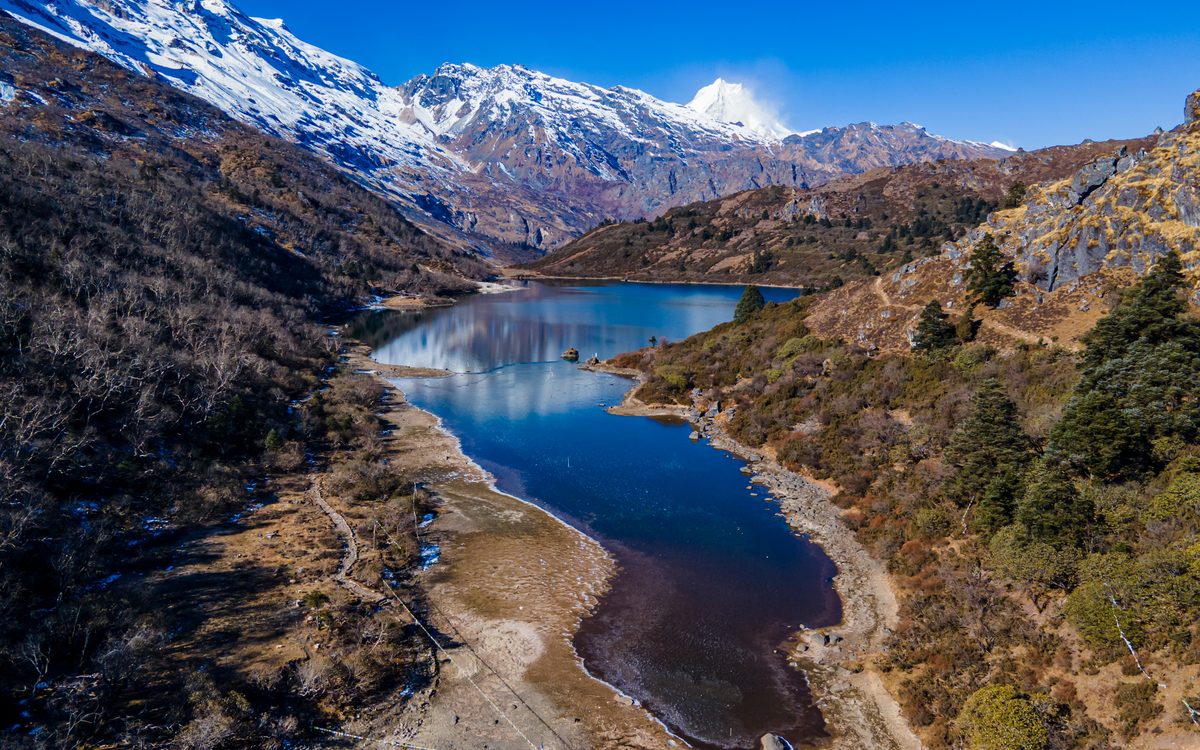
There are lakes you visit, and there are lakes that visit you — that arrive, unbidden, in the quiet hours years after you have left them, the colour of them surfacing behind your eyes like something you once believed and never quite forgot. Tilicho is the second kind.
At an altitude of roughly 4,919 metres, suspended in a high amphitheatre of the Annapurna massif, Tilicho is one of the highest lakes on Earth. For decades it held the title outright; even now, with a rival claimant emerging in the neighbouring Nar Phu region, it remains among the most extraordinary bodies of water on the planet — four kilometres of meltwater so still and so impossibly blue that, the first time you see it, the mind simply refuses the evidence of the eyes. In the year 2000, a team of Russian divers descended into its freezing depths and recorded the highest-altitude scuba dive in human history. It is, in every sense, a place at the edge of what is possible.
And yet the truest luxury of Tilicho is not its altitude, nor its records, nor even its colour. It is its silence. To stand on the moraine above that water at first light, with the wind held momentarily in abeyance and the peaks of Tilicho, Nilgiri and the Grand Barrier burning gold above you, is to understand something that no five-star suite in any city on earth can offer: the wealth of being, for one suspended hour, entirely and gloriously alone with the world.
Why Tilicho Belongs to a Different Order of Journey
Nepal is generous with its wonders, and the seasoned traveller will already know the great set-pieces — the helicopter dawns over Everest, the forbidden ridges of Upper Mustang, the tiger-haunted grasslands of the Terai. Tilicho asks something more particular of you. It is not a destination you collect; it is a threshold you cross.
The lake sits on a demanding spur of the classic Annapurna Circuit, reached by a final approach along a notorious traverse of scree and shifting mountainside known, with mountaineer's understatement, as the landslide section. The standalone journey runs nine to ten days from Kathmandu; folded into the full Circuit, with the Thorong La pass and the temples of Muktinath beyond, it becomes a fortnight or more. This is high country — Manang, the old Tibetan trading kingdom, where apple orchards give way to juniper and then to bare blue rock, and where the air itself becomes a discipline to be respected.
For precisely these reasons, Tilicho rewards the traveller who arrives prepared, acclimatised, and unhurried. It is the antithesis of the rushed itinerary. And it is here that the philosophy we hold most dearly — that true wealth is experiential, measured not in what you acquire but in who you become — finds one of its purest expressions in the Himalaya.
The Difference Between Trekking to Tilicho and Journeying to It
Let us be honest about something the brochures rarely say aloud. The teahouses on the high approach to Tilicho are simple structures — plywood walls, shared facilities, a wood stove if you are fortunate. There is no marble here, and there should not be. The mountain does not bend to luxury, and any operator who promises you a palace at 4,900 metres is selling you a fiction.
The luxury of a properly conceived Tilicho journey, therefore, is not architectural. It is operational. It is the invisible architecture of care that surrounds you at every step.
What Refined Logistics Actually Mean at Altitude
Consider what changes when a journey is designed rather than merely booked. Your acclimatisation is engineered, not gambled — built around generous rest days in Manang, a private guide reading your oxygen saturation each evening, the itinerary flexing to your body rather than the reverse. Your nights begin in the finest boutique retreats of Kathmandu and Pokhara, so that the trek is bookended by genuine comfort and your body arrives at the trailhead rested rather than depleted.
On the mountain itself, a dedicated culinary team carries fresh provisions and prepares food that bears no resemblance to the standard trail fare — warm, nourishing, restorative. Expedition-grade down bedding rated to minus twenty degrees, silk liners, hot water bottles delivered to your room without your asking. A satellite phone, a portable altitude chamber, and comprehensive helicopter evacuation cover travel with you at all times, unseen and, with any fortune, unneeded — the quiet insurance that lets you give yourself fully to the experience because someone else is carrying the weight of every contingency.
And then, the detail that transforms the entire architecture of the journey: the helicopter. A private aircraft, summoned to lift you from the high country back to Pokhara in a single soaring quarter-hour, sparing your knees the brutal descent and gifting you, instead, an aerial farewell to the Annapurna sanctuary that few human beings will ever witness. This is the signature of our Ultimate journeys — the seamless marriage of the earned and the effortless.
The Sacred Geography of the Lake
To the West, Tilicho is a natural marvel. To Nepal, it is something closer to a presence. The lake has long held a place in Hindu cosmology — devotees identify it with the legendary Kak Bhusundi lake of the ancient epics, the high water beside which a sage in the form of a crow is said to have recounted the story of Rama across the ages. Each year, a small number of pilgrims undertake the brutal ascent not for the view but for the merit, leaving offerings at the water's edge in a tradition that stretches back further than any record can reliably trace.
This matters, and not merely as colour for the guidebook. To walk to Tilicho with an understanding of what the lake means — to the herder in Manang, to the pilgrim, to the long generations who regarded these heights as the literal abode of the divine — is to experience the journey on a register that the merely athletic traveller never reaches. The water ceases to be a backdrop for photographs and becomes what it has always been to those who live beneath it: a threshold between the world of men and the world above it. A good private guide does not simply lead you up the trail; they carry this deeper geography with them, and offer it to you when you are ready to receive it. This is the quiet difference between covering ground and being initiated into a place.
The Mountains Keep Their Own Counsel
There is a temptation, among those accustomed to the world arranging itself around their wishes, to treat altitude as another obstacle to be overcome by force of will or expenditure. The Himalaya does not negotiate. At 4,900 metres the air holds barely half the oxygen of sea level, and the mountain extends no special courtesy to wealth, status or impatience. This is not a limitation of the experience; it is its meaning.
The art of a properly conceived high journey lies in working with this reality rather than against it — which is why our Tilicho itineraries are built around an unhurried ascent profile, with deliberate acclimatisation days woven into Manang and beyond, and a private guide who monitors your wellbeing with quiet, unobtrusive vigilance. We would rather add a day than rush a body that is not ready, and we design every journey with the latitude to do exactly that. The traveller who submits to the mountain's rhythm, rather than imposing their own, is rewarded not only with safety but with something far rarer: the slow, dawning attunement of a person learning, perhaps for the first time in years, to move at the pace of the earth itself.
It is worth saying plainly that this same philosophy animates every journey we craft, from the gentlest valley exploration to the most demanding high traverse. If Tilicho asks more of you than you are presently prepared to give, there is no diminishment in beginning elsewhere — the Himalaya keeps its wonders at every altitude, and the Classic journey opens the door to many of them.
A Journey Designed Around the Lake
No two journeys we craft are ever identical, because no two travellers are. But to give shape to the possible, here is the rhythm of a Tilicho expedition conceived in the Elysian manner.
The Approach — Kathmandu to Manang
You begin not on a trail but in a sanctuary: a heritage suite in the lanes of old Kathmandu, a private audience with the living history of the Kathmandu Valley, a meal that introduces you to Nepal's quiet culinary sophistication. From here, the journey lifts you — by road through the deepening river gorges, or by air to Hongde, the small airstrip that delivers you straight into the high amphitheatre of Manang.
Manang itself deserves unhurried days. This is the old salt-road kingdom, its medieval village clinging to the mountainside, its monasteries fragrant with butter lamps, its horizon dominated by the great north faces of the Annapurnas. Here you acclimatise — and here, with a private guide, you begin to read the mountains not as scenery but as a living text of geology, faith and human endurance.
The Ascent — Into the Realm of the Lake
From Manang the trail turns toward Tilicho Base Camp, the air thinning with each hour, the landscape shedding its last greens for a palette of slate, ochre and brilliant white. The final morning begins in darkness. You climb in the blue hour, the cold absolute, your breath the only sound — and then the ridge falls away and the lake is simply there, holding the dawn in its surface like a vow.
There is no adequate way to prepare a traveller for this moment, and we no longer try. We simply ensure that when it comes, nothing — not exhaustion, not discomfort, not anxiety about the descent — stands between you and the full force of it.
The Return — and the Sky
Where another journey would condemn you to retrace every brutal step, ours offers the sky. The helicopter rises from the high country, banks once above the turquoise water as if in salute, and carries you out over a kingdom of ice and shadow toward the warmth of Pokhara — where a lakeside suite, a long bath, and a celebratory dinner await. The transformation from the austerity of the heights to the embrace of comfort, accomplished in minutes, is itself one of the great sensations the modern Himalaya can offer.
Who Tilicho Is For
This is a journey for the traveller who has, perhaps, already stood at Everest Base Camp or walked the Annapurna Sanctuary, and who now seeks something quieter, rarer, more intensely their own. It suits the couple marking a milestone with an experience no resort could rival; the solitary traveller drawn to high places and high silences; the seasoned mountain lover who wants the wildness of the Himalaya without surrendering the dignity of being properly cared for.
It is not, in truth, for everyone — and that is precisely the point. The crowds that throng the famous trails in their thousands do not come here. The solitude of Tilicho is not an accident of geography; it is the reward of effort, and it is becoming, in our crowded age, one of the most precious luxuries left on earth.
If the architecture of such a journey speaks to you, you may find it illuminating to understand the philosophy from which every Elysian journey is drawn — and to see how the same intention shapes our gentler Classic and Premium journeys for those who wish to meet the Himalaya at a different altitude.
The Practical Heart of the Matter
For those who think in specifics, a well-appointed private Tilicho journey is typically conceived over nine to fourteen days, with the optimum windows falling in the spring months of March to May and the crystalline autumn of late September through November, when the skies are at their most generous and the lake at its most luminous. It demands genuine fitness and a respect for altitude, but no technical climbing skill — what it asks is not mountaineering prowess but patience, preparation, and a willingness to be moved.
Everything else — the acclimatisation strategy, the choice of retreats, the culinary team, the medical contingency, the helicopter — is ours to carry. That is the entire premise of bespoke travel: that the traveller should be free to experience, while the architecture of the experience rests, invisibly and absolutely, in expert hands.
An Invitation to the Highest Water
Some journeys give you photographs. A very few give you a new interior landscape — a place you carry within you, a reference point against which the noise of ordinary life is forever measured and, quietly, found wanting. Tilicho is the second kind of journey. It does not merely show you the highest lake on earth; it changes the altitude at which you live.
If you feel the pull of that high, blue water — if some part of you has already begun the climb — then perhaps it is time to begin the conversation in earnest. Let us design your journey to Tilicho, conceived entirely around you, and discover what it means to measure your wealth not in possessions, but in the rarefied air of the places that change you.