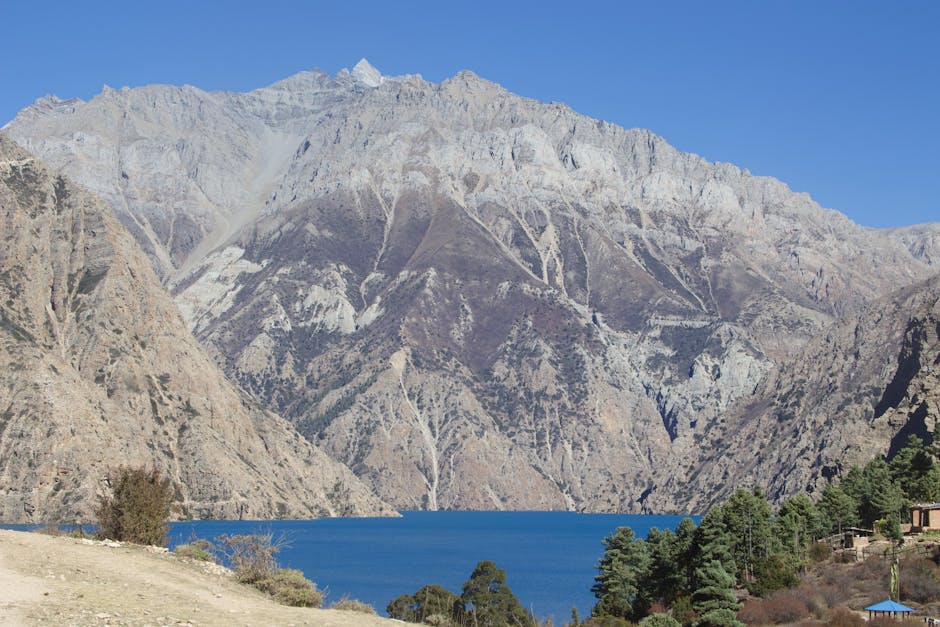
There is a place in Nepal where the maps stop pretending. Where the satellites still struggle, where the helicopters bank low against ridges that have no English name, where the monasteries are older than most countries on earth and the children have never seen a stranger from outside the valley. It is called Upper Dolpo, and almost no one goes there.
That is precisely the point.
For travellers who have already collected the obvious Himalayan trophies — the helicopter to Everest Base Camp, the morning at Bandipur, the long lunch at Dwarika's — Upper Dolpo is not the next destination. It is a different category of experience entirely. To go there is to deliberately step outside the small, well-lit corridor of contemporary luxury travel and into something older, harder, and infinitely more rewarding. It is the only trek in Nepal where the word exclusive is not a marketing flourish but a literal description of who is permitted to enter.
This is what it means to cross Upper Dolpo on the terms it deserves.
What Upper Dolpo Actually Is
Dolpo is a vast, high-altitude region tucked behind the main Himalayan ridge in north-western Nepal, sealed off from the monsoon by the mountains themselves and from the modern world by geography, altitude, and government decree. Lower Dolpo is restricted; Upper Dolpo is severely restricted. To enter the upper region, you must hold a special permit costing roughly five hundred US dollars for the first ten days, you must travel in a registered group, and you must be accompanied by a licensed guide. The permits are capped each season. There are no roads. There is no mobile signal. There is no electricity beyond what your camp brings with it.
The landscape is what people who have never seen it call lunar, which is lazy. It is more interesting than that. The ochre, copper, and bone-white ridges fold into one another like the pages of a book that has been left open in the sun for a thousand years. Yak caravans still move salt and barley across the high passes, exactly as they have done since the Tibetan diaspora settled here in the eighth century. The villages — Dho Tarap, Saldang, Bhijer, Shimen — are some of the highest permanent human settlements anywhere on the planet, sitting between four thousand and nearly four and a half thousand metres of altitude. The people speak a dialect of Tibetan. They practise Bön, the pre-Buddhist animist religion of the high plateau, alongside the older schools of Tibetan Buddhism. In Upper Dolpo, the Cultural Revolution never happened. What you see is what Tibet looked like before 1959.
This is not a metaphor. This is a fact, and it is the single most important reason Upper Dolpo exists in our Ultimate journey tier.
The Three Landmarks That Define the Journey
Three places anchor any serious itinerary in Upper Dolpo, and each of them is, in its own way, unrepeatable.
Shey Phoksundo Lake is the deepest lake in Nepal and arguably the most beautiful body of water in the entire Himalaya. It sits at roughly three thousand six hundred metres, ringed by cliffs that fall straight into the water from over a thousand metres above. The colour is a turquoise so saturated and so improbable that the first time you see it, the brain refuses to accept it as real. It looks like a lake that has been digitally graded for a film. There are no motorboats, no waterfront cafés, no jetties. You hear nothing but wind and the occasional snow leopard track-checker calling to his colleague across the valley. Most travellers who reach it cry. The ones who don't cry usually go very, very quiet. Shey Gompa, the Crystal Monastery, sits at over four thousand five hundred metres on the other side of the Kang La pass. It is roughly eight hundred years old, founded in the eleventh or twelfth century, and it remains one of the most important pilgrimage sites in the Bön tradition. The monastery faces Crystal Mountain, which devotees circumambulate every twelve years in a ritual called the parikrama. To stand inside Shey Gompa, watching the butter lamps flicker against thangkas that have been hanging in that exact spot for half a millennium, is to feel the boundary between religion and geology dissolve. The mountain and the monastery are the same thing. Dho Tarap is the heart of Upper Dolpo's living culture. It is one of the highest permanent human settlements on earth, and it functions today much as it did in the fifteenth century. Visiting families during festival season — Saka Dawa in May or June, or Lhosar at the Tibetan New Year — is a privilege so rare that we structure entire itineraries around the calendar. There are no hotels in Dho Tarap. There is, however, a tradition of hospitality that predates the concept of hospitality as commerce.Why Upper Dolpo Is Harder to Reach Than Mustang
This is the question we are asked most often by guests who already know Upper Mustang and assume Dolpo will feel similar. It will not.
Mustang has a road now. A rough one, built primarily to serve the salt trade with Tibet and the steady increase in Chinese border activity, but a road nonetheless. You can drive into Lo Manthang. You can fly to Jomsom and walk in over a few days. There are now several genuinely refined hotel options — Shinta Mani Mustang most prominently — that have transformed what was, a decade ago, a pure expedition into something approaching a luxury circuit.
Dolpo has none of this. There is no road into Upper Dolpo. The only realistic access is by helicopter into the small airstrip at Juphal, followed by either further helicopter staging or several days of walking across high passes with full camp support. The infrastructure is, by design, almost non-existent. There are basic teahouses in lower Dolpo and a handful in the upper region, but they are simple in a way that even adventurous travellers occasionally find sobering. To experience Upper Dolpo at the standard our guests expect, you cannot rely on what is already there. You have to bring it with you.
This is the central operational reality of any luxury trek in Upper Dolpo, and it is why so few operators in the world will even attempt it.
What Luxury Actually Means in Upper Dolpo
The temptation, when designing a journey of this calibre, is to define luxury in the language of urban hotels. That language does not work here. There are no chandeliers. There are no marble bathrooms. The nearest five-star property is roughly a week away by foot.
Luxury in Upper Dolpo means something else. It means a private helicopter waiting for you at the moment the weather window opens, not the moment a commercial flight is theoretically scheduled. It means a base camp that is air-lifted into position before you arrive, with goose-down bedding, hand-stitched canvas tents, a full kitchen, and a wood-fired hot bucket bath waiting at the end of every day. It means a chef who travels with the expedition and who has cooked at properties whose names you would recognise immediately. It means a private physician with high-altitude experience. It means a permit and logistics team that has been working for three months before your arrival to ensure that every village you pass through is expecting you, that every monastery is prepared to receive you, that every herdsman whose pasture you cross has been thanked in advance.
It means oxygen. Quietly, unobtrusively, but available.
It means the freedom to change the itinerary on the morning of any given day because the light over Shey is suddenly impossible and you want to spend two more nights there, and the answer is yes, of course, here is how we will do it.
This is a very specific definition of luxury. It is the one we believe in, and it is the only definition that makes sense in a place like Upper Dolpo. Read more about how we approach this in our design philosophy.
The Best Time to Go
Upper Dolpo has a famously narrow weather window. The two viable seasons are mid-April through early June, and mid-September through late October. Outside these windows, the high passes — particularly Kang La at roughly five thousand four hundred metres and Saldang La at five thousand metres — are either snowed in or unsafe. The summer monsoon, which dominates most of Nepal between June and September, largely spares Dolpo because it sits in the rain shadow behind the main Himalayan range. This is what makes spring and autumn so reliable, and it is also what gives the region its distinctive arid landscape.
May is, in our considered view, the most extraordinary month. The wildflowers in the valleys around Phoksundo are at their peak. The festival of Saka Dawa, which commemorates the Buddha's enlightenment, frequently falls in May or June and is celebrated in Dho Tarap with monastic dances that have not changed in eight hundred years. The light is impossibly clean. The nights are cold but never punishing. We tend to recommend a late May departure for guests who want to combine the trek with a festival window.
Autumn — late September into mid-October — offers the clearest mountain views of the year. The post-monsoon air is washed and brilliant. The harvests are coming in, the villages are at their fullest, and the cultural texture of daily life is most vivid. The trade-off is that the high passes can begin to ice over earlier than expected in years of early winter.
For a deeper look at how the season shapes the experience across all of Nepal, our season-by-season guide is the most thorough resource we publish.
Who Upper Dolpo Is For
It is worth being honest about this, because it matters.
Upper Dolpo is not the right journey for every guest. It rewards a particular kind of traveller — someone who finds the absence of cellular signal a feature rather than an inconvenience, who is willing to walk between five and seven hours a day at altitude for ten or twelve days, who reads Peter Matthiessen's The Snow Leopard not as a curiosity but as a manual, who understands that the most exclusive thing in the world is not a private jet but a silence that no one else has access to.
It is for guests who have already done the obvious, and who are now looking for what comes after the obvious.
It is, in our experience, the journey that changes people most. Every guest who has crossed Upper Dolpo with us has come back different. Quieter. More patient. More aware of what is essential and what is decorative. We are not a wellness brand, and we are not interested in the language of transformation as marketing. But the transformation in Dolpo is real, and it is one of the reasons we keep designing these journeys despite the operational difficulty.
How We Build the Journey
A typical Upper Dolpo expedition with us runs sixteen to twenty-one days from arrival in Kathmandu to departure. The first two days are spent acclimatising in Kathmandu — staying at Dwarika's, paying respects at Boudhanath at dawn, meeting the head of the expedition team. The third day involves a charter flight to Nepalgunj and onward to Juphal. From there, the trek properly begins.
We typically build itineraries around three anchor experiences: at least four nights at or near Phoksundo Lake; a multi-day stay at Shey Gompa with full access to the resident monks; and a festival window in Dho Tarap or Saldang. The exact route is shaped around the guest's appetite for trekking, the festival calendar of the year, and the weather. Helicopter staging is used to compress travel days, to evacuate a high pass if conditions deteriorate, and — in our experience, the most important use — to give guests an additional day at a place that has moved them, without losing the rest of the itinerary.
We never run more than one Upper Dolpo journey at a time. The region cannot absorb more than that and remain what it is.
A Final Note
There is a moment, usually around the seventh or eighth day, when guests stop asking questions about the schedule and start asking questions about Bön cosmology, or the difference between the Sakya and Nyingma traditions of Tibetan Buddhism, or what the herdsmen sing to their yaks at dusk. That moment is the entire point. Everything before it is logistics. Everything after it is the reason you came.
If Upper Dolpo is the journey you have been waiting for — and many of our most discerning guests tell us, in retrospect, that it was — we would be honoured to design it for you.
Begin designing your journey →To understand the philosophy behind every itinerary we build, you may also wish to read about our founder and the Greek-to-Nepal story that shapes everything we do.