Update, 2 September 2026: after the Rasuwa flood of 26 August 2026, Gosaikunda, the Langtang valley and the road to Syabrubesi are closed until further notice. Read what is open now and how we are travelling Nepal this autumn.
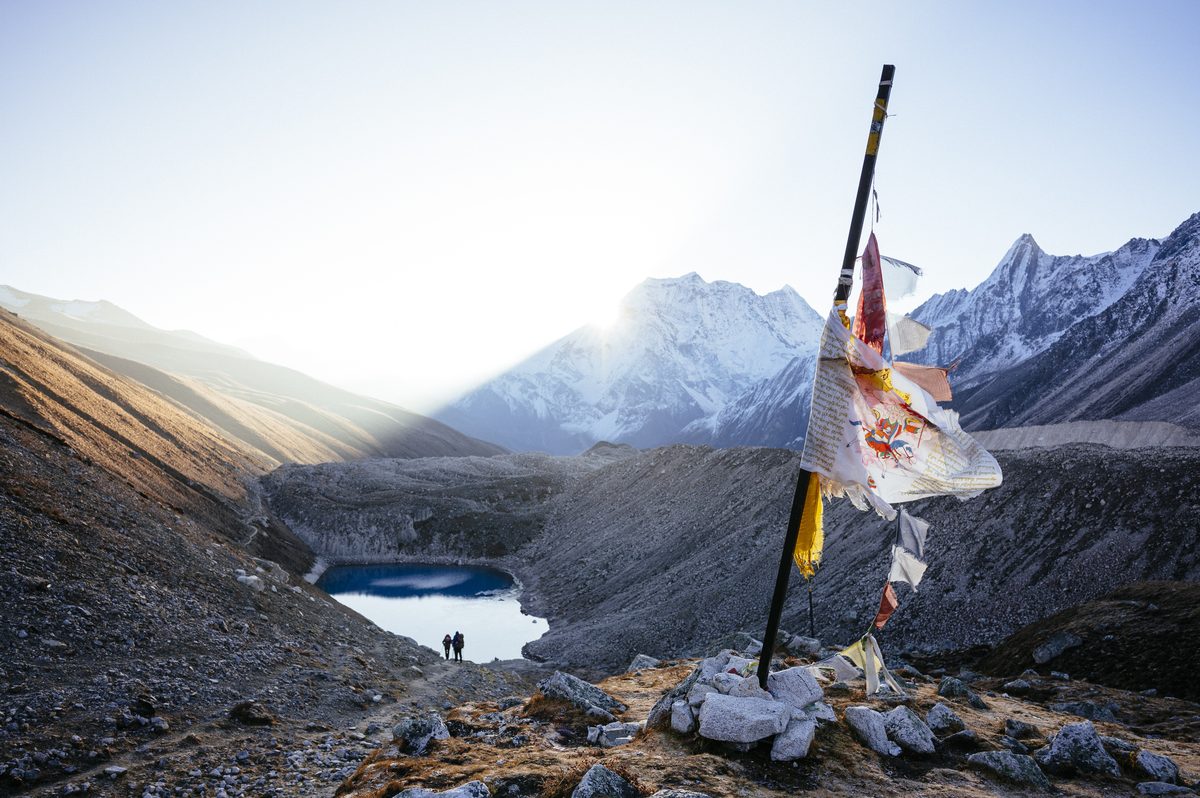
There is a moment on the climb above Chandanbari — somewhere past the last of the rhododendron, where the forest gives up and the ridgeline takes over — when you crest a rise and the lake simply appears. No warning. No slow reveal. One step you are walking on grey scree under a hard blue sky, and the next there is a body of water below you the colour of melted turquoise, ringed by stone, absolutely still, with a spine of snow peaks standing behind it like witnesses.
Nobody speaks. In my experience, nobody ever does. Not the pilgrims who have walked three days barefoot to reach it, and not the traveller who arrived by helicopter that morning with a thermos of coffee still warm in the vehicle behind. Gosaikunda flattens the distinction between them for a moment, and then hands it back.
This is Nepal's most sacred alpine lake, and the strange truth of it is this: the Gosaikunda luxury trek barely exists. Thousands of Hindu pilgrims make this journey every August. Trekkers on a budget have walked it for forty years. But almost no one has designed it properly — with the comfort, the pacing and the interpretation that a place of this magnitude deserves. That gap is not a failure of the mountain. It is an invitation.
Where Gosaikunda Is, and Why It Matters
Gosaikunda sits at 4,380 metres in Langtang National Park, roughly north of Kathmandu and close enough to the Tibetan frontier that the culture on the trail is more Himalayan than Nepali in any lowland sense. It is not a single lake but the principal jewel in a cluster — a high basin holding, by tradition, one hundred and eight sacred water bodies, of which perhaps a dozen are readily visible: Saraswati Kunda, Bhairav Kunda, Surya Kunda, Naag Kunda, each named for a deity or a force, each holding its own particular silence.
The geography is generous in a way the Everest and Annapurna regions are not. From the trailhead at Dhunche, you can be standing on the shore of Gosaikunda within a few days of walking — no punishing three-week commitment, no chain of high passes to survive first. And yet the altitude is genuine, the scenery is genuinely Himalayan, and the crowds are a fraction of what you would encounter on the Everest trail in October.
For travellers who want the true high Himalaya without surrendering a month of their lives to it, this is one of the most efficient exchanges of time for wonder in all of Nepal. It is the same logic that draws so many of our guests toward the shorter, sharper journeys on our destinations — the understanding that scale is not the same as depth.
The Story the Water Carries
You cannot understand Gosaikunda as landscape alone. To the Hindu world, this is not a lake. It is evidence.
The story belongs to the churning of the cosmic ocean, when the gods and demons together turned the sea to draw out the nectar of immortality and drew out, first, a poison so virulent it threatened every living thing. Shiva drank it to save creation. It burned in his throat — turning it blue, giving him the name Neelkantha — and in his agony he struck the mountainside here with his trident, and the water that came forth cooled him.
It is a story about swallowing something terrible so that others need not. Whatever your own metaphysics, it is difficult to stand at 4,380 metres beside water that a civilisation has believed for two thousand years was created by an act of self-sacrifice, and feel nothing. This is what I mean when I speak of experiential wealth rather than tourism. You are not looking at a view. You are standing inside somebody's cosmology.
Janai Purnima: The Most Extraordinary Week
Each year, on the full moon of the month of Shrawan — falling in August — tens of thousands of pilgrims converge on this basin for Janai Purnima. Hindu men renew the sacred thread, the janai, worn across the chest. Shamans, the jhankris, come up from the villages in headdresses of peacock feathers, drumming and dancing along the shoreline in a rhythm that does not stop for hours. Devotees enter water cold enough to steal your breath.
I will be direct with you, because that is what this work requires: Janai Purnima is not a comfortable time to visit. The trail is crowded, the lodges are overwhelmed, and the basin is loud. It is also, without question, one of the most astonishing pieces of living religious theatre on the Asian continent, and I have designed journeys around it for travellers who wanted precisely that — with a private camp established well away from the main shore, our own kitchen, our own staff, and a scholar walking with us who could explain what was unfolding and why. Handled well, it is unforgettable. Handled badly, it is simply a difficult night in a crowd.
Knowing which travellers belong there, and which belong in the quiet of late October, is most of my job.
What "Luxury" Actually Means at 4,380 Metres
Let me dispense with a certain fantasy immediately. There is no five-star hotel at Gosaikunda. There will not be one. The lodges along this route are honest mountain teahouses — plywood, a stove in the dining room, a bucket of hot water if you ask early. Anyone who promises you marble at this altitude is selling something that does not exist.
Real luxury on this trail is a different substance altogether, and it is built from four things.
The first is the approach. The conventional journey begins with a seven-to-nine-hour drive from Kathmandu to Dhunche on a road that will remove any romance you brought with you. We do it differently: a private helicopter transfer that reduces that grinding day to a matter of minutes, delivering you to the trailhead rested rather than wrecked, with the whole Langtang range unrolling beneath you on the way in. It is the single highest-value decision in the entire itinerary, and it costs you a morning instead of a day. The second is pacing. The great danger on this route is not difficulty — it is speed. The standard itinerary hauls travellers from roughly 1,960 metres at Dhunche to 4,380 metres at the lakes in about three days. That is aggressive, and it is why so many people arrive at the most sacred lake in Nepal with a splitting headache and no appetite for transcendence. We build in an extra night, almost always at Chandanbari, and we do it deliberately. Altitude sickness is not a badge of authenticity. It is a planning error. The third is everything that arrives before you do. A crew moving ahead of you means your room is warm when you reach it, your bedding is yours rather than the lodge's, and dinner is cooked by our own chef with produce carried up rather than whatever the kitchen has left. It means oxygen and a satellite communication system in the party as a matter of course, never as a special request. It means a guide who has walked this basin dozens of times and can tell you which lake is which, and what each one is for. The fourth is what surrounds it. Nights at Dwarika's before and after. A private day in the Kathmandu Valley to decompress. A massage, in Kathmandu, on the evening you come down, which I promise will rank among the more memorable hours of your life. This architecture — the hard, beautiful centre held inside a shell of genuine comfort — is the essence of how we build our Premium journeys.The Journey, Section by Section
The route has a clear internal logic, and understanding it helps you understand what you are choosing.
Dhunche to Chandanbari
From the trailhead the path climbs steeply through oak and hemlock, then into rhododendron forest that in spring turns the entire hillside red and pink and white. Chandanbari — also called Sing Gompa — is a small settlement with a Buddhist monastery and, improbably and wonderfully, a yak cheese factory that has been operating for decades. The cheese is excellent. The monastery, at dusk, with the wind moving through the trees below, is the first moment on this trail where you feel the altitude in your chest and the quiet in your head at the same time.
Chandanbari to Lauribina
Above Chandanbari the forest thins and then ends, and the trail opens onto a long ridgeline walk with the view swinging north to the Langtang massif, crowned by Langtang Lirung at 7,227 metres, and south across a sea of foothills that on a clear morning appear to run all the way to India. On the finest days you can see the Annapurnas and Manaslu from this ridge. It is one of the great walks in Nepal, and hardly anyone talks about it.
Lauribina to the Lakes
The final approach crosses stony ground scattered with cairns and prayer flags. You pass Saraswati Kunda first, then Bhairav Kunda, and then Gosaikunda itself opens below the path. There is a small stone shrine at the water's edge and, in the middle of the lake in the drier months, a rock formation that pilgrims hold to be Shiva himself, resting.
We arrive in the early afternoon and stay. That is a deliberate choice, and it is where the luxury lives: not in the walking but in the hours afterward, when the day-trippers have gone down and the light turns from white to gold to that peculiar high-altitude violet, and the lake goes so still that the peaks are reproduced in it exactly.
Onward, or Down
From the lakes, the route may be reversed to Dhunche or continued over the Laurebina La at roughly 4,610 metres, descending into the Helambu valley on the far side — a longer traverse that ends among Sherpa and Tamang villages and Buddhist monasteries, and finishes far closer to Kathmandu than you would expect. For those with the time, it is the more elegant conclusion. For those without, a helicopter lift from the lakes themselves ends the journey on the highest possible note — an option we routinely fold into our Ultimate journeys.
When to Go
Late September through November is the finest window, without argument. The monsoon has washed the air clean, visibility is extraordinary, and the temperatures at the lakes remain manageable. March through May is the second season and belongs to the rhododendron — the forest below Chandanbari becomes something close to hallucinatory in April.
August brings Janai Purnima, discussed above, with everything that implies. Winter, from December to February, freezes the lakes solid and closes the high route to all but the genuinely committed — though the sight of Gosaikunda under ice, with almost no other human being present, is an image I have never quite been able to shake.
Who This Journey Is For
I do not recommend Gosaikunda to everyone, and I would rather tell you that now than after you have booked.
It suits the traveller who has already seen the obvious Himalaya and wants something with a pulse of meaning running through it. It suits those drawn to sacred landscape — Kailash, Mount Athos, Santiago — who understand that a pilgrimage route feels fundamentally different underfoot from a scenic trail. It suits a fit person with limited time who wants genuine altitude and genuine remoteness inside a compact number of days. It works beautifully as a second Nepal journey, after the Classic route through Kathmandu, Pokhara and the Annapurna foothills has already given you the country's shape.
It does not suit anyone looking for luxury as upholstery. The teahouses are basic. The trail is steep in places. What we can guarantee is that every element within human control will be handled impeccably, and that the elements outside it — the weather, the altitude, the mountain's mood — will be met with judgement earned over years rather than optimism.
A Personal Note
I came to Nepal from Greece, from a country with its own long habit of building shrines in high and difficult places, where getting to the holy thing has always been part of the holy thing. The first time I walked up to Gosaikunda I recognised something I had known since childhood in an entirely unfamiliar landscape. That recognition is more or less why I do this work, and if you would like the longer version, my story is here.
What I can tell you is that the people who come back down from those lakes come down changed in some small, specific way they usually cannot articulate at dinner that night. They articulate it months later, in an email, out of nowhere. That is the only measure of this work I have ever found worth trusting.
The mountain is not going anywhere. But the version of you that would be transformed by standing beside that water is not permanent, and that is worth considering.
When you are ready, let us begin designing your journey — and walk to the lake that a god is said to have opened with his own hands.