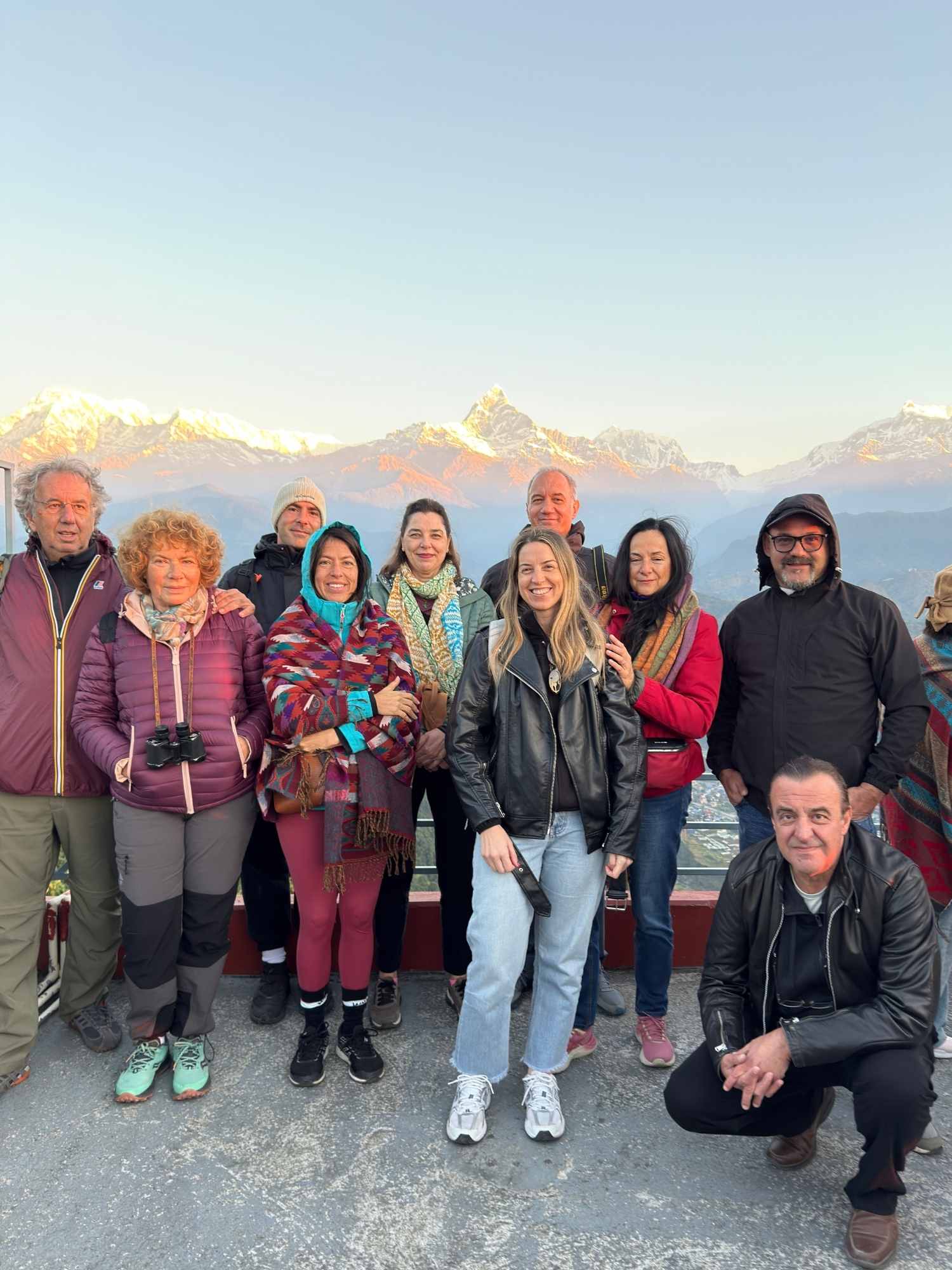
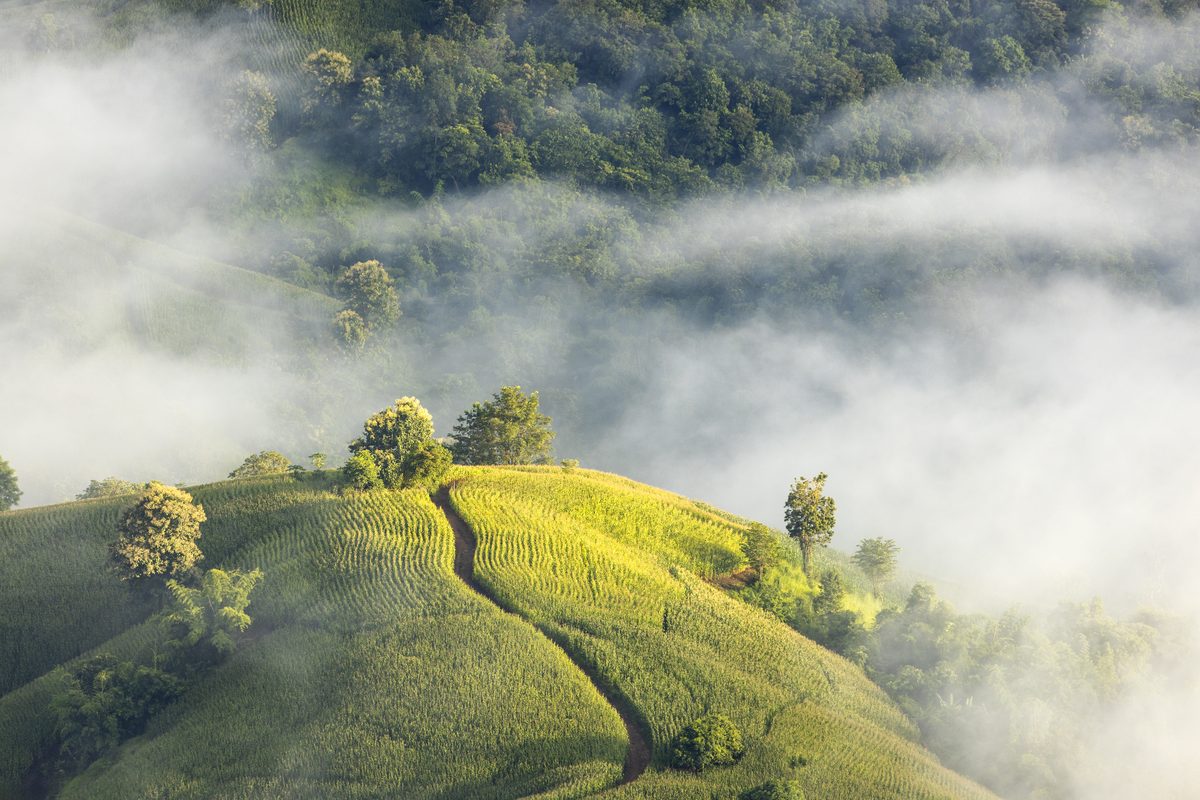
At twenty to six in the morning, on a ridge called Antu Danda, the light does something I have never adequately described to anyone.
The valley beneath you is full — not misted, full — of cloud, so that the tea hills emerge from it like islands. To the north-west, Kanchenjunga takes the first sun and turns the colour of a struck match, and because the massif genuinely resembles a reclining figure, the local name for it is the Sleeping Buddha. Then, somewhere below, a radio starts playing in a village you cannot see, and by six-fifteen the pickers are already moving through the rows in a slow diagonal line, and the whole thing smells — extraordinarily — of wet green leaf and woodsmoke and cardamom.
This is Ilam. It is in Nepal. And in twenty years of designing journeys in this country, it remains the single place I have the hardest time convincing people to visit — right up until the morning they stand on that ridge, at which point I never have to say another word about it.
This is the case for Ilam's tea gardens as a luxury journey: the most underestimated few days in Nepal, and the one I most often add to an itinerary that its owner thought was already finished.
Where Ilam Is, and Why Almost Nobody Goes
Ilam is the far eastern hill district of Nepal, in Koshi Province, pressed directly against the border with the Indian state of West Bengal. Look at a map with fresh eyes and the geography stops being obscure and becomes obvious: the ridge on the far side of Ilam's tea is Darjeeling. Same hills. Same elevation band — roughly 1,000 to 1,800 metres for the gardens themselves. Same monsoon, same mineral soil, same mountain above them.
The reason almost no one goes is not quality. It is routing. Nepal's tourism runs on a triangle — Kathmandu, Pokhara, the Everest and Annapurna ranges — and Ilam sits a full country's width east of all of it, reachable only by a flight most visitors have never heard of. That is the entire explanation. It is not that Ilam has been judged and found wanting. It is that it has never been on the way to anywhere.
Which is precisely why it feels the way it does. There is no tourist infrastructure to speak of, no hawkers, no menu in four languages. You will be, on most mornings, the only foreign traveller on the ridge.
The 1863 Story, and the Injustice Underneath It
Tea came to Nepal in 1863, and the story has the pleasing improbability that the best origin stories do.
The Chinese emperor sent tea seeds as a diplomatic gift to Jung Bahadur Rana, then Nepal's prime minister. His son-in-law, Colonel Gajraj Singh Thapa, had seen the plantations across the border in Darjeeling, understood immediately what the hills of Ilam were, and planted the country's first estate there. The Ilam Tea Estate still stands. Some of the bushes you will walk between are, remarkably, descendants of that original planting — and the trees shading them have been doing it for a century and a half.
Then comes the part that matters commercially, and which I find genuinely moving.
For most of the twentieth century, Nepal's finest orthodox tea did not leave the region under its own name. It crossed the border, was blended into Darjeeling lots, and was sold to London and Hamburg and Tokyo as something else. The soil was Nepali, the labour was Nepali, the leaf was — by the assessment of any honest taster — frequently the equal of what it was blended into. The name on the tin belonged to someone else.
I am Greek. I do not need this explained to me. We have watched our olive oil leave in tankers and come back in Italian bottles for three generations. When a Nepali estate owner tells you this story over a second cup, standing in a room that smells of drying leaf, you are not hearing a marketing grievance. You are hearing a country arguing for the right to its own name — a fight Nepali orthodox tea has, in the last decade, finally begun to win under its own collective mark.
That conversation is, for me, the actual reason to come here. The scenery is the excuse.
What You Actually Drink
Nepal produces two entirely different products, and knowing which is which changes everything about what you taste here.
CTC tea — crush, tear, curl — is grown in the flat terai belt of Jhapa below, and it is the strong, brisk, granular tea that most of the subcontinent drinks with milk and sugar every morning. It is not what you have come for. Orthodox tea is the high-hill product, whole-leaf, hand-plucked, rolled rather than shredded, and grown in Ilam, Panchthar, Dhankuta and Terhathum. This is Nepal's world-class agricultural export, and it moves in seasons the way a vineyard does. First flush, roughly March into April, is the spring pluck after winter dormancy — pale in the cup, floral, high, almost green in character, and the harvest that dedicated buyers wait for. Second flush, May into June, is the one connoisseurs argue about. This is where the muscatel note arrives: a rounder, honeyed, faintly grape-like depth that only these hills at these altitudes produce. If you drink one Nepali tea in your life, make it a good second flush. Monsoon flush, through the summer rains, is bolder and less refined — the workhorse. Autumn flush, October into November, is my own quiet favourite: darker, coppery, more amber than gold, with a settled quality that the spring teas do not yet have.To sit in a tasting room in Ilam with the estate's manager, working across a line of five cups from the same field in the same year, is a completely different experience from being handed a cup on a tour. It is the tea equivalent of a vertical tasting, and it takes about ninety minutes, and it will permanently ruin supermarket tea for you. This is exactly the kind of thing our luxury food and gastronomy journeys are built around.
Beyond the Gardens
Ilam would justify three days on the tea alone. It does not have to.
Antu Danda, at around 2,300 metres, is the sunrise ridge — the one described at the top of this piece. Kanchenjunga, the world's third-highest mountain, sits on the horizon, and on the clearest winter mornings the view runs all the way down to the plains of India. You leave in the dark. It is worth every minute of it. Kanyam and Fikkal are the estates most people photograph — vast, immaculately contoured green slopes that genuinely do look like they have been combed. Kanyam in late afternoon, when the light goes long and low across the rows, is one of the most beautiful agricultural landscapes I have stood in anywhere, including in my own country. Mai Pokhari is a small, dark, nine-cornered lake in a forest above the town, sacred to Hindus and Buddhists alike and protected as a Ramsar wetland since 2008. It is quiet in a way that is almost startling — cool, mossy, thick with rhododendron and orchid and birdsong. Half a day, unhurried, at most. Sandakpur, on the border ridge above Ilam at around 3,600 metres, is the great secret. From the top, on a clear morning, you can see four of the world's five highest mountains at once — Everest, Kanchenjunga, Lhotse and Makalu — in a single 180-degree sweep. It is reached by a rough jeep track and it is genuinely cold up there, and it is, without qualification, one of the finest viewpoints in the Himalaya.And beneath all of it, everywhere, cardamom. Ilam is one of the world's great producers of large black cardamom, and the drying sheds perfume entire valleys in autumn. There is no equivalent smell anywhere in Nepal.
When to Come
October to early December is the finest window overall. Post-monsoon air gives the clearest possible Kanchenjunga, the autumn flush is being processed, the cardamom is drying, and the hills are still fully green. If you come once, come now. February to April is the second window and the most beautiful for the gardens themselves: first-flush plucking, pickers working the rows daily, factories running, and rhododendron in flower above the tea line. Slightly hazier mountain views, considerably more agricultural life. May and June deliver the second flush and the best cup of the year, with humidity and haze as the trade. For a serious tea traveller, still worth it. Late June to September is the monsoon: spectacularly green, frequently invisible, and roads that will test your patience. We do not schedule Ilam then. The full national picture is in our season-by-season guide to Nepal.What Luxury Honestly Means Here
I want to be precise about this, because the honest answer is more interesting than the flattering one.
There is no five-star hotel in Ilam. There will not be one soon. Anyone who tells you otherwise is selling you a photograph of somewhere else.
What exists instead — and what we build — is something I have come to think of as the more valuable version of luxury: total control of the experience in a place that has not been arranged for you.
Private estate access. The difference between visiting a tea garden and being received by one is absolute. We arrange the plucking, the factory floor at the hour it is actually running, and the tasting with the person who made the tea — not with a guide reciting it. The best rooms in the district, properly prepared. Ilam's accommodation is boutique and family-run at its top end, and it is genuinely charming. We book it out, upgrade the bedding, send ahead what needs sending ahead, and place our own team in it. Or a private camp. For clients who want a specific view rather than a specific address, a full private tented camp on an estate ridge — proper beds, a dedicated cook, heating, a dining tent facing Kanchenjunga — outperforms any hotel that could plausibly be built here. This is the same architecture as our luxury camping journeys, and in Ilam it is frequently the right answer. A chef who travels with you. Eastern Nepali food is superb and under-documented — Limbu and Rai kitchens, fermented greens, wild honey, river fish, buffalo churpi. Paired with the estate's own teas across a meal, it is one of the most memorable tables in the country. That takes a chef who knows the region, and we bring one. Compressed logistics. Private aircraft to Bhadrapur, vehicles and drivers who know the border roads, and a helicopter option that turns a five-hour transfer into forty minutes. In a district this remote, time is the luxury good.This shape of journey sits naturally within our Premium tier; with private helicopter movement, a chartered camp and full estate exclusivity, it becomes an Ultimate component. Ilam is also one of the very few additions that makes a Classic journey feel genuinely bespoke rather than merely well-run.
Getting There
Fly Kathmandu to Bhadrapur — about forty-five minutes, over the whole eastern Himalaya if you sit on the right side — then drive roughly two and a half to three hours up into the hills through the tea belt. The ascent itself is part of the journey: terai heat and rice below, then cardamom, then the first green shoulders of tea, then cloud.
For those who would rather not spend the afternoon on a road, a private helicopter from Bhadrapur to Ilam is straightforward and, in October and November, spectacular.
Three nights is the honest minimum. Four is right. Five if you are adding Sandakpur, and I would.
What It Costs
Ilam is, by the standards of luxury Nepal, remarkably good value — because you are not paying a room rate for a brand, you are paying for access and logistics.
A well-designed private four-night Ilam journey — private guiding throughout, estate access and private tastings, best-available accommodation on exclusive-use terms, a travelling chef, all transfers and domestic flights, and full support — typically runs €3,200 to €5,500 per person, based on two travelling together.
Add a private helicopter for the Bhadrapur transfer, a full private tented camp on an estate ridge, and the Sandakpur excursion with a dedicated 4×4 team, and the figure moves toward €7,000 to €9,000 per person. Our wider breakdown of what a luxury trip to Nepal really costs puts that in national context.
Most clients do not travel to Ilam alone. It attaches beautifully to Kathmandu at the start and, with a single flight, to almost anything else in the country — the full range is laid out across our destinations.
Why This One Stays With People
I have watched clients come off Everest Base Camp, off the Mustang road, out of a helicopter at four thousand metres. Those journeys deliver something enormous and they deliver it loudly.
Ilam does the opposite, and it is the reason I keep putting it in front of people who did not ask for it.
There is a morning, usually the third one, when a guest stops photographing the rows and simply sits on the edge of the ridge with a cup of the estate's own second flush, watching a line of women work across a hillside their grandmothers worked, with the third-highest mountain on earth going gold behind them, and says nothing at all for about twenty minutes.
That is the whole thing. No summit, no certificate, no adrenaline. Just an extremely specific place, entered properly, at the right hour, with nothing in the way.
That is what I mean by experiential wealth: not the accumulation of spectacle, but the acquisition of a few hours you will still be able to describe, precisely, in thirty years. Nepal is exceptionally good at producing them, and Ilam produces them more cheaply and more quietly than anywhere else in the country. If you would like to know why a Greek spent his life building journeys around moments like that one, my story is here.
Begin
The autumn 2026 window — clearest air, autumn flush, cardamom drying — runs from early October into December, and the estates worth being received by are arranged personally, months ahead.
Tell me what your Nepal is going to be, and whether there is room in it for four slow days at the eastern edge of the country. If there is, I will build them properly: the right ridge, the right hour, the right cup, and someone waiting for you who has made tea on that hillside for forty years.
Let us begin designing yours. Bring nothing. The best thing here is already in the cup.