Update, 16 October 2026: some details in this article date from 5 September and have changed. The Kathmandu–Pokhara road is open again: Krishnabhir since 17 September, while a new subsidence at Galaundi on 9 October closed the road for two days. Langtang is gradually reopening from Thulo Syabru, with no official announcement yet. Manaslu was hit by a new flood on 11 October: the lower trail is damaged and Tsum Valley is closed. See what applies today.
There is a stretch of the Prithvi Highway at a place called Krishnabhir where, for as long as I have lived in this country, the road has run along a shelf above the Trishuli. As of 5 September, roughly two hundred metres of that shelf is not there any more. The river undercut the slope beneath it during the flood of 26 August and the road went into the water.
I live in Pokhara. That highway is how I used to get home. Since 4 September the Department of Roads has been cutting a three-hundred-and-fifty-metre temporary track into the hillside above the collapse; the engineer on site expects seven to ten days, and the government is targeting a reopening within September. Until that reopening is announced officially, the road is closed, traffic is being diverted to alternative routes, and Nepal Police advises against non-essential long-distance travel. I have set out what is open and what is closed across the whole country in the article I keep current on the Rasuwa flood, and I update it as the picture moves.
So for the first weeks of this autumn there is one honest answer to the question of how you get from Kathmandu to Pokhara, and it is that you fly. Twenty-five minutes. The domestic network is operating normally and has been throughout.
What follows is the part I find more interesting, and the part that outlasts this particular season: we would have flown you anyway.
The road, when there is a road
I want to be fair to the Prithvi Highway, because it is a beautiful piece of engineering in places and because it will reopen.
In a good year the drive takes six to seven hours. In a bad one — a festival weekend, a lorry across the carriageway at Mugling, a slope that has come down in the night — it takes eleven, and nobody can tell you at breakfast which day you are going to have. The road follows the Trishuli for most of its length, which is exactly why it is spectacular and exactly why it is fragile. A river that carves a gorge worth driving through is a river that is still carving.
I have made that drive more times than I can count. There is a moment about two hours out of Kathmandu, where the valley opens and the water goes a colour of green you do not quite believe, that is genuinely one of the loveliest half-hours of road in Asia. And there is another moment, usually around hour eight, in the dark, behind a queue of freight, when you understand that you have spent an entire day of a fourteen-day journey looking at the back of a truck.
That is the arithmetic that matters. Not comfort. Time.
Why twenty-five minutes is not really about twenty-five minutes
Guests sometimes assume that when we put a flight into an itinerary we are buying them a softer day. We are not. We are buying them a day.
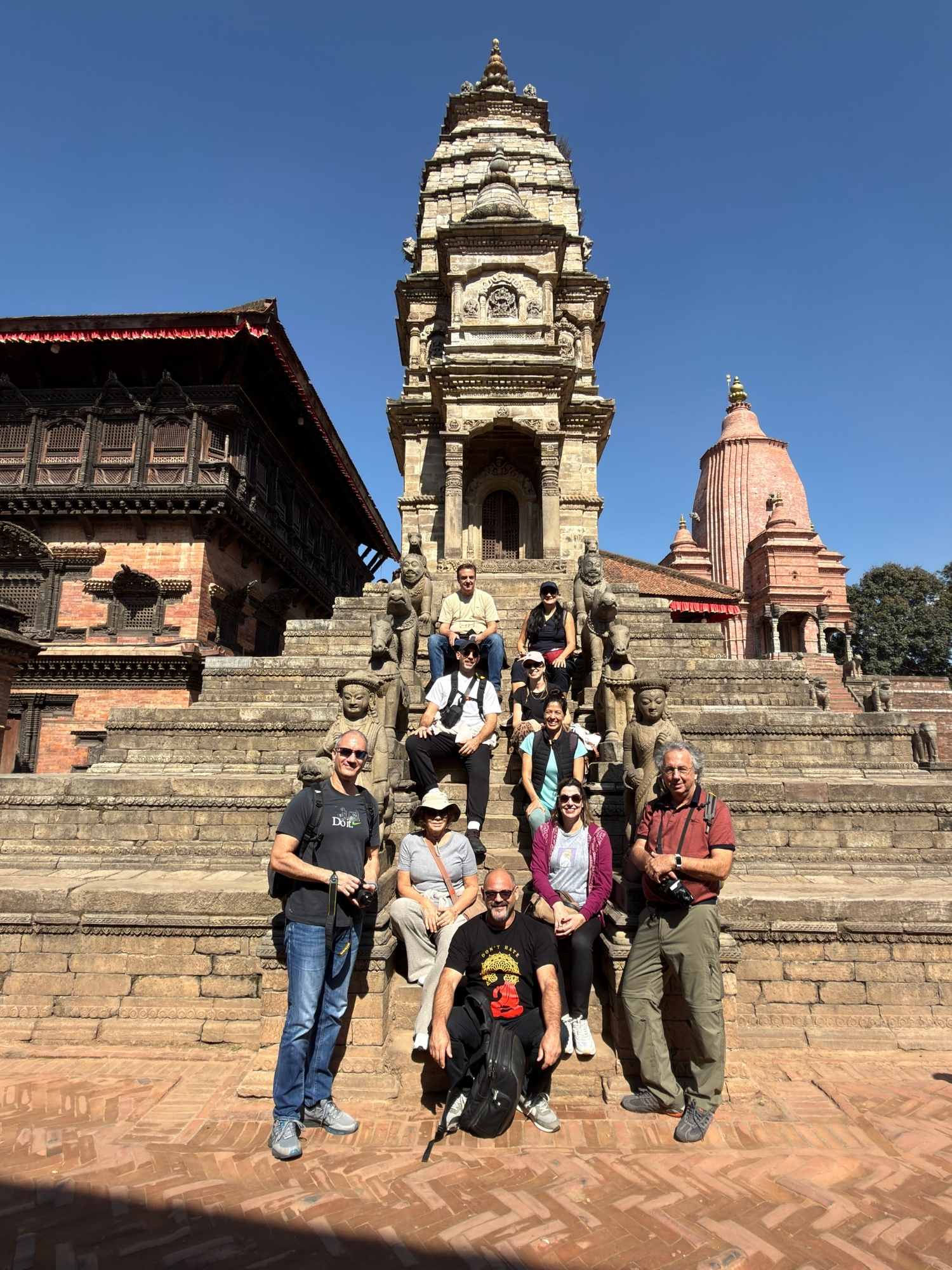
Consider what the two versions actually contain. The road version is a departure at six in the morning, a packed lunch, a service station somewhere past Mugling, an arrival at Lakeside in the late afternoon if the day has gone well, and an evening in which the only ambition anybody has left is dinner and bed. The flight version is a leisurely morning in Kathmandu — Patan in the good light, when the courtyards are still quiet and the metalworkers have their shutters half up — an early afternoon flight, and a first evening in Pokhara that is a real evening. Phewa Lake at dusk. The Annapurnas turning pink and then grey while you are still holding a drink. Dinner that is not a collapse.
You did not save six hours. You gained an afternoon in Patan and an evening on the water, and you removed the possibility that the whole of it evaporates because of a lorry at Mugling.
That is the entire philosophy of how I design journeys, compressed into one leg. Time in Nepal is the scarce resource. Everything else is negotiable.
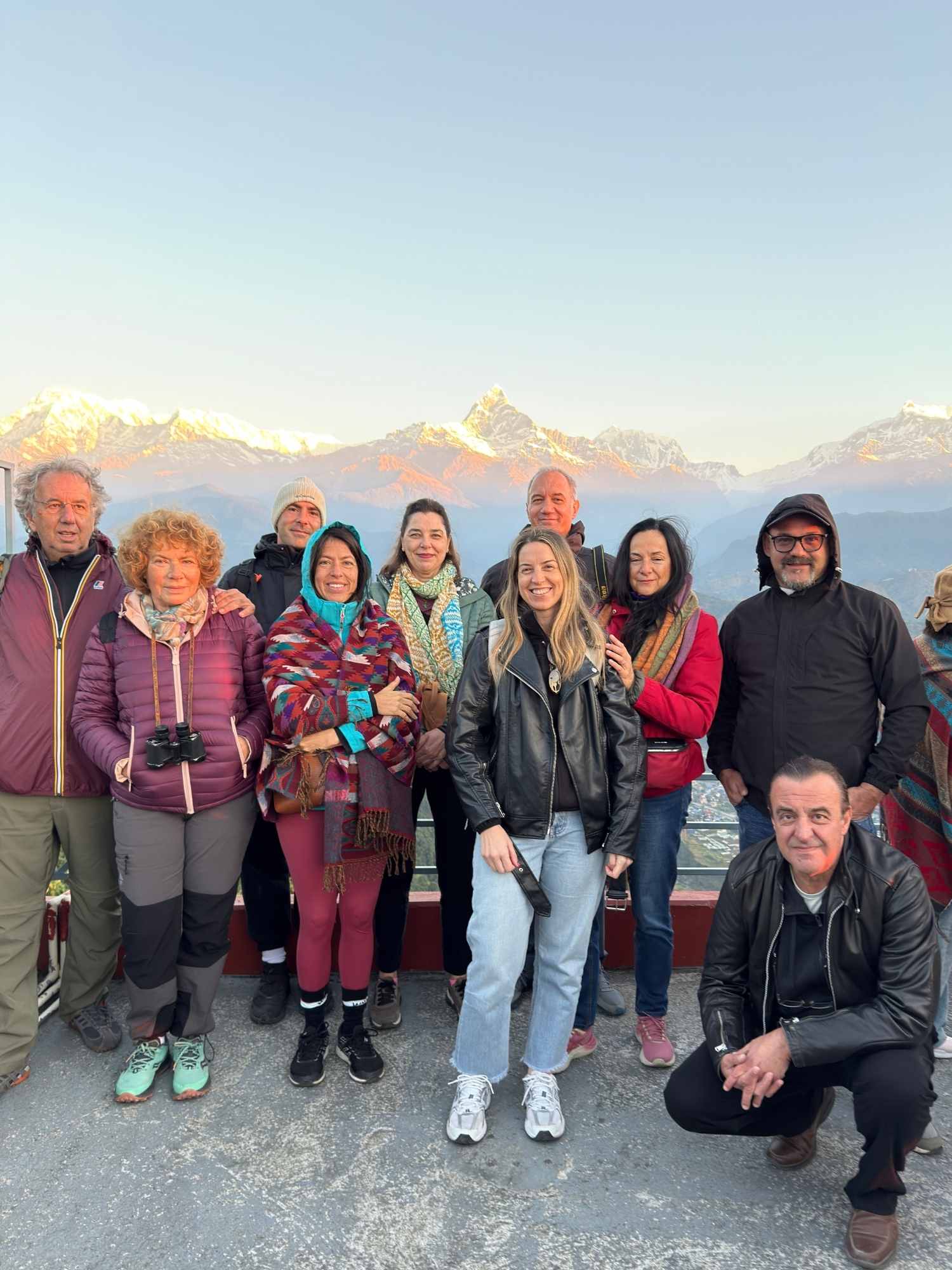
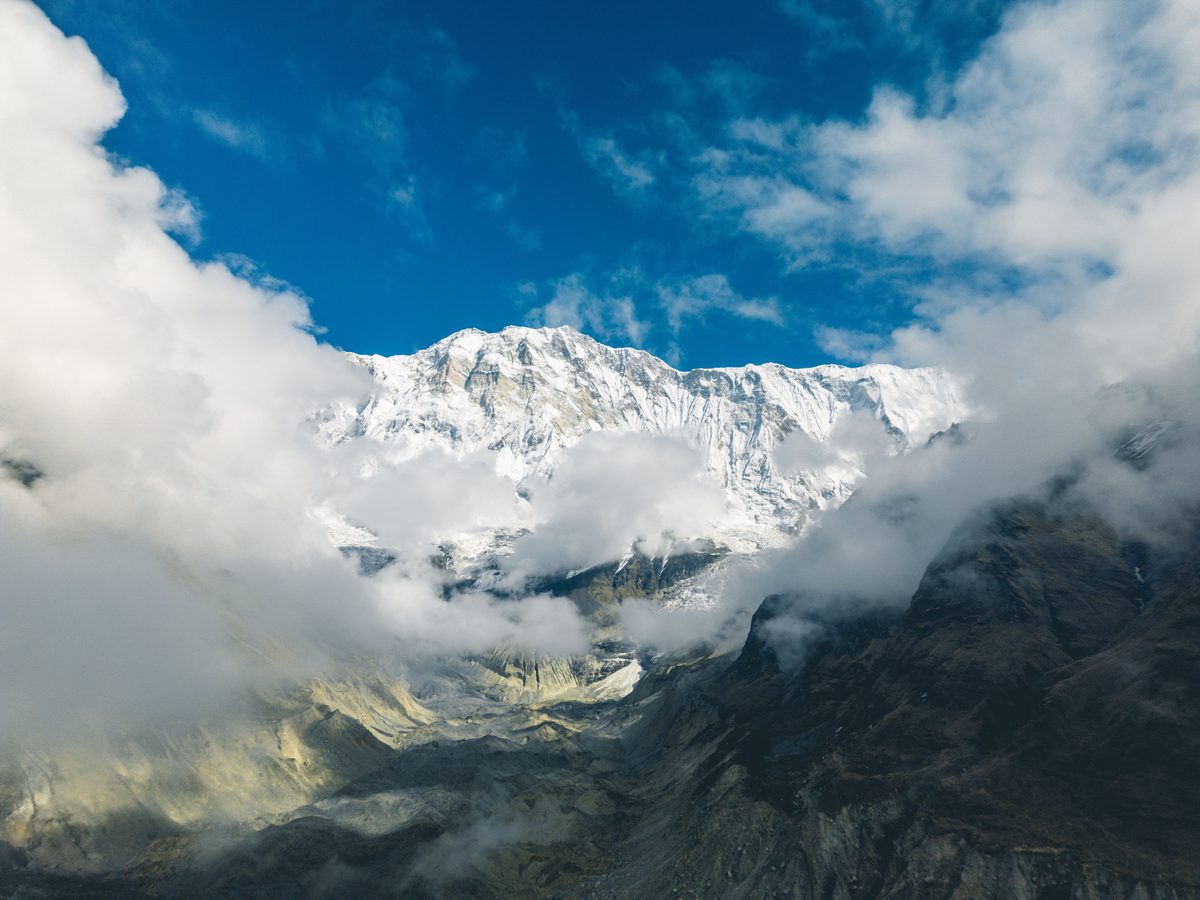
And there is a second thing that flight gives you, which I would pay for in isolation. On a clear morning the aircraft tracks west with the whole Himalaya lined up along the right-hand side of the cabin: Ganesh, Manaslu, then the Annapurnas coming up ahead, and Machhapuchhre — the fishtail, the mountain nobody is permitted to climb — standing up on its own as you turn for the approach. It is not a mountain flight. It is a transfer. It just happens to be a transfer with that outside the window, which is why I always ask for seats on the right.
The three ways to make the crossing
There is more than one kind of flying, and the difference matters more than most travellers expect.
- The scheduled service. Several carriers run the Kathmandu–Pokhara route through the day. It is the workhorse, it is what most journeys use, and in the autumn it is generally reliable. Its weakness is that it is a schedule: it is subject to the morning fog in the Kathmandu valley in late autumn, and when a day backs up, everything behind it slides.
- The private charter. A fixed-wing aircraft taken for your party alone, flying when you choose to fly rather than when the timetable chooses. This is what we reach for when a journey has a fixed point in it — a permit day, a connecting international flight, a dinner that cannot move — and when the party is large enough that the whole aircraft is going to your itinerary anyway. It is the quiet backbone of most of our Premium journeys.
- The helicopter. Not for the speed, which is not much better, but because it removes a variable. A helicopter can lift in conditions and into places that a fixed-wing aircraft cannot, it can put you down on the far side of a road that is not there, and it can be turned around in an hour when the plan needs to change at short notice. This is the machinery behind our Ultimate journeys, and this year it has earned its place several times over.
Which one belongs in your journey is not a question of budget tiers. It is a question of what else is in the itinerary that day, and how much the rest of the trip depends on you arriving.
The question Nepal deserves to be asked
I am not going to talk around the obvious.
Nepal's domestic carriers have sat on the European Union's air safety list since 2013, and everyone who plans travel here professionally knows it. Guests raise it with me — usually carefully, sometimes not at all, which is worse, because it means they are worrying in silence. I would much rather have the conversation.
Here is how I hold both facts at once. A country-level listing is a regulatory judgement about an aviation authority and its oversight. It is not a verdict on every operator, every aircraft type, every route and every crew, and it is not a reason to write off a means of transport that hundreds of thousands of people use safely every season. What it does mean is that the choice of who flies you is not a detail to be left to whoever has the cheapest seat on the day. It is part of the design.
So we choose, deliberately, and these are the things we actually look at:
- The operator's own record and fleet, rather than the country average — which carriers we and our ground partners have flown consistently and would put our own families on.
- The aircraft and the route profile. Kathmandu–Pokhara is a valley-to-valley hop flown by turboprops in the main; it is a very different proposition from a short-strip mountain landing, and it should be assessed as what it is.
- The time of day. Nepal flies its mountain sectors in the morning for a reason: the air is calmer and the visibility is better before the afternoon builds. Where we can, we put you on the earlier movement.
- What happens when it does not fly. This is the part that separates a designed journey from a booking. There is a plan B written down before you leave — the later service, the charter, the helicopter, the rearranged day in Kathmandu that is a pleasure rather than a penalty — and someone whose job it is to execute it without waking you up to ask.
- Insurance that includes helicopter evacuation and high-altitude cover. We insist on this in a normal year. This year it is not negotiable.
None of that is a promise that nothing will ever go wrong. It is the difference between a risk that has been thought about and one that has not.
What we are doing about the road this autumn
Very little of what we design has changed this season. What changed is the margin we build into it.
We route around Rasuwa entirely — Langtang, Gosaikunda and the Trishuli and Bhote Koshi corridors are out of every itinerary until they officially reopen, because travelling into a live search area helps nobody and obstructs the crews doing the work. And we do not put a designed journey onto the Prithvi Highway until the reopening at Krishnabhir is official, however encouraging the reports from the site are. A temporary track cut into a hillside in a hurry, under traffic, at the end of a monsoon, is a road I will drive myself before I put a guest on it.
Everywhere else, the country is doing what it always does in October. Kathmandu, Pokhara and Chitwan are open and operating normally. The Everest and Annapurna regions are open, with trails, lodges and the flights to Lukla running as usual. Manaslu is open — a different river system entirely — though we ask about the access road before committing anyone to it. The domestic flights are normal, without interruption. That is the picture as of 5 September, and it is the reason the answer to "should I come" is still yes.
About what this costs
It comes up in the first conversation, always, and it should.
I cannot answer it here, and I would be doing you a disservice if I pretended otherwise, because the honest answer depends on things I do not yet know: how many of you there are, how many days you have, whether the aircraft is shared or yours, whether there is a helicopter in the plan because of something else entirely. A journey of this kind is costed only once it has been designed, because no two of them are the same. If you would like a figure, that conversation starts on our design a journey page, and I will give you a straight one quickly.
What I can tell you is where the thinking goes. We do not put a flight into an itinerary to make an invoice look impressive. We put it in when it buys back a day, removes a variable, or is the only responsible way to move — and this autumn, on this particular leg, it is all three.
Questions travellers are asking
How do I get from Kathmandu to Pokhara right now?
By air, in twenty-five minutes, and for the first weeks of the season that is the only sensible answer. As of 5 September the Prithvi Highway remains closed at Krishnabhir, where roughly two hundred metres of road subsided. Since 4 September the Department of Roads has been cutting a three-hundred-and-fifty-metre temporary track above the collapse; the site engineer expects seven to ten days and the government is targeting a reopening within September. Until that is official, plan on flying.
Are domestic flights in Nepal operating normally?
Yes. Tribhuvan International Airport is operating without interruption, as are the domestic services to Pokhara, Lukla, Bharatpur and the rest of the network. That has been the case throughout.
Is it worth chartering a private flight rather than taking the scheduled service?
It depends on what else is in your day. A charter is worth it when the journey has a fixed point that cannot move, when your party is large enough to fill the aircraft, or when the itinerary either side of the flight is tight. For a relaxed transfer on an open day, the scheduled service in the morning is usually the right call.
How long is the flight from Kathmandu to Pokhara?
Twenty-five minutes in the air. Allow a morning around it rather than a rush: the airport formalities are quick, but Kathmandu traffic is not.
Can I still drive it once the highway reopens?
Yes, and some people should — the Trishuli gorge is genuinely beautiful and the drive is part of the country. But wait for the official reopening, and treat the first weeks after it as provisional. We will tell you honestly when we would drive it ourselves.
Which side of the aircraft has the mountain views?
The right-hand side flying west from Kathmandu to Pokhara. On a clear morning you get Ganesh, Manaslu and then the Annapurnas ahead of you.
Come this autumn
October and November remain the finest weeks of the Nepali year. The monsoon clears, the air washes out, the trails dry, and this year the country will be quieter than it deserves to be. The mountains that people come for were never touched by what happened in Rasuwa, and the people who make a living from them need this season badly.
If you want it designed properly — the right flight, on the right morning, with a plan for the morning it does not fly, and with money that stays in the valleys it is earned in — begin here. If you would like to know who is writing this and why a Greek is telling you about a road above the Trishuli, the story is on the founder page.
I will be at the other end. Probably at Pokhara airport, watching the Annapurnas do the thing they do at four in the afternoon.