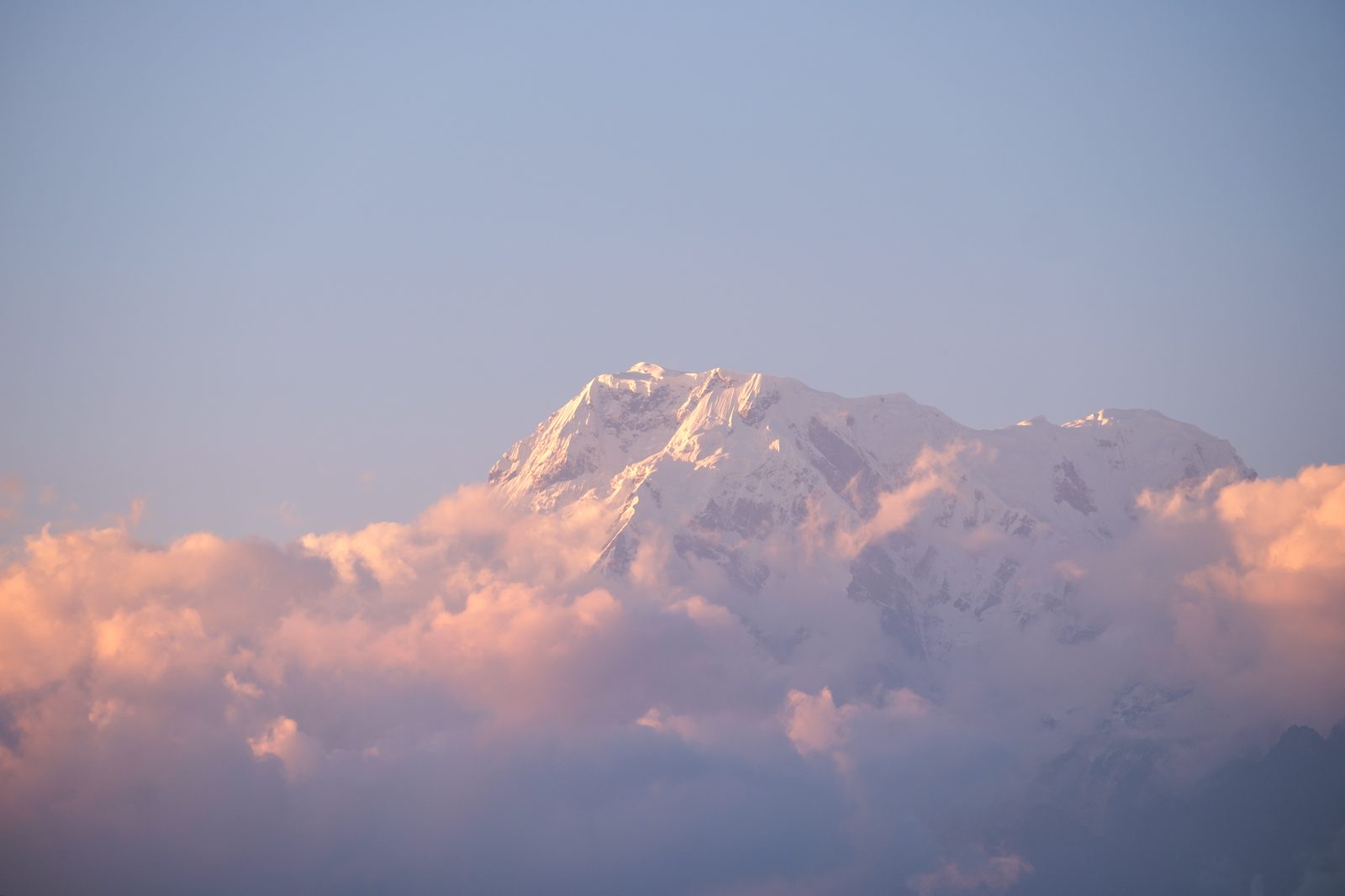
The most beautiful morning I have ever seen in Nepal was in the second week of January.
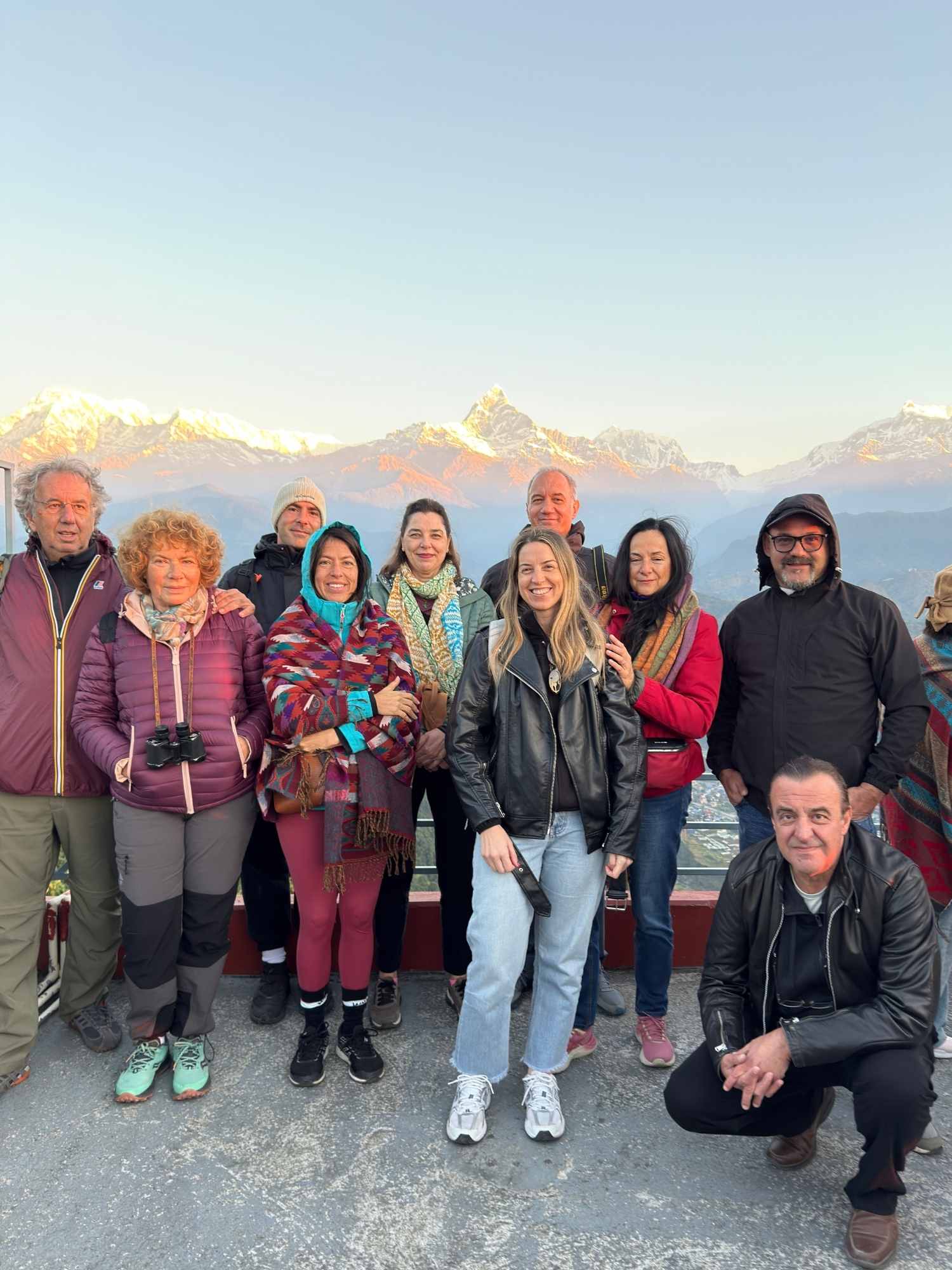
I was standing on a terrace above Dhulikhel at ten past six, holding a coffee that had gone cold in about ninety seconds, and the entire eastern Himalaya was laid out in front of me with an edge on it like cut glass. Not a smudge. Not a haze. Every ridge from Langtang to Everest to Numbur separated cleanly from the one behind it, each rendered in a different shade of the same impossible pink. Behind me, the lodge was almost empty. Below me, the valley was still under fog. I could hear a dog and a bell and nothing else.
Two hundred metres of trail away, at the viewpoint where in October you would be standing among sixty people and forty tripods, there was one man in a down jacket, and he was not looking at the mountains. He was looking at his phone, trying to explain to someone at home why he had come to Nepal in what the internet had told him was the wrong month.
He had not come in the wrong month. He had come in the best one, and almost nobody in this industry will tell you so.
Why Winter Is Nepal's Most Misread Season
The received wisdom about Nepal winter luxury travel is that it does not exist. October and November get the acclaim, March and April get the rhododendrons, and December through February gets described — in brochure after brochure — as the off-season. Cold. Difficult. Best avoided.
That framing was built for a different traveller, on a different budget, walking a different itinerary. It was built for someone crossing high passes in a teahouse dormitory with a sleeping bag rated optimistically. For that person, winter genuinely is hard. For a traveller with a private vehicle, a helicopter on standby, a heated room and a designed itinerary, the calculation inverts almost entirely.
And the market has quietly noticed. Nepal recorded 98,190 international arrivals in December 2025 alone — up roughly seven percent year on year — in the month the guidebooks still call dead. The country's tourism board is now openly building strategy around higher-value, year-round visitors rather than volume in two crowded autumn months. Winter is no longer the empty quarter. It is simply the quarter that nobody has designed properly yet.
The Air
Here is the single most important fact, and it is the one that ought to end the argument.
The Himalaya are not reliably visible. Most of the year, something is in the way — monsoon cloud from June to September, then progressively more dust, smoke and agricultural haze as the dry season wears on toward spring. October is famous for clarity because the monsoon has just finished scrubbing the sky. But the truly stable, driest, most consistently transparent air of the entire year arrives in December and January, when there is no monsoon moisture left, the pre-spring dust has not yet begun to lift off the plains, and cold high pressure sits over the range for days at a stretch.
Visibility in a Nepali December is not a matter of luck. It is close to a structural certainty. I have taken guests up for a mountain flight in the third week of October and had them see a wall of grey. I have never once done so in January.
The Emptiness
The second fact follows from the first prejudice: because everyone believes winter is wrong, everyone goes somewhere else.
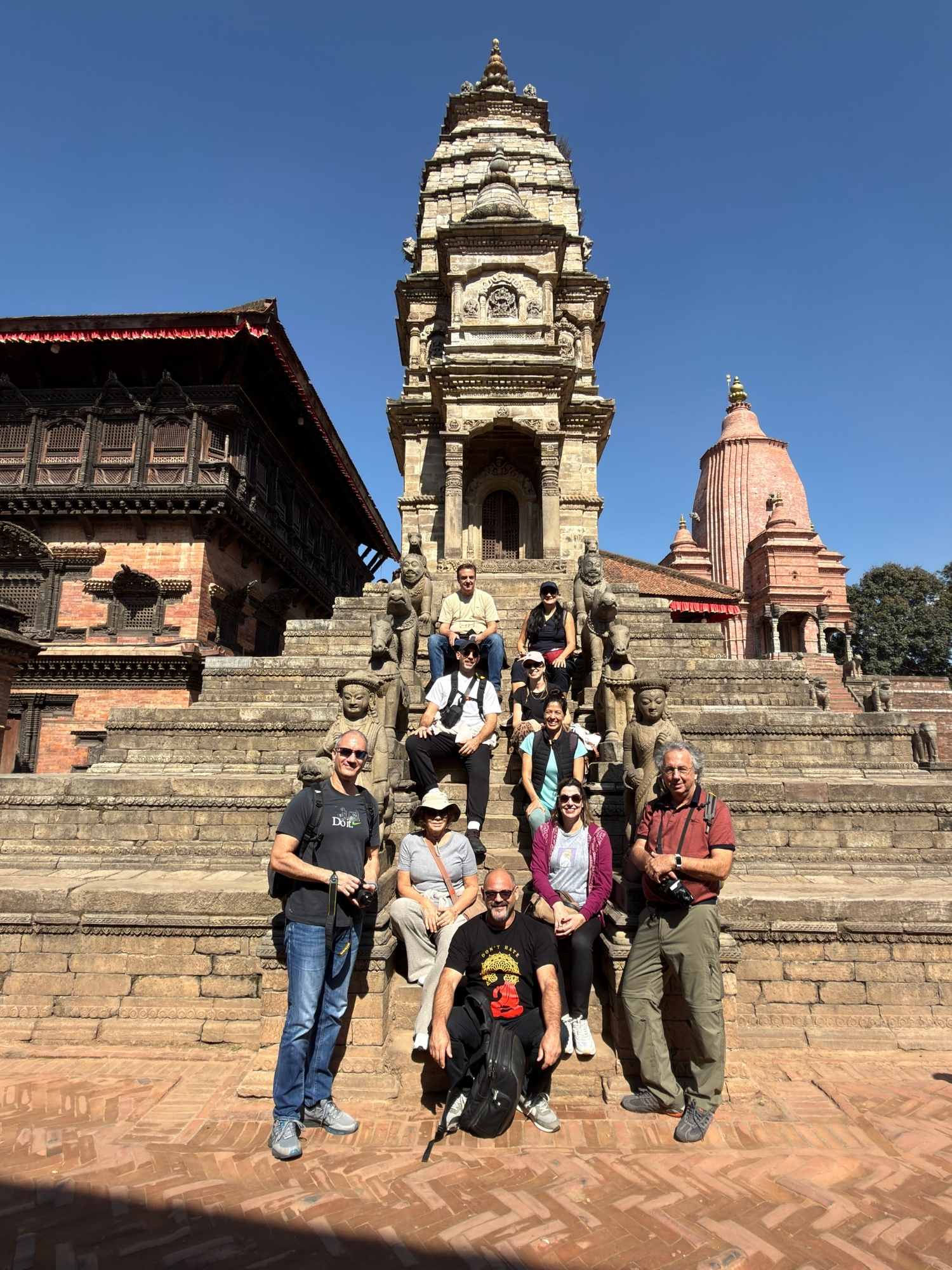
Poon Hill in October is a queue. Poon Hill in late December is a hillside with nine people on it and the same view. The Everest View Hotel terrace in autumn is a scrum for the railing; in January you may well have it to yourself with a pot of tea. The great Buddhist stupa at Boudhanath, circled by thousands at any hour of a spring afternoon, becomes in a winter morning a place where you can walk the kora slowly, in low gold light, among Tibetans doing exactly what they came to do, with almost no camera between you and it.
This is the part that matters to the traveller I actually work with. Nobody with the means to travel well is short of beautiful places. What they are short of is a beautiful place without four hundred other people in it. Winter buys that, and it buys it at the precise moment the mountains look their best. It is the cleanest exchange available anywhere in our destinations.
The Honest Numbers
I am not going to sell you a season without telling you what it costs. Here is what winter actually does, plainly:
- Kathmandu Valley (1,400m): daytime highs of roughly 17–20°C, nights dropping to 2–5°C. Genuinely pleasant days, sharp nights, and very few Nepali buildings are built to hold heat.
- Pokhara (820m): milder throughout, daytime highs near 20°C, mornings often opening under lake fog that burns off by nine to reveal Machhapuchhre with snow on it.
- The Terai lowlands — Chitwan, Bardia (150m): the most comfortable place in the country in January. Cool, misty dawns and afternoons around 22–25°C.
- Trekking altitudes of 2,500–3,500m: crisp, sunny, entirely walkable by day; nights well below freezing and the sun gone behind a ridge by four in the afternoon.
- Daylight: short. Fully dark by around 5:30pm. Days must be built tighter, and mornings start earlier.
- Snow: far less than people imagine below 3,500m. Real snow on the popular foothill trails is occasional, not constant.
And two genuine drawbacks I will not soften. First, the Kathmandu Valley suffers a winter temperature inversion that traps pollution in the bowl of the city, and the air in Kathmandu in January is the worst it gets all year. My answer is structural: we keep valley time short, sleep on the rim rather than in the centre, and get you out to Pokhara, the Terai or the ridges quickly. Second, the high passes — Thorong La, the Everest Three Passes, Larke La — are either closed, snowbound or serious mountaineering propositions from December onward. Winter is not the season for the great high circuits, and anyone telling you otherwise is not managing your risk.
Where Winter Genuinely Excels
The Sunrise Ridges
Nagarkot, Dhulikhel and the terraced hills on the eastern rim of the Kathmandu Valley exist for exactly one purpose, and winter is when they deliver it flawlessly. A dawn from these ridges in December — with fog filling the valley below like poured milk and eight thousand metres of mountain standing above it — is the single most reliable spectacular hour in Nepali travel, and it requires nothing of you but a warm coat and the willingness to be awake.
Pokhara and the Foothill Treks
The Annapurna foothills between 1,500 and 3,300 metres are the great winter asset. Poon Hill, Mardi Himal's lower ridgeline, the Ghandruk and Dhampus circuits, the walks above Begnas Lake — all of them are open, all of them are warm enough by day, and all of them are near-empty. Meanwhile the mountains they look at are wearing considerably more snow than they were in October, which is to say they look more like what you came to see. A short winter foothill journey, wrapped around Kathmandu and Pokhara, is very close to the ideal shape of our Classic journey.
The Terai
If there is a single argument that wins winter outright, it is Chitwan and Bardia. Summer in the Terai is brutal — heat and humidity that make a jeep unbearable by ten in the morning. Winter is the opposite: cool enough for a blanket at dawn, warm enough for a shirt by noon, and the wildlife concentrates near water. It is the most comfortable safari window Nepal has. I will note honestly that the elephant grass stands tall through December and January, which limits sightlines, and that pure tiger-sighting odds improve later, from February into spring. If tigers are the point, we push your dates. If the point is a beautifully run river camp, gharial on a sandbank, rhino at close range and 900 species of bird in perfect light, January is superb.
The High Himalaya, by Air
This is where winter turns from good to extraordinary. Helicopter and fixed-wing flying in Nepal is governed almost entirely by morning weather windows, and winter mornings produce the most reliable windows of the year: cold, stable, cloudless, with the thermal build-up that scrubs afternoon flights in other seasons largely absent.
A January morning flight to the Everest region — landing at Kongde or Syangboche, breakfast at 3,880 metres with the whole Khumbu skyline unobstructed, back in Kathmandu before lunch — is close to a guaranteed success in a way the same flight in a warmer month simply is not. The same holds for a private lift into the Annapurna sanctuary rim or over Langtang. Flying is the mechanism that unlocks winter completely: it gives you the high Himalaya at its clearest without asking you to sleep in it, and it is why so much of what we design in these months leans on our Ultimate journeys.
The Festivals Nobody Books For
Nepal's autumn festivals — Dashain, Tihar — are magnificent and thoroughly discovered. Winter's are not, and they are in some ways more intimate.
Tamu Lhosar, the Gurung new year, falls at the very end of December. Sonam Lhosar, the Tamang new year, arrives in late January or February. Gyalpo Lhosar, the Tibetan and Sherpa new year, follows in February or early March. Boudhanath during Lhosar is one of the great sights of the Buddhist world — the stupa repainted, saffron thrown into the air in great arcs, monastic processions, families in full brocade, and a density of joy that has nothing performed about it because no tour bus has arrived to watch. Add Maghe Sankranti in mid-January, when the country eats sesame and molasses and yam and bathes in cold rivers to mark the sun's turn north, and winter has a cultural calendar that most visitors never learn exists.
Being in the right courtyard on the right morning, with someone beside you who can explain what is happening and why, is not something you can arrange from a hotel concierge desk in the week you arrive. It is planned months out. That is most of what I do.
What Luxury Means in a Nepali Winter
It means one thing above all: heat.
I want to be very direct, because this is where winter journeys are won or lost. Most Nepali buildings — including some expensive ones — were designed for a hot climate and have essentially no thermal mass, no insulation and no central heating. A property can have exceptional service, a beautiful courtyard, a serious kitchen and a genuinely cold bedroom in January. The difference between a superb winter journey and a miserable one is almost entirely a matter of knowing, property by property and room by room, which ones are actually warm.
That knowledge is not published anywhere. It comes from having stayed in these rooms in January myself. It informs which lodges we use, which specific rooms we request, where we send hot water bottles ahead, where our own bedding travels with us, and where a fireplace is decorative rather than functional.
Beyond warmth, the winter architecture is straightforward and it is the same architecture that underpins all of our Premium journeys: private vehicles rather than exposed public transfers, days built around a hard early start and an early, generous dinner, flexibility to move a flight forward when a perfect morning window appears, and a guide who reads the sky rather than the schedule.
One more practical point in winter's favour: the finest properties in Nepal have availability in January that they do not have in October, and the mountains do not charge more for looking better.
Who Should Come in Winter
Winter suits the traveller who has already understood that the crowd is the enemy of the experience. It suits photographers, unreservedly — the light and the clarity are simply not available at any other time. It suits anyone whose diary is fixed by a European or American holiday calendar and who has quietly assumed that made Nepal impossible. It suits families with children out of school over the new year, provided the itinerary stays low and warm. And it suits a returning guest who saw Nepal in autumn and wants to see what the same country looks like when it is cold and empty and lit like a cathedral.
It does not suit anyone whose heart is set on a high pass, on Upper Mustang at its most hospitable, or on a long, remote wilderness traverse. Those journeys belong to other months, and I will tell you so rather than sell you a compromised version of them.
A Personal Note
I grew up in Greece, where the summer is the thing everyone comes for and where anyone who actually lives there will tell you that the island in November — empty, luminous, cold enough for a jacket at dinner — is the better place. It took me a few years in Nepal to recognise the identical pattern here, and the same small stubborn pleasure in being one of very few people standing somewhere extraordinary. If you would like to know how a Greek ended up designing journeys in the Himalaya at all, that story is here.
The mountains do not perform on a schedule set by tour operators. They are at their clearest and their most magnificent in the exact weeks that the market has agreed to ignore. I have never fully understood why that consensus holds, and I have long since stopped arguing with it — because every January morning I spend on a ridge with a guest and almost nobody else, the argument makes itself.
If you have three weeks in winter and have been told to spend them somewhere warm, consider the alternative. When you are ready, let us begin designing your journey — and see the Himalaya in the season they were meant to be seen.