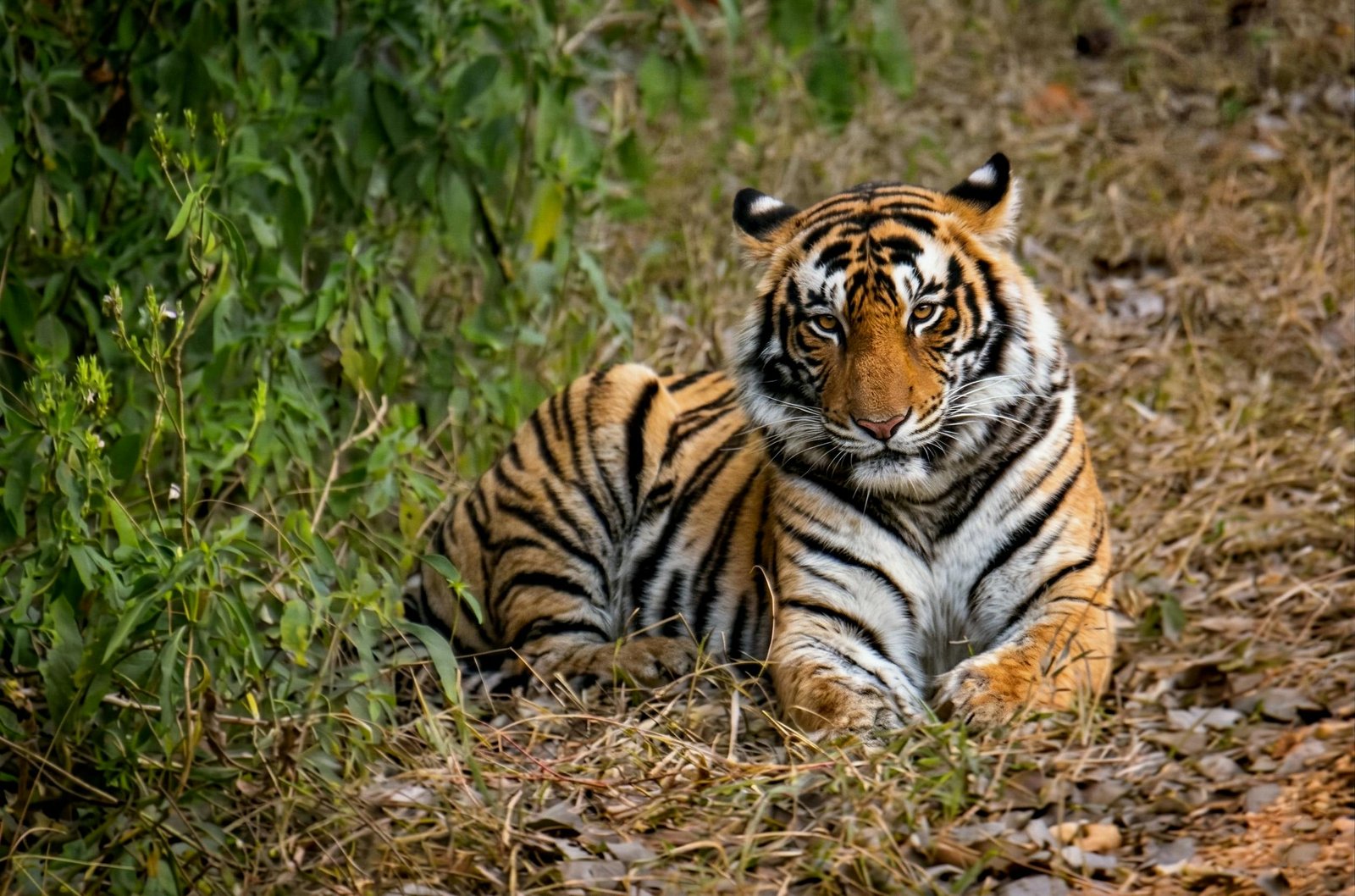
Some places announce themselves. They have a postcard, a famous skyline, a pilgrim's road already worn smooth by other people's footsteps. Bardia is not one of them.
Bardia hides. It hides in Nepal's far west, half a day from the nearest international flight path, beyond the Karnali River where the lowlands of the Terai begin to dissolve into forest. It hides behind the louder fame of Chitwan — Nepal's celebrated safari park — which receives the safari coachloads while Bardia receives almost no one. And it hides, most importantly, the largest concentration of wild Royal Bengal tigers in the country: somewhere between 125 and 130 magnificent animals, roaming free across 968 square kilometres of sal forest, riverine grassland and braided river channels.
For our most discerning guests, the ones who have already done the obvious things, who have stood at Everest Base Camp and dined in private courtyards in Kathmandu and watched dawn break over the Annapurnas, Bardia is the journey we propose next. Not because it is more comfortable than what they have done before — comfort, after all, is not difficult to engineer in 2026 — but because it is genuinely rare. Real wilderness, in our increasingly catalogued world, is not something you buy. It is something you are quietly invited into.
This is what Bardia is. And this is why, for those who understand the difference between travelling and being moved, it is the most extraordinary safari in the Himalayan kingdom.
A Wilderness That Refused to Disappear
To understand the privilege of Bardia today, you have to understand how close it came to vanishing.
In 2010, when Nepal joined eleven other tiger-range nations in pledging to double their wild tiger populations by 2022 — the so-called TX2 commitment — Bardia held just 18 confirmed Royal Bengal tigers. Eighteen. A figure so fragile that conservationists privately wondered if the species was already, here, ecologically extinct.
What happened next is one of the great quiet miracles of modern conservation. By 2022, Bardia's tiger population had multiplied seven-fold to 125 confirmed adults. The park won the global TX2 Award that year — recognition that no other reserve on Earth had achieved such a recovery. Recent scientific assessments now suggest the ecosystem can support up to 133 adult tigers, meaning the population still has room to grow. Nepal's fifth national tiger census, launched in December 2025 with more than 1,100 camera traps deployed across Chitwan, Bardia, Parsa, Banke and Shuklaphanta, will give us the most accurate picture yet.
We share these numbers not because they are a marketing point — they are not — but because they are the reason a Bardia safari today feels like a different kind of experience to one taken even a decade ago. You are no longer walking into a depleted forest, hoping. You are walking into a thriving wilderness, one where every river bend and every sal grove holds a real, living possibility.
What Makes Bardia Different from Chitwan
Guests who already know Nepal often ask the same question: I have done Chitwan — why Bardia?
The answer is that Bardia is not the next chapter of the same book. It is a different book entirely.
Chitwan is closer to Kathmandu, easier to reach, more developed. Its lodges are accessible by road, its safari trails are well established, its visitor numbers are an order of magnitude higher. Chitwan is a magnificent introduction to Nepal's lowland wildlife — the rhinos, the gharial crocodiles, the elephants — and we send many guests there with great satisfaction. Bardia is the opposite proposition. It is remote. It receives perhaps a tenth of Chitwan's visitors. Its forests are larger, its predator concentrations higher, its silences deeper. To reach it, you fly to Nepalgunj — the dusty regional capital of mid-western Nepal — and continue by private vehicle for ninety minutes through villages that few luxury travellers ever see. The journey is part of the story.What this remoteness produces, for the discerning traveller, is something money alone cannot replicate: the feeling of being, perhaps, the only people in the forest. Of hearing a langur troop's alarm call answered by nothing but more silence. Of knowing that the tiger you are tracking is genuinely tracking you back, with no other guests, no other vehicles, no other cameras lifted in your direction.
Bardia is also one of the very few places in Asia where walking safaris are permitted. In most of the great parks of India and Sri Lanka, you must remain in your vehicle. In Bardia, with an experienced naturalist and a forest guard, you walk. You learn to read pugmarks in the river silt. You stand still at the edge of grasslands that have grown taller than your head. You begin to understand, in your body and not just your imagination, what it means to share a landscape with apex predators. There is nothing in the modern luxury travel canon that compares to it.
The Lodge: Tiger Tops Karnali
A safari is only as good as the people running it. In Bardia, that means Tiger Tops Karnali Lodge — and in choosing partners for our Premium and Ultimate journeys, no one in Nepal has the lineage that Tiger Tops does.
Tiger Tops was founded in 1964. They are not a luxury brand that pivoted into safari; they are a safari company that helped invent what luxury Himalayan wildlife travel even means. Their conservation credentials are deep, their guides are among the most experienced in Asia, and their philosophy — that the forest comes first, the guest second — is the exact ethical posture that the most thoughtful HNW travellers now look for.
Karnali Lodge sits on the southern edge of the park, on land they have stewarded for decades. The accommodation is divided into two atmospheres:
- Nine Signature Rooms, refurbished to the standard of contemporary luxury without erasing their origin story. Air conditioning, hand-finished local furniture, a soft cream palette, deep linen, the kind of restrained design that lets the landscape outside remain the protagonist.
- Six Traditional Rooms, built in the historical style of the lodge — local materials, mud-and-thatch construction, an honest beauty that some of our most travelled guests actively prefer.
The rhythm of the day is quietly choreographed. Pre-dawn coffee. A safari in vintage open-top Land Rover Defenders, the canvas roof rolled back, the cold air still carrying the scent of last night's fires from the Tharu villages. A return for breakfast on the terrace. A long, unhurried middle of the day — swim, read, sleep, sketch, do nothing at all. A walking safari in the late afternoon, often along the Karnali river, where mugger crocodiles sun themselves on the white sandbars and the Gangetic river dolphins — yes, dolphins, here in the foothills of the Himalayas — surface in the deeper pools. Sundown drinks at the fire pit. Dinner of organic produce grown on the lodge's own farm.
The phrase "barefoot luxury" is overused. Karnali earns it.
The Tiger Encounter
Let us speak honestly about tigers, because honesty is the only respectable position when discussing wild animals.
A tiger sighting in Bardia is more likely than almost anywhere in Nepal — but it is never guaranteed, and any guide who promises one is not a guide we would work with. What we can promise is that the probability has shifted dramatically in the last decade. With 125+ adults now confirmed in the park, and with the dry season between February and July concentrating wildlife around shrinking water sources, the chances of a meaningful sighting during a three- to four-night stay are higher than they have ever been.
Our most experienced guests have learned to come for the wilderness first and the tiger second. The forest is the gift. The tiger is the grace.
When the encounter does happen — and on a recent journey it happened on the second morning, a young male crossing the river road in a single, unhurried movement before disappearing into ten-foot grass — there is an absolute stillness that descends. No words are spoken. The vehicle is cut to silence. You become aware, in a way you cannot rehearse, that you are looking at one of the most beautiful creatures in the natural world, and that he is looking back, and that he could close the distance between you faster than you could form a thought. The scale of life shifts. Many guests describe this as the moment that recalibrated everything else they thought they knew about travel.
This is not a transaction. This is a privilege.
Beyond the Tigers: What Else You Will Meet
The marquee animal is the tiger. The supporting cast is extraordinary.
- One-horned rhinoceros, reintroduced to Bardia from Chitwan in successful translocations from the 1980s onward, now breeding stably in the park.
- Asian elephants, both wild and domesticated.
- Gharial and mugger crocodiles, the gharial being one of the most endangered crocodilians on Earth.
- Sloth bear, leopard, dhole (Asiatic wild dog), swamp deer, blackbuck.
- More than 250 species of birds, including the great hornbill, the Bengal florican, sarus cranes and white-rumped vultures.
- Gangetic river dolphins in the Karnali — perhaps the rarest and most lyrical sighting of all.
In ecological terms, you are inside one of the last functional megafauna landscapes south of the Himalayas. There are not many of these left in the world.
How to Travel Bardia: The Elysian Approach
We design every Bardia journey privately, but the architecture of a thoughtful stay tends to follow this shape.
Three to four nights at Tiger Tops Karnali is the appropriate minimum. Anything shorter and you are still arriving when you should be leaving. Game drives operate twice daily — sunrise and late afternoon — with walking safaris, river excursions and visits to the Tharu villages that have lived alongside this forest for generations interleaved between them. We arrange these village visits in the spirit of cultural immersion rather than spectacle: small numbers, long conversations, no choreography. Pair Bardia with the right counterpoint. The journey works most beautifully when bracketed by contrast. We frequently combine four nights of Bardia wilderness with three nights of luxury Kathmandu — the cultural and the wild, the historic and the primal — or with a high-altitude pivot into Upper Mustang for guests who want the full Nepal: jungle one week, desert moonscape the next. Travel in the right season. The optimal months are late February through early May, when daytime temperatures are still pleasant, the foliage has begun to thin, and animals concentrate around the rivers. The monsoon (June–September) brings dense vegetation and rougher access; we generally do not recommend Bardia during these months. Bring the right naturalist. Tiger Tops' senior guides are world-class, but for guests with deep wildlife or photography interests we sometimes layer in a private specialist — a tiger photographer, a birding scholar, a behavioural biologist — who travels with the group. The conversations alone are worth the journey.Who Bardia Is Really For
We will be direct, because directness is part of what we owe our guests.
Bardia is not the right journey for everyone. It is for travellers who are deeply curious, who can sit with stillness, who do not need an itinerary that fills every hour. It is for couples who already understand each other well enough to share long silences. It is for photographers, naturalists, and those readers of nature writing who have always wondered what the forests of Jim Corbett's books actually felt like. It is, above all, for the traveller who has begun to suspect that the best things in luxury travel are no longer about adding more — more flights, more cities, more boxes ticked — but about going deeper into fewer places, more slowly, with greater intention.
If that is you, Bardia will be one of the journeys you remember when you are old.
The Quiet Luxury of the Last Wilderness
There is a particular feeling, late on the third afternoon of a Bardia stay, that we have heard described back to us many times. You are sitting on the terrace of Karnali Lodge. The light is going. The sky over the forest has turned the colour of old amber. Somewhere in the trees, a peacock calls — that long, lonely note that means something has moved through the undergrowth that should not be there. You take a sip of your drink. You realise that you have not looked at your phone in seven hours. You realise that you are not thinking about anything at all.
This, finally, is what we believe luxury travel is for. Not the suite, however beautiful. Not the menu, however refined. But the moment in which a person is returned, by the immensity of the natural world, to the size and shape of themselves.
Bardia gives this gift more reliably than almost any place we work.
If you would like to begin a conversation about a private Bardia journey — alone, with a partner, or with the small group of people who matter most to you — we would be honoured to design it. Our Design Journey process begins with a single conversation, no obligation, in which we listen first and propose later. Some of our guests' favourite journeys have begun precisely this way: with a rumour about a forest in the far west of Nepal, and a quiet curiosity about what might still be there.
It is still there. It is waiting. And in its way, it is one of the last great gifts the Himalayas still have to give.
Begin Designing Your Private Bardia Journey →