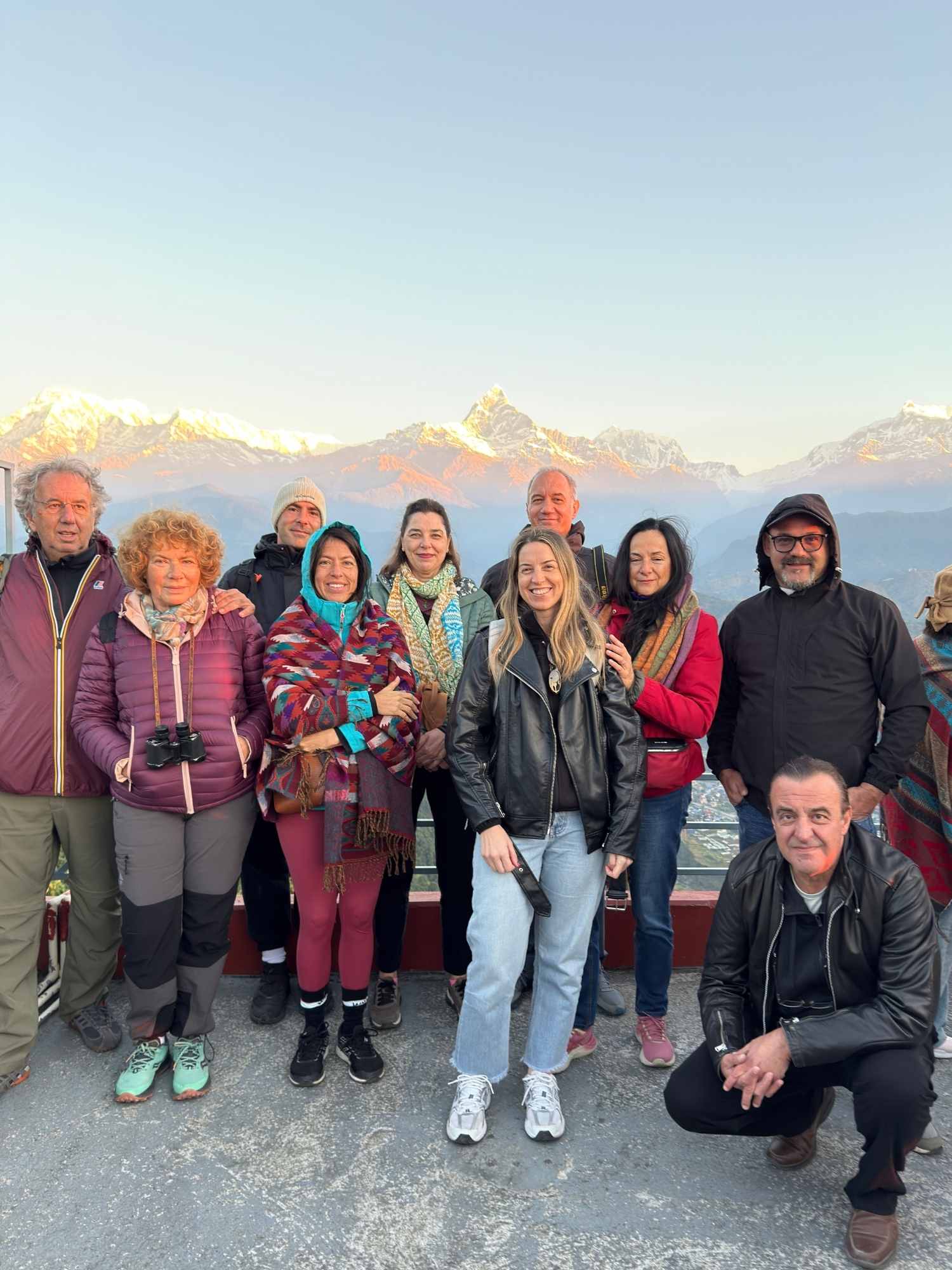
There is a moment in Bhaktapur, a little after six in the morning, when the city belongs entirely to the people who live in it. A woman in a red-bordered sari circles the Nyatapola temple with a brass plate of rice, marigold and vermilion. Two old men sit on the plinth of a shrine that has stood there for three hundred years, arguing gently about something that happened yesterday. From an alley you cannot yet see comes the thud of a potter's wheel being kicked into motion. Nobody is selling anything. Nobody is looking at you.
By half past ten the tour buses from Kathmandu have arrived, and the city becomes something else: still beautiful, still extraordinary, but a place being looked at rather than a place being lived in. Most visitors only ever see that second Bhaktapur. A Bhaktapur luxury tour, as we design it, is built entirely around the first.
Why Bhaktapur Is Different From Everywhere Else in the Valley
The Kathmandu Valley once held three rival royal cities — Kathmandu, Patan and Bhaktapur — each with its own palace, its own Durbar Square and its own school of craftsmen trying to outbuild the other two. All three survive, and all three are part of the Kathmandu Valley World Heritage Site. But only Bhaktapur still feels like a complete medieval city rather than a set of monuments inside a modern one.
Some of that is history. Bhaktapur was the capital of the whole valley under the Malla kings until the late fifteenth century, and it kept its own crown for three hundred years after that. Some of it is geography: the old city sits on a low ridge about thirteen kilometres east of Kathmandu, a little apart from the capital's sprawl. And some of it is choice. From the 1970s onward, a long restoration programme — largely funded from Germany — paved the lanes in brick, rebuilt drains and wells, and helped the town keep its traffic out of the historic core. Walking through it today, you hear footsteps and bells rather than engines.
The Newars, the people who built the valley's cities, call Bhaktapur Khwopa. The Sanskrit name means "the city of devotees", and it is not a figure of speech. There are said to be more shrines, temples and sacred water spouts here per street than anywhere else in Nepal, and nearly all of them are still in use. This is not a museum with a population. It is a population that happens to live inside a museum.
The Four Squares: How to Read the City
Bhaktapur is best understood as a chain of squares linked by narrow brick lanes. A good private guide will walk you through them in an order that tells the city's story rather than the order the coaches follow.
Durbar Square: the royal city
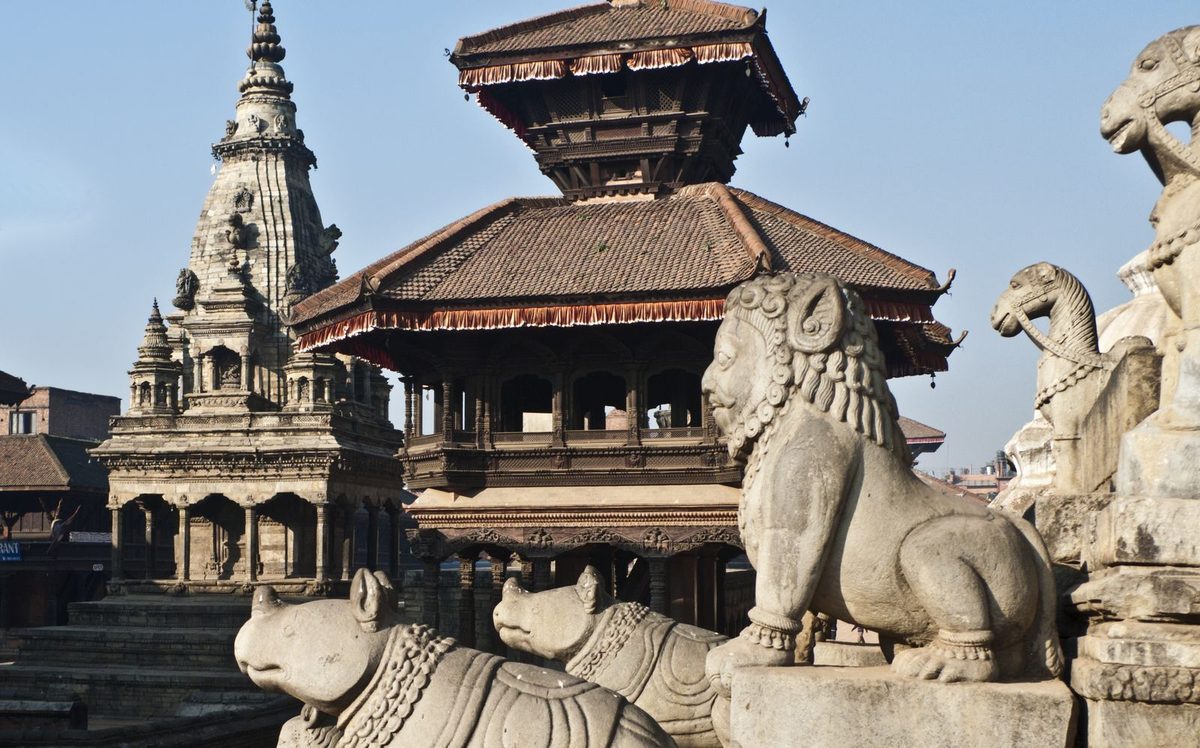
The Durbar Square is where the kings lived, and where the Malla court staged its power in stone and timber. The long brick palace with its carved window frames is known as the Palace of Fifty-Five Windows; each one is a small masterpiece of latticed wood. Set into it is the Golden Gate, a gilded doorway built in the mid-eighteenth century, crowned by the goddess Taleju and the mythical bird Garuda, and widely considered the single finest piece of metalwork in the valley. Beyond it lies the royal temple of Taleju, the kings' own goddess — a courtyard non-Hindus may not enter, which is worth knowing before you arrive rather than at the door.
Around the square stand the stone shikhara of the Vatsala Durga temple, the pavilion-style temples that were carefully rebuilt after the 2015 earthquake, and the rows of stone guardians — lions, griffins, elephants — that face outwards as if the palace still needed defending.
Taumadhi Square: Nyatapola
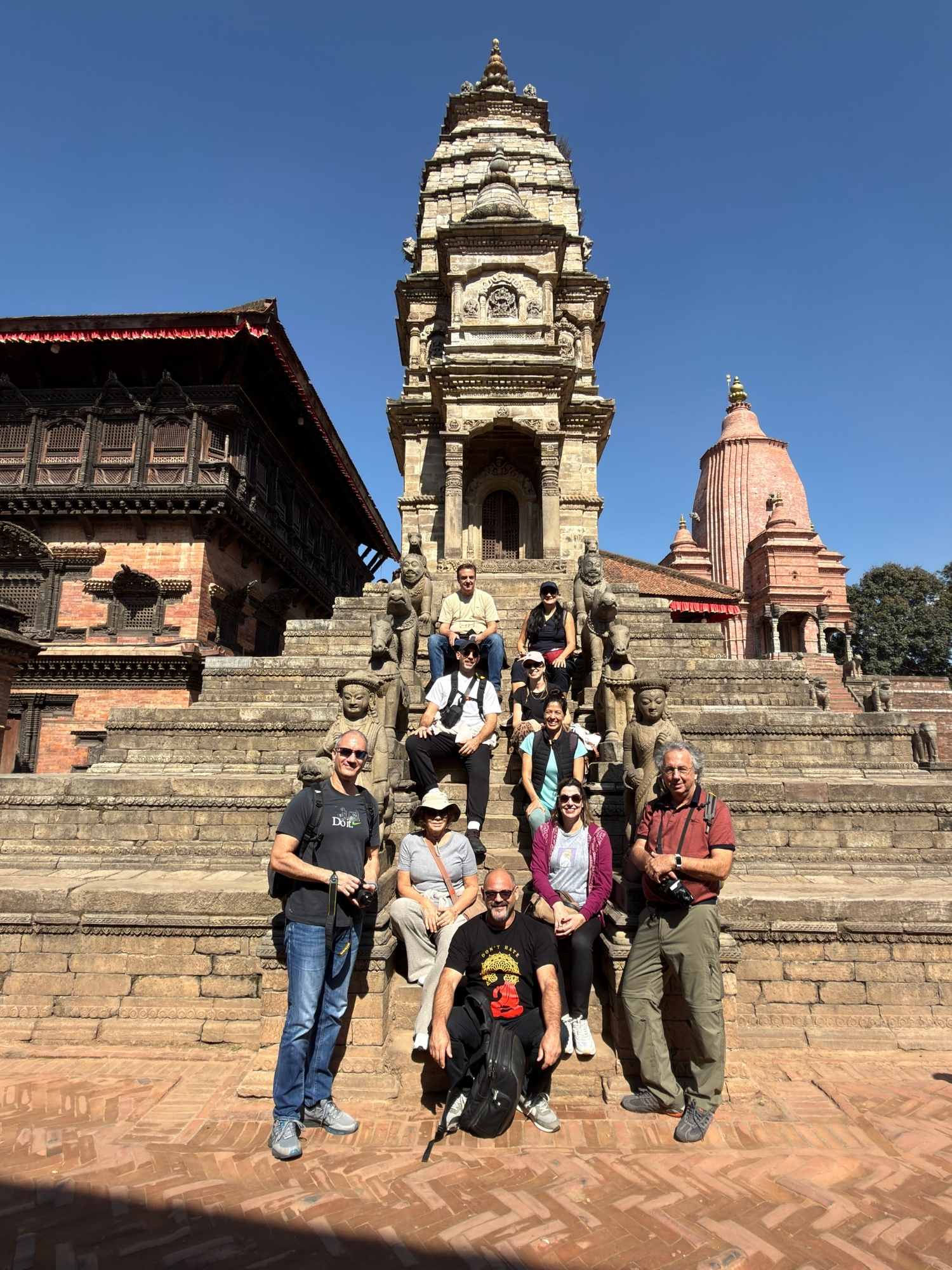
A two-minute walk south brings you to the most famous building in Bhaktapur and, arguably, in Nepal. The Nyatapola temple was raised in 1702 by King Bhupatindra Malla: five tiered roofs on five stepped plinths, around thirty metres tall, the highest pagoda in the country. Its staircase is lined with guardians arranged in ascending order of strength — two legendary wrestlers at the bottom, then elephants, lions, griffins, and finally two goddesses at the top — each said to be ten times stronger than the pair below.
What moves most people is not its height but its survival. Nyatapola came through the great earthquake of 1934 and again through the earthquake of 2015 with remarkably little harm, while much around it fell. The Newar builders who designed it understood more about timber, flexibility and foundations than anyone in Europe would have credited at the time.
Sit on the steps of the café terraces facing it at dawn, before the square fills, and watch the city begin its day around the temple. This, more than any photograph, is the image of Bhaktapur you will carry home.
Potters' Square: the working city
West of Taumadhi, the lanes open onto a square covered in clay. Hundreds of freshly thrown pots — water jars, lamps, the small bowls used for curd — sit drying in rows on the bricks, turned by hand every hour so they bake evenly in the sun. The potters work at wheels set just inside their doorways, many of them from families who have done exactly this, on exactly this square, for generations.
On a private visit, we arrange for you to sit at a wheel with one of them. You will almost certainly make something lopsided. That is not the point. The point is an hour spent in someone's workplace as a guest rather than a spectator, and a conversation — through your guide — about what it means to practise a craft your great-grandfather practised in the same spot.
Dattatreya Square: the scholars' city
The oldest part of Bhaktapur lies to the east, around Tachupal Tole and the Dattatreya temple, which tradition says was built in the fifteenth century from the timber of a single tree. The quarter feels quieter and more domestic than the royal square. Its great treasure is the Pujari Math, a former priests' house whose courtyard window — the Peacock Window — is the most celebrated piece of woodcarving in Nepal. The building now houses the National Woodworking Museum, and the Brass and Bronze Museum stands across the square.
Around them, in small workshops that open straight onto the street, carvers still cut struts, window frames and deities from sal wood, using techniques unchanged in centuries. Thangka painters work in upstairs rooms by the light of a single window. With the right introduction, these doors open.
What Makes a Bhaktapur Tour Genuinely Luxurious
Luxury in Bhaktapur has almost nothing to do with thread counts. The city has no grand hotels inside its walls, and it would be poorer if it did. What it offers instead is access, time and quiet — and those are precisely the things a well-designed private journey can deliver and a coach tour cannot.
Arrive before everyone else
The single most important decision is timing. We bring travellers into Bhaktapur either the evening before or at first light, so that the Durbar Square and Taumadhi are experienced while the city is still waking. The difference between Bhaktapur at seven and Bhaktapur at eleven is the difference between being a guest and being a visitor.
Stay the night
Most people never sleep in Bhaktapur. Those who do find that the city after dark is the one they remember most: oil lamps in the shrines, the evening bhajan devotional singing in the rest houses around the squares, and a silence in the lanes that seems impossible thirteen kilometres from a capital city. There are small heritage guesthouses in restored Newari townhouses, and we choose between them carefully, room by room, according to the light, the view and the quiet. For travellers who prefer the comforts of a full-service hotel, we base the stay elsewhere in the valley and simply return to Bhaktapur at the hours that matter — dawn and dusk. Our guide to luxury Kathmandu explains how we think about those bases.
The right guide
A Bhaktapur guide should be a Newar, ideally from Bhaktapur itself — someone whose family appears in the stories they are telling, who knows which aunt runs which shrine and which workshop will welcome a visitor on a given morning. We work with a small number of guides we know personally, and we match them to travellers the way you might choose a dinner companion: by temperament as much as by knowledge.
Doors that are not on any map
The most memorable hours of a Bhaktapur journey tend to happen behind a doorway: a courtyard where a family is preparing for a festival, a woodcarver's upstairs room, a rooftop where you drink tea above the pagoda roofs at sunset. None of these can be booked online. They exist because of relationships built over years, and they are the core of what we mean by experiential wealth — not more things to see, but a deeper way of seeing.
Eating in Bhaktapur: The Newari Table
Newari cuisine is one of the great undiscovered food traditions of Asia, and Bhaktapur is its heartland.
- Juju dhau — "the king of curds". Buffalo milk, lightly sweetened, set in the unglazed clay bowls from Potters' Square, which draw out the whey and leave the curd thick, cool and faintly caramel. Eat it mid-morning, in the square, from the bowl it was made in.
- Samay baji — a ceremonial platter of beaten rice with roasted and spiced meats, black soybeans, ginger, garlic and a lentil pancake, served at festivals and family rites. A private lunch arranged in a Newari home is the best way to understand it.
- Yomari — a steamed rice-flour dumpling filled with molasses and sesame, shaped like a fig, traditionally made for the winter full moon but found in Bhaktapur's kitchens far more often than that.
- Bara and chatamari — lentil pancakes and the thin rice-flour "Newari pizza", both best eaten hot from a family kitchen rather than a restaurant menu.
We usually build at least one meal of a Bhaktapur journey inside a private home, cooked by the family, eaten on the floor on woven mats in the traditional way. It is the meal most of our guests describe first when they come home. For a broader tour of the country's food, see our guide to Nepal's finest culinary experiences.
Bhaktapur's Festivals
Bhaktapur's calendar is dense with festivals, and timing a visit to one of them changes the city completely.
- Bisket Jatra marks the Nepali New Year in April. Enormous wooden chariots carrying the gods are hauled through the streets by rival halves of the city in a tug-of-war that can last hours, and a towering ceremonial pole is raised and then pulled down. It is exhilarating, crowded and utterly unlike anything in Europe.
- Gai Jatra, in late summer, is the city's festival of remembrance for those who died during the year, part procession and part satire, with a lightness about grief that many visitors find unexpectedly moving.
- Dashain and Tihar, the great autumn festivals of Nepal, fill Bhaktapur's courtyards with family ritual, kite-flying, oil lamps and marigold garlands.
Festival days reward preparation: the right vantage point, a rooftop arranged in advance, and a guide who knows when to be in the thick of it and when to step back. Our wider guide to Nepal's festivals covers the national calendar.
How to Build Bhaktapur Into a Nepal Journey
Bhaktapur works beautifully as part of a longer journey rather than as a hurried day trip from Kathmandu. A few patterns we return to again and again:
- The gentle opening. Arrive in Kathmandu, then spend your second and third nights in and around Bhaktapur before the mountains. It is a soft landing into Nepal — cultural rather than physical, and a better way to recover from a long flight than a hotel lobby.
- Bhaktapur, Changu Narayan and Nagarkot. Changu Narayan, a hilltop temple a short drive north of Bhaktapur, holds the oldest dated inscription in the valley, from the fifth century, and is part of the same World Heritage listing. Continue up to the ridge at Nagarkot for a night facing the Himalaya, as described in our guide to Nagarkot's luxury resorts, and you have one of the most rewarding forty-eight hours in the country.
- The heritage thread. Combine Bhaktapur with Patan and Kathmandu's own Durbar Square over several unhurried days, each with a different specialist guide, and the three royal cities start to speak to one another. This sits naturally within our Elysian Classic journey.
- The contrast. Close a trek or a Mustang expedition with two nights in Bhaktapur. After weeks of high silence, the density and warmth of the city land very differently. Our Premium journeys are often shaped exactly this way.
When to Visit Bhaktapur
Bhaktapur is a year-round city, but the experience changes with the season.
- October to November brings clear skies, soft light and the major festivals of Dashain and Tihar — the classic season, and the busiest.
- December to February is cool and very clear, with crisp mornings, empty squares and wonderful low light for photography. Pack warm layers for dawn.
- March to May is warm and bright, with Bisket Jatra in April as the highlight.
- June to September, the monsoon, brings rain most afternoons, but mornings are often fine, the city is at its greenest and quietest, and the festival of Gai Jatra falls in this period.
Whatever the month, the rule is the same: the city's finest hours are before ten in the morning and after four in the afternoon.
What a Private Bhaktapur Journey Costs
This is the question we are asked most often, and the honest answer is that a journey of this kind is costed only once it is designed, because no two are the same. The shape of it depends on where you stay, how many nights you spend inside the old city, which guides and specialists you work with, whether a festival is involved, and how Bhaktapur fits into the rest of your time in Nepal. If you would like a figure, that conversation starts on our design a journey page.
Frequently Asked Questions
Is Bhaktapur worth more than a day trip?
Yes. The day-trip version shows you the monuments at their most crowded. A night or two inside or near the old city lets you see Bhaktapur at dawn and after dark, when it is most itself — and gives time for the workshops, homes and courtyards that a three-hour visit never reaches.
How far is Bhaktapur from Kathmandu?
The old city lies roughly thirteen kilometres east of central Kathmandu. We always travel by private vehicle and plan timings around the valley's traffic rather than a fixed itinerary.
Can non-Hindus enter all the temples?
Most of Bhaktapur's squares and temple exteriors are open to everyone. A few inner sanctums, including the Taleju temple courtyard inside the royal palace, are reserved for Hindus. A good guide will explain each boundary before you reach it.
What should I wear?
Comfortable, closed shoes for brick lanes, and modest clothing covering shoulders and knees for temple visits. Leather items are best left behind when entering certain shrines. In winter, bring warm layers for the early mornings.
Can Bhaktapur be combined with a Himalayan journey?
Easily, and it is one of our favourite combinations. Bhaktapur sits on the eastern side of the Kathmandu Valley, close to Nagarkot and within easy reach of the airport, which makes it a natural first or last chapter of a longer journey through the destinations we design.
Begin Your Bhaktapur Journey
I have walked through Bhaktapur's squares more times than I can count, and I still find something I have never noticed before — a carved figure on a roof strut, a shrine tucked into the angle of a wall, a family ritual I had never been invited to see. That is the nature of the place. It does not give itself up to people in a hurry.
If you would like to experience it the way it deserves — at first light, with the right guide, behind the right doors — tell us how you like to travel and we will design the rest. Your journey begins on our design a journey page.