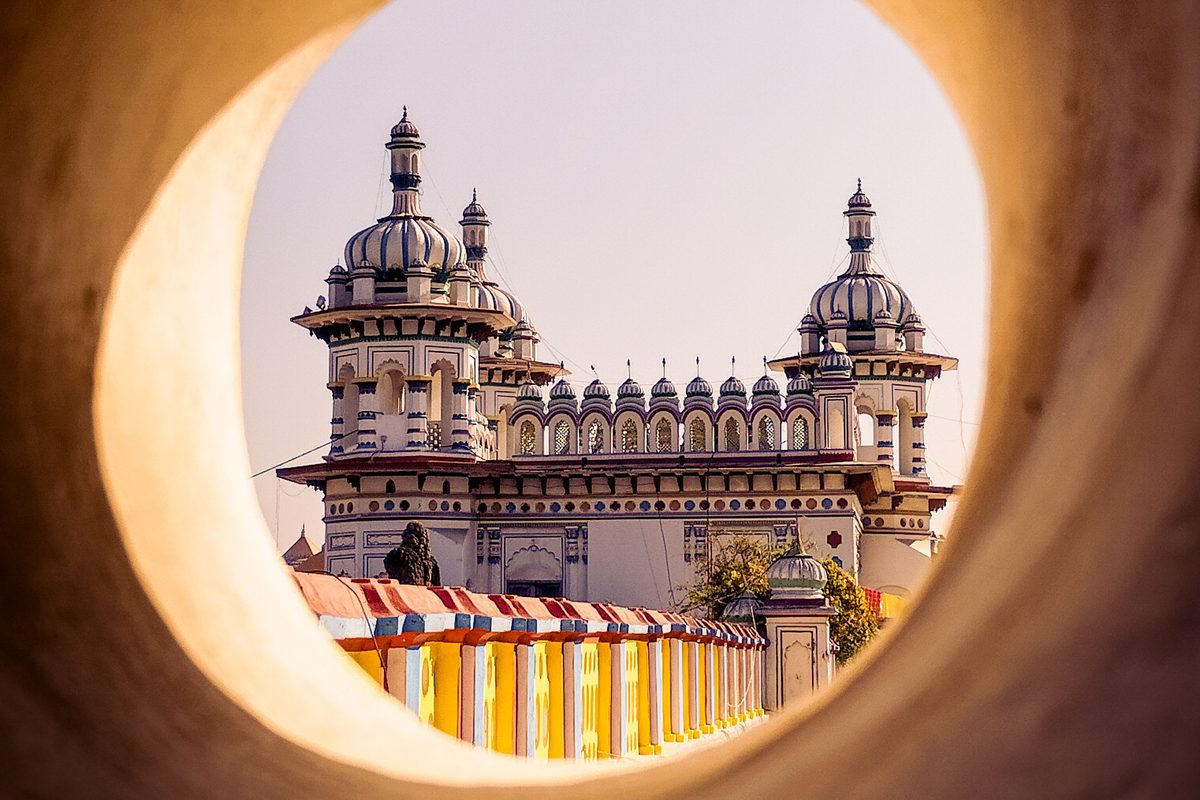
The light goes first from the domes. Across the great forecourt the marble is still warm underfoot, but the sky above the Janaki Mandir has already turned the colour of turmeric, and the white façade, all arches, turrets and lattice, begins to glow as though it were lit from inside. Somewhere within, a conch is blown three times. Then the bells, and a hymn sung by a few hundred voices at once in Maithili, a language most visitors to Nepal never hear. A grandmother in a red and gold sari presses a thumb of vermilion into the parting of her granddaughter's hair. A boy sells marigold garlands from a bamboo pole. Nobody looks at you. They are here for Sita.
This is Janakpur, on the hot, flat plains of southern Nepal, a few kilometres from the Indian border and a world away from the Himalaya most travellers come for. It is the city of King Janak, the birthplace of Sita, the heroine of the Ramayana, and the place where, the epic tells us, Prince Rama broke the great bow of Shiva and won her hand. For hundreds of millions of people across South Asia it is one of the holiest places on earth. For the luxury traveller it remains almost entirely undiscovered. A Janakpur luxury tour, designed privately and with care, is one of the most unexpected and rewarding things we can add to a journey through Nepal.
Why Janakpur Belongs in a Himalayan Journey
Most of our guests arrive in Nepal thinking of mountains. They are right to. But Nepal is also a lowland country: the Terai, the strip of fertile plain along its southern edge, is where half the population lives, where the rice and mustard are grown, and where two of the great religious stories of Asia begin. Lumbini, in the west, is the birthplace of the Buddha. Janakpur, in the east, is the birthplace of Sita.
To fly down from Kathmandu to Janakpur is to change worlds in under an hour. The air is warmer and heavier. The houses are of brick and mud, painted with birds and fish. The language changes, the dress changes, the food changes, and the faith becomes louder, more public and more joyful. If Kathmandu is the head of Nepal and the mountains are its spine, the Terai is its heart, and Janakpur is the place where that heart beats most openly.
The ancient kingdom of Mithila
Janakpur was the capital of Videha, the ancient kingdom of Mithila, which once stretched across what is now southern Nepal and northern Bihar in India. Mithila was famous in antiquity for its scholars, its philosophers and its kings who argued about the nature of the soul. King Janak, Sita's father, appears in the Upanishads as a philosopher-king, the patron of debates between sages. Greeks will hear an echo of something familiar here: a court where kings sat with philosophers, and where the question of how to live was treated as the most serious question of state.
The kingdom vanished long ago. Mithila as a culture did not. Its language, Maithili, is spoken by millions on both sides of the border, and its art, painted for centuries by women on the walls of their own homes, has become one of the most admired folk traditions in the world.
The Janaki Mandir: A Marble Palace for a Goddess
At the centre of Janakpur stands the temple that everything else revolves around. The Janaki Mandir was completed in 1910, commissioned by Queen Vrisha Bhanu of Tikamgarh, a princely state in central India, and it looks like nothing else in Nepal. Where the temples of the Kathmandu Valley are pagodas of carved wood and brick, this one is a palace of white stone, with domes, turrets, cusped arches and coloured glass, in a style usually described as a blend of Mughal and Koiri architecture. It is often compared to a wedding cake, and it is meant to be festive. This is, after all, the house of a bride.
Inside the inner sanctum are images of Sita and Rama, along with his brothers. According to local tradition, the temple stands on the spot where an image of Sita was found, and pilgrims come from all over Nepal and India to see her. Visitors of all faiths may enter the courtyard and watch, with shoes removed and shoulders and knees covered.
The evening aarti
The time to be here is at dusk. As the light falls, the temple fills, the lamps are lit, and the evening aarti begins: flames circled before the deities, conches, bells, cymbals and the singing of devotional hymns. It is not a show and it is not staged. It is a city at prayer, and it is one of the most moving religious ceremonies I know anywhere in Nepal.
We arrange for our guests to arrive a little early, to walk the courtyard in the last of the daylight with a guide, and then to find a quiet place at the edge of the crowd, close enough to feel it and far enough not to intrude.
A City of Sacred Ponds
Janakpur is said to have well over a hundred sacred ponds, and they define the city as much as its temples do. Each has its own story. The two greatest, Ganga Sagar and Dhanush Sagar, lie a short walk from the Janaki Mandir, and in the early morning their stepped banks are full of people bathing, praying, washing clothes and talking. Small shrines stand at the water's edge. A priest reads from a book under an umbrella. Cows wander with great dignity through all of it.
A slow walk around the ponds at sunrise, with a guide who knows which shrine belongs to which part of the story, is to my mind the best introduction to the city. You see Janakpur waking up as it has woken up for centuries, before the traffic and the heat.
The wedding pavilion
Beside the Janaki Mandir stands the Vivah Mandap, the pavilion that marks the place where, according to tradition, Rama and Sita were married. Inside, the wedding party is recreated in painted figures, and newly married couples from across the region come here to be photographed and blessed. It is affectionate, a little kitsch and entirely sincere, and it tells you how personally this city still holds the story of a wedding that took place, if it took place at all, thousands of years ago.
The Women of Mithila and Their Painted Walls
For many of our guests, the most memorable hours in Janakpur are spent not in a temple but in a room full of women painting.
Mithila painting began on walls. For generations, the women of the region decorated the inner rooms of their houses, especially the wedding chamber, with images of gods, fish, birds, elephants, the sun and moon, lotus flowers and bamboo groves, all drawn in bold lines and filled with bright colour. The fish stand for fertility, the parrots for love, the bamboo for the continuation of the family line. Every image has a meaning, and the meanings were passed down from mother to daughter along with the brushes.
Today that tradition lives on in a few dedicated workshops and cooperatives on the edge of Janakpur, where Maithili women paint on paper, canvas and pottery, and earn an income of their own from it. The work is exuberant, intensely detailed and unlike anything else in Nepal.
A private afternoon with the artists
We arrange private visits to these workshops, with an interpreter who speaks Maithili and who knows the artists personally. Guests can sit beside a painter, watch a design take shape line by line, and ask what each figure means. Those who wish can try their own hand, under the patient instruction of women who have painted since childhood. And those who fall in love with a particular piece can commission one, or buy directly from the artist who made it, so that the money goes to the woman who held the brush.
This is the kind of encounter we mean by experiential wealth. You do not leave with a souvenir. You leave with an object whose maker you have met, and with a story you will tell at your own table for years.
Dhanusha Dham: Where the Bow Was Broken
The climax of Sita's story is the contest of the bow. King Janak declared that his daughter would marry only the man who could lift and string the mighty bow of Shiva. Prince after prince failed. Rama lifted it with ease and, in stringing it, broke it in two.
At Dhanusha Dham, a short drive north-east of Janakpur, pilgrims venerate what is said to be a fragment of that bow, turned to stone. It is a quiet, rural shrine set among fields and old trees, and it makes a gentle half-day excursion from the city, especially in the soft light of a winter morning, with a stop on the way to watch village life in the Terai: the rice harvest, the brick kilns, the buffalo carts, the ponds full of lotus.
Janakpur in Festival
Janakpur is never more itself than during its festivals, and two of them fall in the season when most of our guests travel.
Chhath: devotion to the sun
Chhath is the great festival of Mithila, and the ponds of Janakpur are its stage. Six days after the Tihar festival of lights, devotees, most of them women, fast for some thirty-six hours, without even water, and then stand waist-deep in the ponds at sunset and again at sunrise to make offerings to the sun. The banks are lined with sugarcane, baskets of fruit and clay lamps, and the songs of Chhath drift across the water in the half-light. In 2026 it falls in mid-November. It is one of the most beautiful religious sights in South Asia, and the visitor's place in it is to watch quietly and respectfully from the bank.Vivah Panchami: the wedding re-enacted
Vivah Panchami, the anniversary of the wedding of Rama and Sita, falls in late November or December; in 2026 it is in December. For several days, Janakpur re-enacts the wedding. A procession arrives as Rama's wedding party, the bridal rites are performed, and pilgrims arrive in tens of thousands from across Nepal and India. The city is crowded, colourful, noisy and filled with music.For guests who want to witness it, we plan around the crowd rather than inside it: a vantage point arranged in advance, a guide who knows the rhythm of each day, and a calm place to retreat to. For guests who prefer stillness, we simply choose other dates.
How We Design a Private Janakpur Journey
Janakpur does not have the grand heritage hotels of Kathmandu, and I would rather say so plainly than pretend otherwise. The best rooms in the city are comfortable, clean and welcoming rather than palatial. What we can offer, and what makes the difference, is everything around the room.
Arrive by air
The flight from Kathmandu to Janakpur is short, around half an hour, and on a clear morning you see the Himalaya fall away behind you as the hills flatten into the plain. We arrange the timings so that you land, settle in, rest through the heat of the day and are at the Janaki Mandir in time for the evening aarti.
The right guide, and the right interpreter
In Janakpur, language matters more than anywhere else in Nepal. Many people here speak Maithili first, and the stories of the ponds, the paintings and the festivals are told in it. We pair our guests with a guide who knows the Ramayana well and with local interpreters who are trusted in the communities we visit, so that conversations happen rather than translations.
A rhythm that respects the climate
The Terai is warm. We plan the walking for early morning and late afternoon, keep the middle of the day for rest, lunch and the painting workshops, and make sure a car is never far away.
One night or two
Most guests spend one or two nights. One night allows the evening aarti, the morning walk around the ponds and an afternoon with the Mithila painters. Two nights add Dhanusha Dham, a slower pace and, in the right season, a festival.
Janakpur Within a Longer Journey
Janakpur is rarely a journey on its own. These are the combinations that work best.
The two birthplaces
For guests drawn to the religious history of Asia, few pairings are as striking as Janakpur and Lumbini: the birthplace of Sita in the east of the Terai and the birthplace of the Buddha in the west, two of the great figures of Asian faith born on the same strip of plain. Joined by a stay in the jungle at Chitwan, they make a lowland journey of extraordinary depth, which we often weave into our Classic journeys.
The plains, then the mountains
More often, Janakpur is a chapter in a longer journey: a few days in the sacred sites of the Kathmandu Valley, such as Budhanilkantha, then a flight south to the plains, and then north again to Pokhara or the high country. The contrast between the flat, crowded, devotional Terai and the silence of the mountains is part of what makes the journey memorable. Our Premium journeys are often built around exactly this kind of contrast.
When to Visit Janakpur
The temples and ponds are open every day of the year, but the climate on the plains shapes the experience.
- October to early December is the finest season: the monsoon is over, the heat has eased, the fields are green and gold, and Chhath and Vivah Panchami bring the city to life.
- January and February are cool and often misty in the early morning, quieter and very beautiful, ideal for those who prefer calm.
- March brings Holi, celebrated in the Terai with exuberance, before the heat builds.
- April to September is hot, and then wet. We generally advise against it unless there is a particular festival you want to see.
What It Costs
A Janakpur journey is never priced on its own, because it is never designed on its own. It depends on the season, the number of nights, the guides and interpreters you need, whether a festival is involved, and what comes before and after. A journey of this kind is costed only once it is designed, because no two are the same. If you would like a figure, that conversation starts on our design a journey page.
Frequently Asked Questions
Where is Janakpur?
Janakpur lies in the Terai, the southern plains of Nepal, in Dhanusha district, close to the border with India. It is around half an hour by air from Kathmandu.
What is Janakpur famous for?
Janakpur is revered as the birthplace of Sita and the place where she married Rama, according to the Ramayana. It is famous for the Janaki Mandir, completed in 1910, for its many sacred ponds and for Mithila painting, the folk art traditionally made by the women of the region.
Can non-Hindus visit the Janaki Mandir?
Yes. Visitors of all faiths may enter the temple courtyard and watch the ceremonies, with shoes removed and shoulders and knees covered. Photography inside the inner sanctum is not appropriate.
When is the best time to visit Janakpur?
October to early December is the best season, with pleasant weather and the festivals of Chhath and Vivah Panchami. January and February are cooler and quieter.
The Other Nepal
Most people who come to Nepal never see the plains. They fly over them, if they see them at all, on the way from the border to the mountains. That is their loss. Janakpur is where Nepal's faith is at its most open and most tender, where a city still celebrates a wedding as if it had happened last spring, and where women paint fish and parrots and lotus flowers in the way their grandmothers taught them. To stand in the marble courtyard at dusk, among the people who have come for Sita, is to understand that this country is much larger than its mountains.
I live in Nepal, and Janakpur is the place I most often suggest to guests who think they have already seen it all. If you would like to know why a Greek ended up designing journeys here, that story is on my founder page. If you would like Janakpur woven into your own journey, with the timing, the guides and the painters arranged around you, begin your design here.