You hear it before you see it: a handbell, rung quickly and without ceremony, and under it the low murmur of a priest reading aloud. Then the crowd at the railing thins for a moment and there he is, lying on his back in a pool of dark water, larger than any man, carved from a single block of black stone. His eyes are open. His four hands rest on his body, holding the discus, the conch, the mace and a lotus. He lies on the coils of a great serpent whose eleven hooded heads rise behind him like a crown. A priest in a white dhoti stands on the stone at his side, barefoot, pouring milk over his face, and a woman next to you, who has walked here before dawn from somewhere in the valley, closes her eyes and lifts her joined hands to her forehead.
This is Budhanilkantha, at the northern edge of Kathmandu, where the city finally gives way to the forested slopes of the Shivapuri hills. It is the largest stone sculpture in Nepal, and to my mind the most moving. It is also one of the least understood, because most visitors arrive late in the morning, take a photograph through the railing and leave inside twenty minutes. A Budhanilkantha luxury tour, done privately and done properly, is something else entirely: a quiet morning inside one of the oldest living rituals in the Himalaya.
What Budhanilkantha Is
Budhanilkantha is a temple without a building. There is no roof, no tower and no gilded pagoda. There is a sunken rectangular pool fed by the springs that come down from the hills above, and in the water, on a bed of stone serpent coils, lies Vishnu, the preserver among the great gods of Hinduism.
The figure is roughly five metres long and is generally dated to the seventh century, in the Licchavi period, the same golden age of stone carving that produced the sculpture at Changu Narayan on the opposite side of the valley. When this figure was carved, the Parthenon was already more than a thousand years old, and the great Byzantine churches of Thessaloniki were still young. It has been lying in this water ever since, and it has been worshipped every single day.
The sleeping god of the cosmic ocean
The form is called Jalashayana Narayan: Vishnu reclining on the waters. In Hindu cosmology, between one cycle of creation and the next, Vishnu sleeps on the coils of the serpent Shesha, floating on the ocean that existed before the world. Shesha's name means "what remains", the remainder when everything else is gone, and his hoods shelter the sleeping god. From Vishnu's dream, when the time comes, the next world will begin.
The pool, then, is not decoration. It is the ocean before the beginning. Standing at its edge, you are looking at the moment just before creation, carved in stone so that people could see it.
Why the name speaks of Shiva
Here is the first of Budhanilkantha's puzzles. The name means, roughly, "the old blue-throated one", and the blue-throated god is not Vishnu but Shiva. In the myth of the churning of the ocean, a poison rose from the waters that would have destroyed the world, and Shiva drank it to save creation. It burned his throat blue.
Some scholars think the name is simply a confusion that became tradition. Devotees prefer another explanation. They will tell you that Shiva is here too, and that on a still day his reflection can be seen in the water beneath the sleeping Vishnu. You may or may not see it. What matters is that the people beside you believe the two great gods share this pool, and that Newar Buddhists of the valley also come here to venerate the figure as a form of the compassionate Lokeshvara. In the Kathmandu Valley the boundaries between traditions are softer than outsiders expect, and Budhanilkantha is one of the places where you feel that most clearly.
The Legend of the Plough
Every sacred image in Nepal has a story of how it was found, and this one is told with relish. A farmer and his wife, the story goes, were ploughing a field at the foot of the hills when the blade struck something hard beneath the soil. The stone bled. They dug, and found the face of the god looking up at them out of the earth.
Greeks will recognise the shape of this story at once. It is the same story Tinos tells of its icon, found in the ground after a nun's vision: the sacred is not made, it is discovered, already there, waiting under a field. I have watched Greek guests stand at the railing at Budhanilkantha and go very quiet when they hear it.
The king who could not look
The strangest part of the legend belongs to the royal history of Nepal. For centuries the kings of Nepal were regarded as incarnations of Vishnu, and tradition holds that a seventeenth-century king, Pratap Malla, had a vision warning that any reigning king who looked upon the image at Budhanilkantha would die. From then on, no king of Nepal came here. A second reclining Vishnu, smaller, was made at Balaju so that the kings could worship the sleeping god without risking the sight of this one.
Nepal has had no king since 2008. The prohibition belongs to history now, but the story is still told at the railing, usually in a lowered voice, and it tells you something important about this place. It was considered too powerful even for the god-kings.
The Morning Ritual
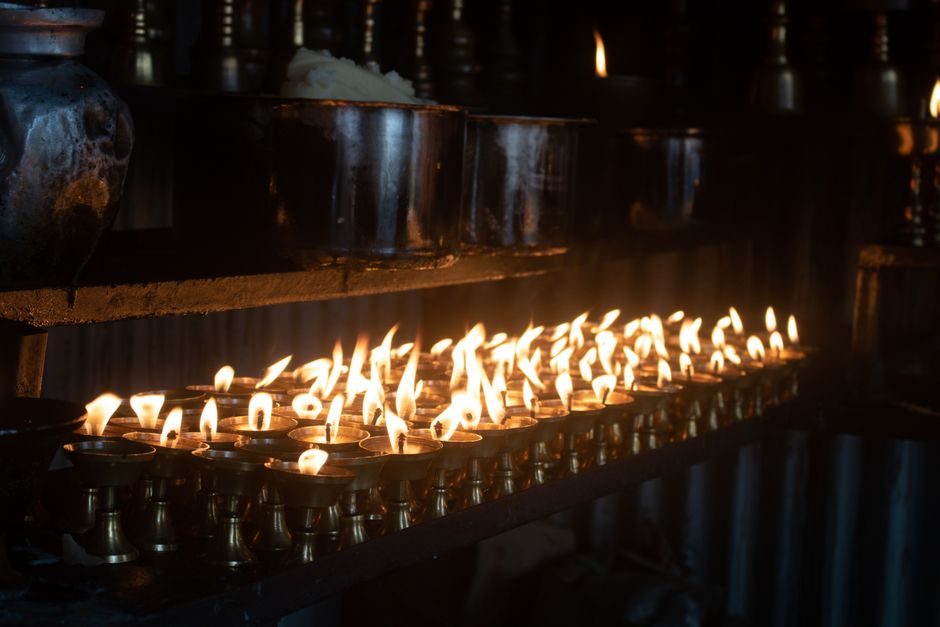
Every morning, the priests of Budhanilkantha climb down to the figure. They step across the water on the stone, bathe the god's face, dress him, offer flowers, rice, sandalwood paste, milk and light, and read from the scriptures while the bells ring. Devotees press against the railing with their own offerings, garlands of marigold, small leaf plates of petals and rice, and the priests take some of them and place them on the stone.
It is not a performance and nobody is performing it for you. That is precisely why it is worth arriving early. In the first hours, Budhanilkantha belongs to the people who have come to pray, and you are allowed to stand quietly among them.
Visiting with respect
Visitors of all faiths may enter the compound and stand at the railing around the pool. Only the priests step down to the figure itself. A few simple courtesies matter here:
- Remove your shoes where your guide indicates, and keep shoulders and knees covered.
- Walk clockwise around the pool, as the pilgrims do.
- Ask before photographing people at prayer, and put the camera away entirely during the most intimate moments of the puja.
- Do not touch the offerings of others, and do not lean over the railing.
How We Design a Private Budhanilkantha Morning
Budhanilkantha rewards a particular kind of visit: early, unhurried, and in the company of someone who knows what is being said and why. Here is how we usually shape it.
Leave the city before it wakes
We collect you from your hotel in the half-dark. Kathmandu at that hour is a different city: shutters still down, the first tea stalls lighting their stoves, pilgrims already walking north along the roadside with flowers in their hands. You arrive with the valley's devotees rather than after them, as the light comes over the hills and the first bells begin.
With a guide who reads ritual
The single most important decision in this visit is the guide. Budhanilkantha needs someone who can follow the Sanskrit of the morning puja, explain the iconography of the figure, tell you which deity a particular offering is for and recognise when it is time to say nothing at all. We work with a small number of guides in the valley who have this knowledge, some of them from priestly families, and we match them carefully to each guest.
A blessing, if you wish
Where it is appropriate, and always through the temple's own priests, guests who wish to may make a simple offering of flowers and light, and receive a tika on the forehead in return. Nothing is staged and nothing is arranged for the camera. It is offered only to those who want it, and many guests tell us afterwards that it was the moment the journey began to feel personal.
Into the Forest: Shivapuri Above the Temple
Directly above Budhanilkantha rise the slopes of Shivapuri Nagarjun National Park, the forested ridge that protects the springs feeding Kathmandu.
A trail climbs from near the temple through oak, rhododendron and pine to Nagi Gumba, a Buddhist nunnery set on a shoulder of the hill. It is a steady climb of a couple of hours at an easy pace, and when you arrive, the nuns may be at prayer, the courtyard is swept, and on clear days the view opens back over the whole of the Kathmandu Valley and north towards the white line of Ganesh Himal. Stronger walkers can continue towards the summit of Shivapuri itself, at a little over 2,700 metres, or to Baghdwar, where the sacred Bagmati river begins as a spring before it flows down past Pashupatinath and through the valley.
Budhanilkantha and the Festival of Awakening
If your journey falls in late October or November, there is one day above all to know about. Vishnu, according to tradition, falls asleep for four months during the monsoon, on the eleventh day of the bright fortnight in the month of Asar, in June or July. He wakes on Haribodhini Ekadashi, the eleventh day of the bright fortnight of Kartik, which falls in October or November. In 2026 it falls in November.
On that day, Budhanilkantha becomes the centre of the valley's devotion. Pilgrims arrive through the night, many having fasted, and by morning the lanes around the temple are full of music, marigolds and families in their best clothes. The god's awakening also marks the return of the auspicious season, and Hindu weddings across Nepal resume in the days that follow.
It is crowded, emotional and genuinely joyous, and it is not for everyone. For guests who want to witness it, we plan the day around the crowd rather than inside it: a place to watch from, a guide who knows the rhythm of the festival and a car that is never more than a short walk away. For guests who prefer stillness, we simply visit on another morning.
Budhanilkantha Within a Longer Journey
Budhanilkantha is a morning, sometimes a day, inside a larger design. These are the combinations that work best.
The sacred valley, in order
Many of our guests who love history and religion ask to understand the valley as a whole rather than as a list of monuments. Budhanilkantha belongs in that story beside the stupa of Boudhanath, the cremation ghats of Pashupatinath and the ancient courtyard of Changu Narayan. Seen in a thoughtful order over four or five unhurried days, these places begin to speak to one another, and the valley stops being a sightseeing programme and becomes a world. This sacred circuit forms the cultural core of many of our Classic journeys.
The valley, then the mountains
More often, Budhanilkantha is part of the opening days of a longer journey: a few days in Kathmandu to rest after the flight, adjust to the altitude and begin to understand the culture, before the mountains. Starting a Himalayan journey with the sleeping god at the source of the valley's waters has a certain rightness to it. Our Premium journeys are often built this way, with the valley first and the high country after.
When to Visit Budhanilkantha
The temple is open every day of the year, and the morning rites continue in every season. For the experience we have described, the best times are:
- October and November, when the monsoon has cleared the air, the hills are sharp and green, and Haribodhini Ekadashi brings the temple to life.
- February to April, when the mornings are mild, the rhododendrons flower on the slopes of Shivapuri and the walk to Nagi Gumba is at its loveliest.
- Early morning, in any season, before the day visitors arrive and while the temple still belongs to the people who come to pray.
What It Costs
A private morning at Budhanilkantha is never priced on its own, because it is never designed on its own. It depends on the guide you need, how many days you spend in the valley, where you stay, whether you walk up into Shivapuri and what comes before and after. A journey of this kind is costed only once it is designed, because no two are the same. If you would like a figure, that conversation starts on our design a journey page.
Frequently Asked Questions
Where is Budhanilkantha?
Budhanilkantha lies at the northern edge of the Kathmandu Valley, at the foot of the Shivapuri hills, roughly ten kilometres north of the city centre. In the early morning it is usually well under an hour from the heritage hotels of central Kathmandu.
How old is the Budhanilkantha statue?
The reclining Vishnu is generally dated to the seventh century, in the Licchavi period. It is carved from a single block of black stone, is about five metres long and is the largest stone sculpture in Nepal.
Can non-Hindus visit Budhanilkantha?
Yes. Visitors of all faiths may enter the compound and watch from the railing around the pool. Only the temple's priests step down to the figure itself.
The God Who Is Still Asleep
Most of the great sights of the Kathmandu Valley are buildings: squares, palaces, stupas, pagodas. Budhanilkantha is not. It is a god, asleep in water, at the edge of a forest, and the reason to go is not to look at him but to be present, for an hour, among the people for whom he is still very much alive. Guests remember the stillness of the water, the smell of incense and wet stone, the priest's bare feet on the serpent's coils, the old woman beside them at the railing. That is what we mean by experiential wealth. It is not something you buy. It is something you are given, if you arrive at the right hour, with the right person, and without hurrying.
I live in Nepal, and the sleeping Vishnu is still one of the places I return to on my own. If you would like to know why a Greek ended up designing journeys here, that story is on my founder page. If you would like a morning like this built into your own journey, with the guide, the timing and the walk into the hills arranged around you, begin your design here.