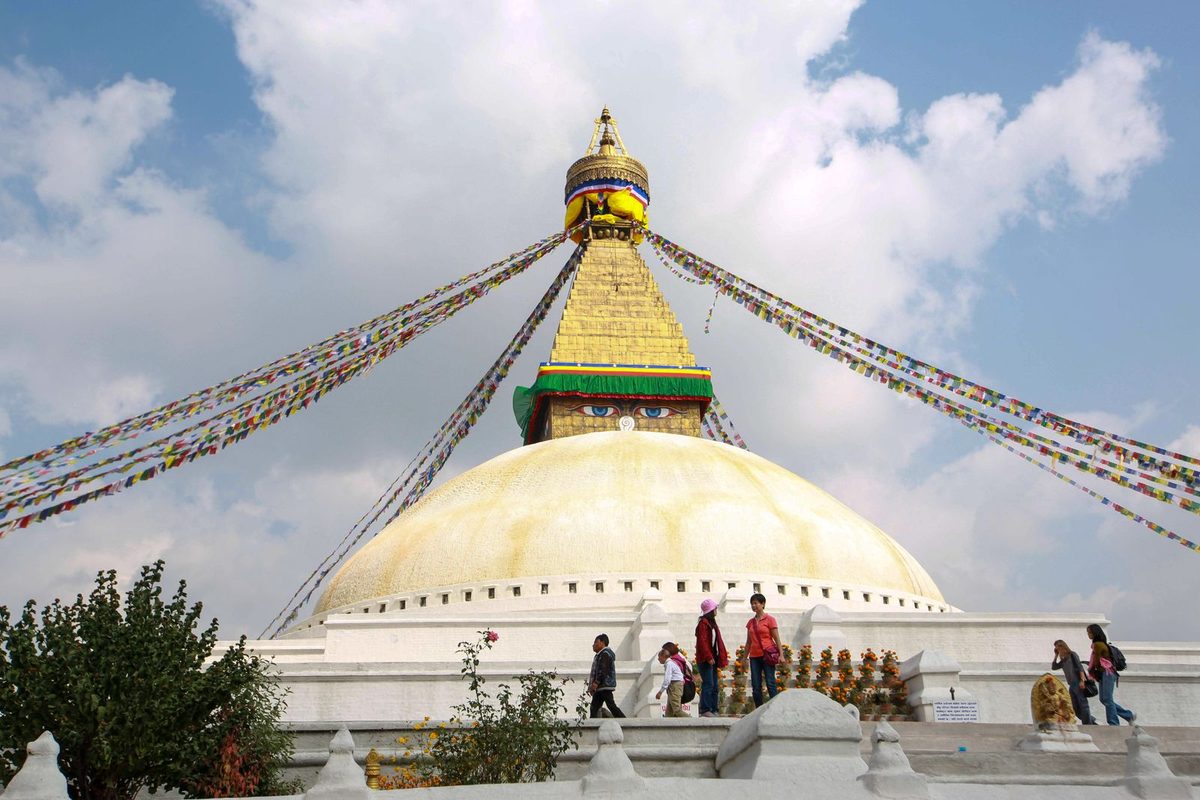
The first people on the circuit are always the old ones. Well before the light comes up over the eastern rim of the Kathmandu Valley, they are already walking: a woman in a striped Tibetan apron with a string of prayer beads moving through her fingers, two elderly monks in maroon talking quietly as they go, a man in a felt hat spinning a hand-held prayer wheel with the patience of someone who has done it every morning for sixty years. Everyone walks clockwise. Nobody hurries. The great white dome of the stupa sits in the middle of it all like a held breath.
Then the first lamps are lit in the small shrines around the base, the smell of juniper smoke drifts across the square, and from somewhere behind the shopfronts comes the long, low note of a monastery horn. For an hour or so, Boudhanath belongs entirely to the people who live their faith around it. A Boudhanath luxury tour, as we design it, is built around being there for that hour, and then walking through the doors that most visitors never know are open.
Why Boudhanath Deserves More Than an Hour
Boudhanath, known locally as Boudha and to Tibetans as Jarung Khashor, is one of the largest stupas in the world and the spiritual centre of Tibetan Buddhism outside Tibet. It stands a few kilometres east of central Kathmandu and forms part of the Kathmandu Valley World Heritage Site.
For centuries it sat on the old trade route between Lhasa and the valley, and Tibetan merchants would stop here to give thanks for having crossed the mountains. After 1959, when thousands of Tibetans followed the Dalai Lama into exile, many settled around the stupa. They built monasteries, workshops, schools and homes, and Boudha became what it is today: a living Tibetan town wrapped around a monument, with dozens of monasteries within a few minutes' walk of the dome.
Most itineraries give it forty minutes in the middle of the day, between lunch and the next temple. The square is at its busiest, the light is flat, and the monasteries are closed for the afternoon. The traveller sees a beautiful building and leaves without meeting the world that surrounds it. That world is the reason to come.
Reading the Stupa: A Mandala You Can Walk Around
A stupa is not a temple. There is no door to enter and nothing to see inside. It is a reliquary and, more importantly, a map of the Buddhist path, meant to be circled rather than visited.
The architecture of enlightenment
Seen from above, Boudhanath is a mandala: a series of square terraces stepping up to a vast white hemisphere, the dome that represents the whole of existence. Above the dome sits the square tower, the harmika, painted on all four sides with the eyes of the Buddha, gazing out over the valley in every direction. Between the eyes, the symbol that looks like a question mark is the Nepali numeral one, a sign of unity. Above the harmika rise thirteen gilded tiers, the thirteen stages on the path to enlightenment, crowned by a parasol.
Strings of prayer flags run from the pinnacle down to the edges of the terraces, blue, white, red, green and yellow for sky, air, fire, water and earth. The wind is said to carry the prayers printed on them across the valley.
The legend of the widow and the buffalo hide
The Tibetan story of the stupa's founding is one of the loveliest in the Himalaya. A poor widow who kept poultry asked the king for a piece of land to build a shrine, only as much as a buffalo hide would cover. The king agreed. She cut the hide into a single thin strip and laid it out in a great circle, enclosing the ground on which Boudhanath now stands. Hence the Tibetan name, Jarung Khashor, often understood as "permission to do, once given, cannot be withdrawn". Ask your guide to tell it at the foot of the stupa. It sounds very different there.
A restoration after 2015
The earthquake of 2015 cracked the stupa's upper structure, and the harmika and spire had to be taken down. The rebuilding was funded almost entirely by the local Buddhist community and devotees, and the stupa was reconsecrated in late 2016, freshly whitewashed and gilded. Today it looks as it must have looked to those Tibetan merchants: impossibly bright against the blue of a clear valley sky.
The Kora: Walking the Circuit at the Right Hour
The kora is the clockwise walk around the stupa, and it is the true experience of Boudhanath. You join it; you do not watch it.
We begin before sunrise. At that hour the circuit is filled with Tibetans and Sherpas, monks and grandmothers, young men on their way to work pausing for three turns before the day begins. You walk at their pace, turning the prayer wheels set into the wall at the base, perhaps stopping to light a butter lamp in one of the small lamp houses. Your guide walks beside you and explains, quietly and only when it helps, what you are seeing: the prostrations on wooden boards in the corners of the square, the mantra om mani padme hum carved into the stones, the reason a certain family always stops at a certain shrine.
After three or four circuits, we climb to the upper terrace of the stupa itself as the sun reaches the dome. There are few places in Asia where the light at dawn feels so much like a ceremony.
The evening kora is the second great hour. As the day-trippers leave, the circuit fills again, the lamps are lit in their hundreds, and the stupa turns gold and then pale blue. We often arrange for travellers to sponsor a lamp offering in one of the monasteries at dusk, which is a very old way of marking a journey, a birthday or a memory.
Beyond the Square: The Monasteries of Boudha
Behind the ring of shops and cafés lies the real Boudha: a quarter of monasteries, each with its own lineage, character and rhythm.
Shechen Monastery
A few minutes' walk from the stupa, Shechen was founded in the 1980s by Dilgo Khyentse Rinpoche, one of the great Tibetan masters of the twentieth century. Its assembly hall is painted from floor to ceiling in a style that belongs to eastern Tibet, and its morning and evening chanting is among the most powerful in the valley. The monastery also runs a school of traditional arts, where young painters are trained in thangka and mural work to the old standards.
Ka-Nying Shedrub Ling, the White Monastery
Known to everyone as the White Monastery, Ka-Nying Shedrub Ling was founded in the 1970s by Tulku Urgyen Rinpoche. It has long welcomed people from outside the tradition, and its courtyard, gilded roofs and quiet corners make it one of the most beautiful places in Boudha to sit and simply watch monastic life go by.
The smaller gompas
Some of our favourite moments happen in monasteries you will not find in any guidebook: a small hall where a handful of monks are making a sand mandala, grain by grain; a courtyard where young novices debate philosophy with theatrical claps of the hands; a family chapel above a shop where an old nun keeps a lamp burning for a teacher she met fifty years ago. These doors open because of relationships, and because we arrive at the right hour, quietly and with respect.
Kopan, on the hill
To the north, on a hilltop overlooking the valley, stands Kopan Monastery, founded in the early 1970s by Lama Thubten Yeshe and Lama Zopa Rinpoche. It has introduced generations of Western visitors to Buddhist meditation. A morning at Kopan, with its gardens, its view back across the valley to the stupa and, when the programme allows, a short session of guided meditation, is one of the gentlest and most memorable additions to a Boudhanath journey.
What Makes a Boudhanath Journey Truly Private
Luxury at Boudha is not a matter of gold taps. It is measured in time, quiet, access and the quality of the people you meet.
An audience with a lama
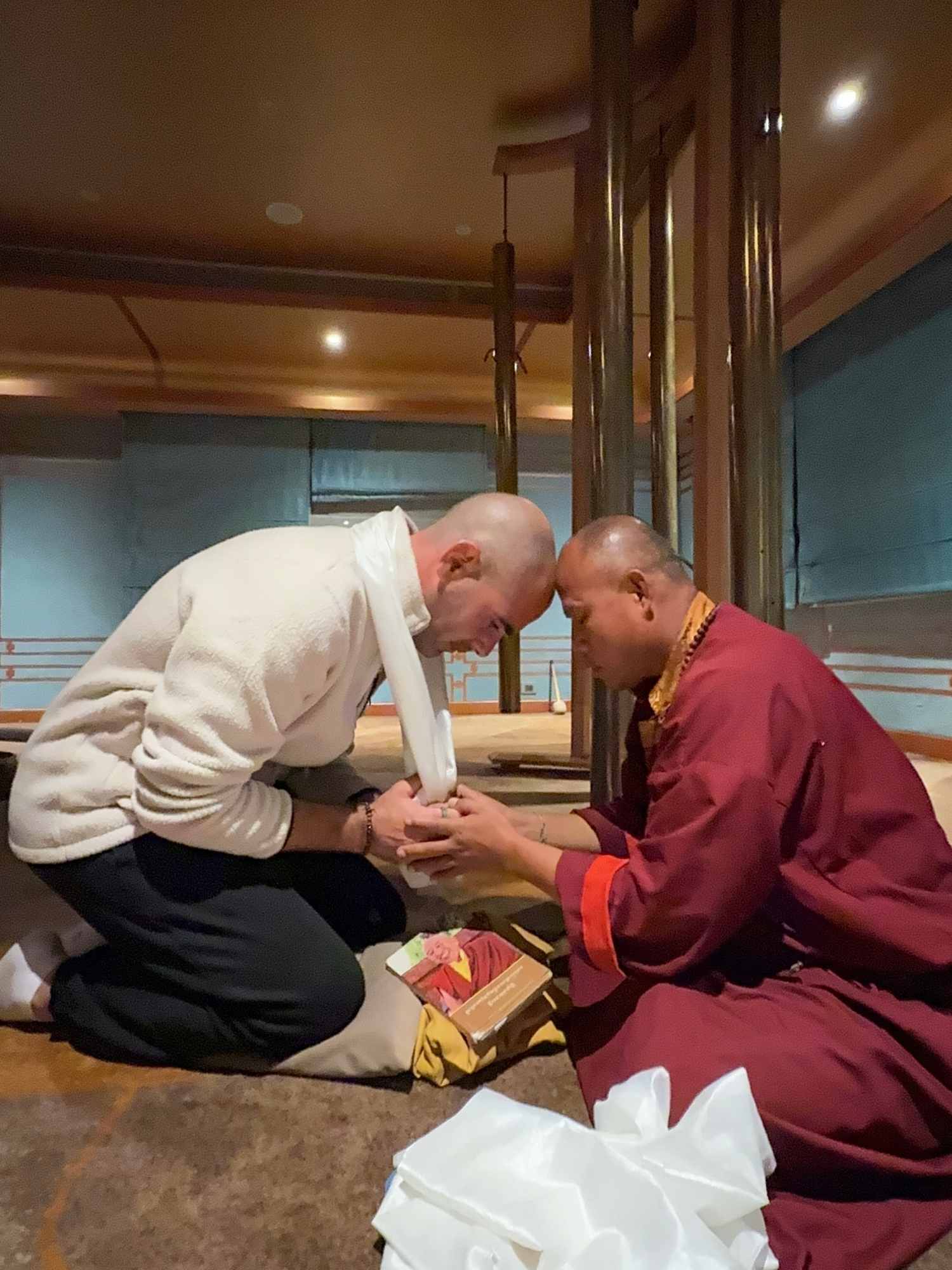
For many of our travellers, the heart of the journey is a private conversation with a senior monk or lama. It is not a performance. It is an hour of questions and answers, sometimes a short teaching, sometimes a blessing and a white khata scarf placed around your shoulders. We arrange these carefully, through people we have known for years, and only when the teacher is genuinely willing to receive visitors.
A guide who belongs to the community
The best guides in Boudha are Tibetans and Sherpas who grew up around the stupa and know its families, feast days and monastery schedules. They are chosen for temperament as much as knowledge: some travellers want a scholar, others a quiet companion who knows when not to speak.
The thangka studio
A thangka is a sacred scroll painting, and in Boudha the craft is still practised to the exacting rules laid down centuries ago. A private visit to a master painter's studio, rather than a shop, shows you the whole process: the grid of proportions, the pigments ground from minerals and stones, the gold applied last and burnished with an agate. A single large thangka can take months. If you fall in love with one, the master will explain what it depicts and how it should be hung. If you do not, you will still leave understanding every thangka you see for the rest of your life.
A rooftop at dusk
On the rooftops overlooking the square, we arrange a private table for the evening, timed so that you watch the lamps being lit and the kora thicken below as the light goes. A Tibetan dinner, a pot of butter tea for the curious, and the prayer flags moving overhead. Most of our travellers describe this moment first when they come home.
Where to stay
Boudha itself has a handful of boutique guesthouses and small hotels with rooftop views of the dome, and a large, garden-set international hotel a short walk from the stupa. We choose room by room, for light, silence and the view. Some travellers prefer to stay elsewhere in the valley and come to Boudha at the hours that matter; our guide to luxury Kathmandu explains how we think about those bases.
Festivals at the Great Stupa
Boudhanath's calendar is shaped by the Tibetan lunar year, and a festival changes the square completely.
- Losar, the Tibetan New Year, falls in late winter. Families in their finest clothes walk the kora, monasteries perform masked dances, and fresh prayer flags are raised from the pinnacle of the stupa.
- Buddha Jayanti, the full moon of spring, celebrates the birth, enlightenment and passing of the Buddha. The stupa is lit with lamps and the kora continues late into the night.
- Full moon and new moon days throughout the year draw larger crowds of the devout, with more lamps, more chanting and a deeper sense of occasion.
Festival days reward careful preparation: a rooftop reserved well in advance, a guide who knows the order of the rituals, and the judgement to step back when a moment belongs to the community. Our wider guide to Nepal's festivals covers the national calendar.
How to Build Boudhanath Into a Nepal Journey
Boudhanath sits close to Kathmandu's international airport and to the other great sites of the valley, which makes it wonderfully easy to weave into a longer journey. Some patterns we return to:
- The sacred valley. Boudhanath at dawn and dusk, with the Hindu temple complex of Pashupatinath a short distance away, and Swayambhunath, the hilltop stupa on the other side of Kathmandu. Paired with the royal cities of Patan and Bhaktapur, this becomes a complete portrait of the valley's two great faiths, and it sits naturally within our Elysian Classic journey.
- The contemplative journey. Several days in Boudha built around the monasteries, a lama's audience, meditation at Kopan and unhurried time on the kora, as the prelude to a longer spiritual retreat in Nepal or a pilgrimage to Lumbini.
- The gentle opening or the gentle close. Two nights in Boudha at the start of a journey let the long flight settle; two nights at the end, after weeks in the mountains, let you return slowly. Our Premium journeys are often shaped exactly this way.
When to Visit Boudhanath
- October to November: clear skies, crisp mornings and the finest light of the year. The classic season, and the busiest.
- December to February: cold, very clear mornings, a quieter square and, in late winter, the celebrations of Losar.
- March to May: warm, bright days, blossom in the valley and Buddha Jayanti at the spring full moon.
- June to September: the monsoon brings afternoon rain, a rinsed and glowing stupa and far fewer visitors.
Whatever the month, the stupa's finest hours are before seven in the morning and after five in the evening. Saturday, Nepal's weekly holiday, brings more local families to the kora, which some travellers love and others prefer to avoid.
How a Private Boudhanath Journey Is Costed
A journey of this kind is costed only once it is designed, because no two are the same. What shapes it is where you stay and for how long, which monasteries, teachers and craftsmen you spend time with, whether a festival or a special offering is involved, and how Boudhanath fits into the rest of your time in Nepal. If you would like a figure, that conversation starts on our design a journey page.
Frequently Asked Questions
Is Boudhanath worth more than a quick visit?
Yes. A midday visit shows you the stupa at its busiest. A night or two nearby gives you the kora at dawn and dusk, time inside the monasteries, and the chance of a conversation with a teacher, which is where the real journey begins.
Do I need to be Buddhist to walk the kora or enter the monasteries?
No. Visitors of every faith are welcome to walk the kora, clockwise, and most monasteries welcome respectful visitors to their halls and courtyards. Dress modestly, remove your shoes where asked, never point your feet at an altar, and ask before photographing monks or ceremonies. Your guide will explain each custom before you need it.
How far is Boudhanath from central Kathmandu?
A few kilometres east of the city centre and close to the international airport. We always travel by private vehicle and plan timings around the rhythm of the stupa rather than a fixed schedule.
Can I attend a puja or meditation session?
Often, yes. Morning and evening chanting in several monasteries is open to quiet observers, and Kopan offers meditation sessions and courses on its own schedule. We confirm what is possible for your dates when we design the journey.
Can Boudhanath be combined with a Himalayan journey?
Easily, and it is one of our favourite combinations. Its position near the airport makes it a natural first or last chapter of a longer journey through the destinations we design.
Begin Your Boudhanath Journey
Every time I bring travellers to Boudha, I notice the same thing: the stupa gives most to the people who slow down. The ones who walk the kora a second time, sit a little longer in a monastery hall, or come back at dusk after seeing it at dawn, are the ones who go home changed. If you would like to know how I came to be here at all, the story is on the founder page.
If you would like to see the Great Stupa as it deserves, at first light, with the right guide, behind the right doors, tell us how you like to travel and we will design the rest. Your journey begins on our design a journey page.