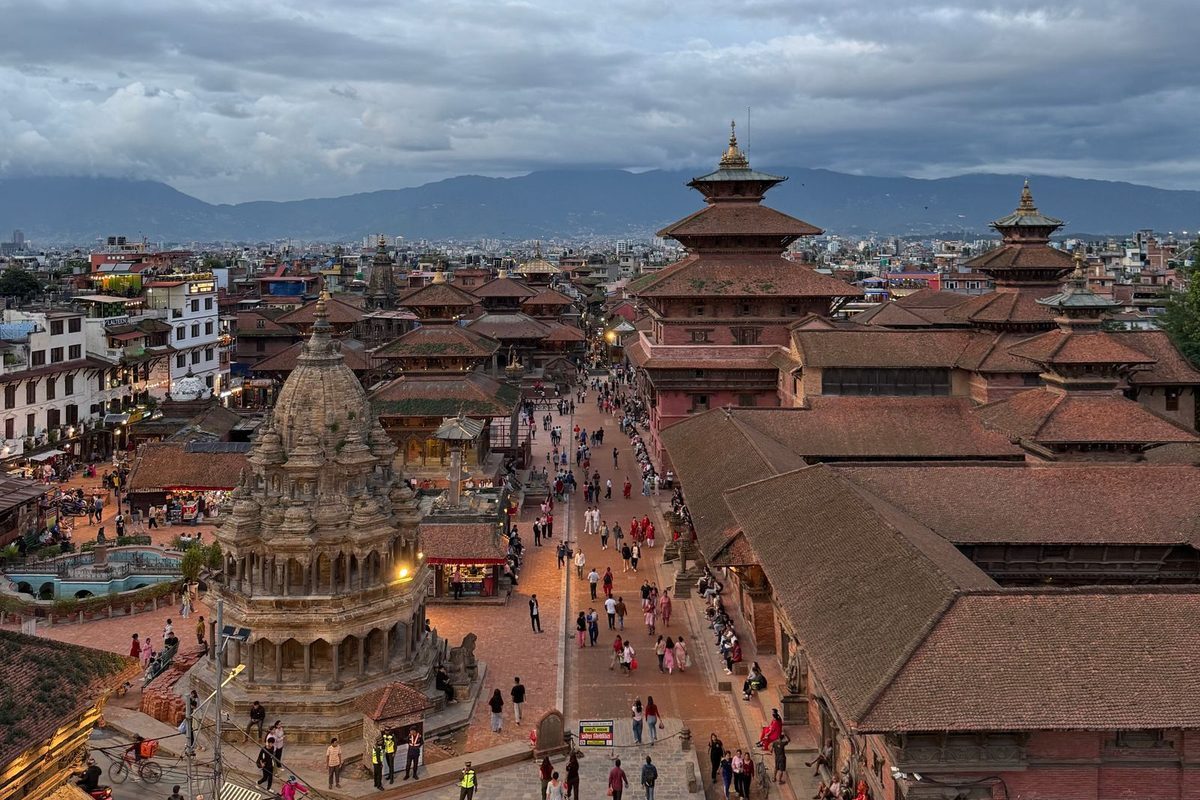
The bells start before the light does. At a little after five in the morning, in the Durbar Square of Patan, a man in a woollen cap unlocks the small shrine at the foot of the Krishna Mandir, rings its bell three times and sets down a leaf plate of flowers. A woman crosses the square with a copper water jar on her hip, heading for the sunken stone spout that has served this neighbourhood for more than a thousand years. Pigeons lift off the roofs of the palace in a single grey sheet. Across the stones, somebody is sweeping.
No ticket booth is open yet, and there is no noise but brooms, bells and water. For an hour or so, Patan is exactly what it was built to be: a city of craftsmen and priests going about the ordinary business of devotion. A Patan luxury tour, as we design it, is about being there for that hour, and for the dozen other quiet hours the city keeps for people who are willing to wait for them.
Why Patan Rewards the Patient Traveller
The Kathmandu Valley was once three rival kingdoms, each with a royal city, a palace and a Durbar Square, and each determined to outbuild the other two. Kathmandu was the seat of power. Bhaktapur was the old capital, proud and self-contained. Patan, just across the Bagmati river from Kathmandu, became the city of artists.
Its Sanskrit name, Lalitpur, is usually translated as "the city of fine arts", and the Newars call it Yala. For centuries the valley's finest bronze-casters, carvers and painters came from its lanes, and their work travelled to the monasteries of Tibet and, eventually, the museums of Europe and America. That tradition never stopped. Walk the back streets of Patan today and you will still hear the tap of a small hammer on metal behind half-open doors.
Patan is also the most Buddhist of the three royal cities. Tucked behind its street fronts are well over a hundred bahals and bahis, courtyard monasteries where Newar Buddhist families still live, worship and care for their shrines. Many are invisible from the street. You pass through a low doorway, often guarded by a pair of stone lions, and find yourself in a quiet square of brick and carved timber with a stupa at its centre and children doing their homework on its steps.
Most visitors give Patan half a day between Kathmandu and Bhaktapur, photograph the Krishna temple and leave. They never find the city behind the façade, and that city is the reason to come.
The Durbar Square: A Royal City in Stone and Timber
Patan's Durbar Square is, by common consent, the most complete and harmonious of the three in the valley. The palace runs along its eastern side; the temples stand in a line along the west, facing it like an audience.
Krishna Mandir
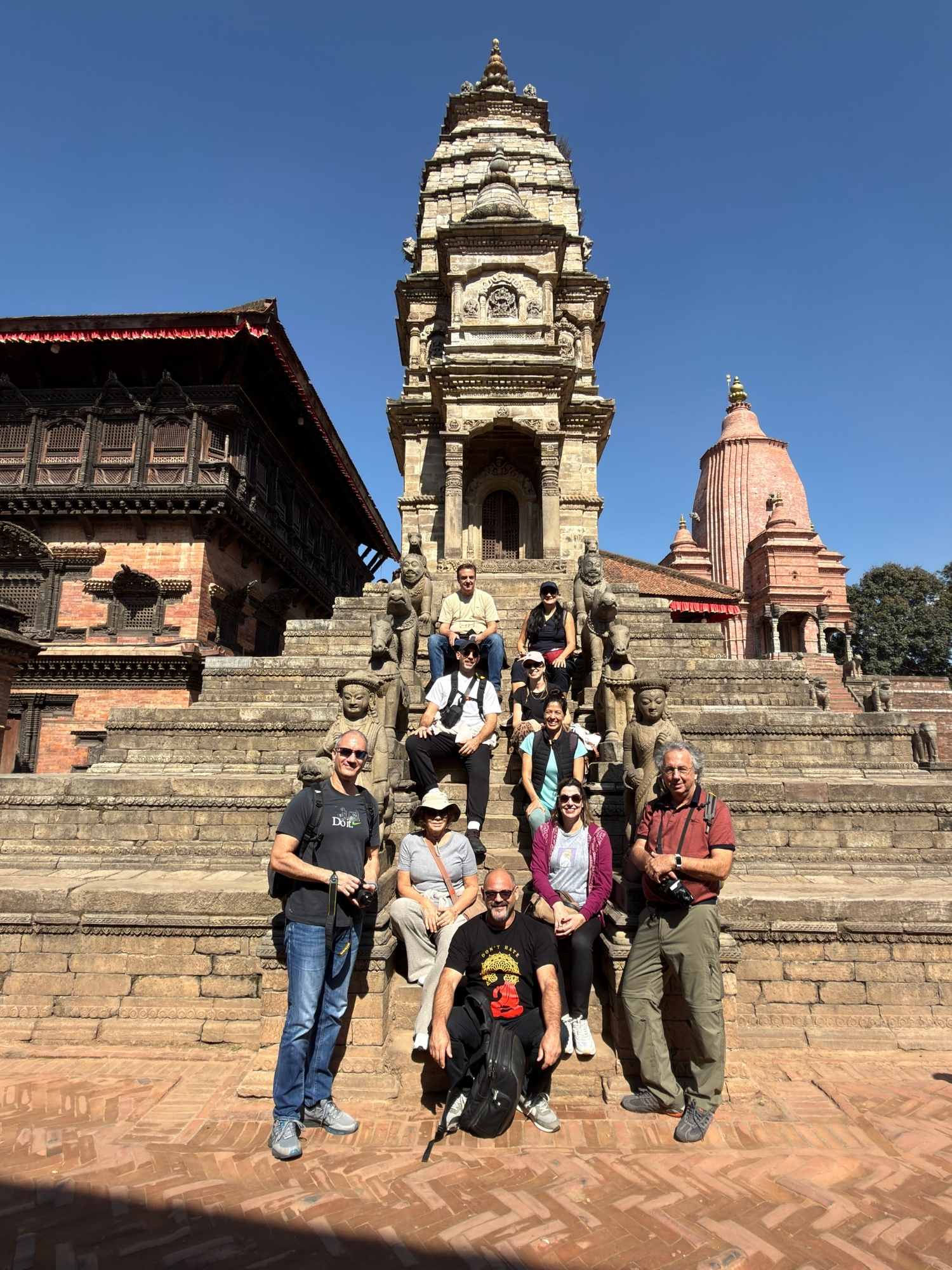
The temple most people recognise is the Krishna Mandir, raised in 1637 by King Siddhi Narasingh Malla. Unlike the tiered pagodas around it, it is built entirely of stone in the shikhara style of northern India, with open pavilions on each level and a slender tower rising above them. Along its friezes, carved in fine grey stone, run scenes from the Mahabharata and the Ramayana, captioned in the old script of the valley. Ask your guide to read a few of them to you. The stories suddenly become very close.
The palace and its courtyards
The royal palace is a sequence of courtyards, each with its own character. Mul Chowk, the central court, was the ceremonial heart of the Malla kings, framed by gilded doorways and the temple of their goddess, Taleju. Sundari Chowk, to the south, holds one of the valley's great hidden treasures: the Tusha Hiti, a sunken royal bath lined with carved stone deities, where the kings performed their morning ablutions.
The northern courtyard, Keshav Narayan Chowk, is now the Patan Museum. It was restored with Austrian support and opened in the 1990s, and it is quite simply the finest museum in Nepal. The collection of bronzes, many cast in the workshops of Patan itself, is displayed with a care and light that would not be out of place in Vienna or London. Allow two hours, not twenty minutes. Then take tea in the garden at the back of the museum, which is one of the most peaceful places in the entire valley.
The temples of the square
Beyond the Krishna Mandir, the square holds a small gathering of masterpieces: the Bhimsen temple, dedicated to the god of traders; the Vishwanath temple with its stone elephants; the octagonal Chyasin Dega; and, on a tall stone column facing the palace, the kneeling bronze figure of King Yoganarendra Malla, hands folded, a cobra rising behind him, watching his city from the late seventeenth century. Local legend holds that as long as the small bird on the cobra's head remains, the king may yet return.
Several of the square's temples fell in the earthquake of 2015 and have since been rebuilt by Newar craftsmen using the original techniques and, wherever possible, the original timbers. Telling old struts from new takes a trained eye, which is a tribute to the craftsmen.
Beyond the Square: The City of Courtyards
The real Patan lies in a web of lanes spreading out from the Durbar Square. We walk them slowly, in an order that follows the city's history rather than its car parks.
The Golden Temple
A few minutes north of the square, through an unremarkable doorway, lies the Hiranya Varna Mahavihar, known to everyone as the Golden Temple. Tradition dates its founding to the twelfth century. The courtyard is small and astonishingly rich: a gilded façade, bronze guardian figures, prayer wheels, and a shrine attended by a young boy from the monastery's own families, who serves as temple priest for a month at a time. Leave your shoes and anything made of leather at the door, and sit for a while. Nobody will hurry you.
Kumbheshwar
Further north stands the Kumbheshwar temple, one of the very few five-roofed pagodas in the valley and by tradition the oldest temple in Patan. Its courtyard holds a sacred pond and a quiet population of old men and pilgrims; it is a working temple rather than a monument.
Mahabouddha
South-east of the square, hemmed in by houses so tightly that you can barely step back far enough to see it, stands the Mahabouddha, the temple of a thousand Buddhas. It was built by a Patan priest who had made the long pilgrimage to Bodh Gaya in India and wanted to bring its great temple home with him. Every one of its terracotta bricks carries an image of the Buddha. It was rebuilt after the earthquake of 1934, and it remains one of the strangest and most beautiful buildings in Nepal. The best view is from a neighbouring rooftop.
The Living Workshops of Patan
If Bhaktapur is the valley's city of potters and woodcarvers, Patan is its city of metal.
The bronze figures you see in the Patan Museum were made using the lost-wax method: a figure is modelled in beeswax, encased in clay, and heated until the wax runs out, leaving a mould into which molten metal is poured. Every mould is broken to release its figure, so every piece is unique. The families of Patan have practised this craft for many centuries, and a handful of workshops still produce sacred images to the standards their ancestors set.
A private visit to one of them is among the most memorable experiences in the valley. You will see a figure at every stage of its making, from the wax model to the final gilding and the painting of the face, which is traditionally the last act and brings the image to life. The master will explain the proportions laid down in the old treatises, and why a single figure can take many months. The visit is an introduction, not a shop.
Nearby, in upstairs rooms, painters work on paubha, the Newar tradition of sacred scroll painting, grinding their pigments from minerals. At the southern edge of the city, the Tibetan community of Jawalakhel has woven carpets since the 1960s, and you can still watch the looms at work.
These are the doors that make a Patan journey. None of them can be booked online. They open because of relationships built over years, and they are what we mean by experiential wealth: not more things to see, but a different depth of seeing.
What Makes a Patan Journey Truly Luxurious
Patan has no palace hotels inside its old city, and it would be less itself if it had. Luxury here is measured in time, quiet and access.
Time your visit to the city's rhythm
The Durbar Square is at its most beautiful before eight in the morning and after five in the evening. We bring travellers in at those hours and spend the busy middle of the day in the museum, a courtyard or a private home.
Stay in the old city, or close to it
Around the Durbar Square, a small number of restored Newari townhouses have been converted into heritage guesthouses, with carved windows, brick courtyards and roof terraces that look across the pagoda roofs. We choose between them room by room, for light and for silence. For travellers who prefer a full-service hotel, we base the stay elsewhere in the valley and return to Patan at the hours that matter. Our guide to luxury Kathmandu explains how we think about those bases.
A guide from Patan itself
The best Patan guides are Newars from the city's own families, who know which courtyard is celebrating a feast day and which master caster will welcome a visitor this week. We work with a small number we know personally, and match them to each traveller by temperament as much as by knowledge.
An evening among the temples
On a fine evening we arrange a table on a rooftop overlooking the Durbar Square, so that you can watch the lamps being lit in the shrines below and hear the evening bhajan, the devotional singing that still fills the rest houses around the square. It is the moment most of our travellers describe first when they come home.
Patan's Festivals
Patan's calendar is dense with ritual, and a festival changes the city completely.
- Rato Machhindranath Jatra is the longest and most spectacular chariot festival in the valley. In late spring a towering chariot carrying the red god of rain is hauled through the streets of Patan by hand, over a period of weeks, and the festival ends at Jawalakhel with the public display of a sacred jewelled vest before a vast crowd.
- Krishna Janmashtami, Krishna's birthday in late summer, surrounds the Krishna Mandir with thousands of devotees singing through the night by the light of oil lamps.
- Dashain and Tihar, the great autumn festivals of Nepal, fill the courtyards with family ritual, kites, marigolds and, on the nights of Tihar, countless small flames.
Festival days reward careful preparation: a rooftop arranged in advance, a guide who knows when to bring you into the heart of it and when to step back. Our wider guide to Nepal's festivals covers the national calendar.
How to Build Patan Into a Nepal Journey
Patan sits within a few kilometres of central Kathmandu, which makes it wonderfully easy to weave into a longer journey. Some patterns we return to:
- The three royal cities. Kathmandu, Patan and Bhaktapur over several unhurried days, each with its own specialist guide, so that the three cities begin to speak to one another. This sits naturally within our Elysian Classic journey.
- The arts journey. Two or three days built around Patan's crafts: the museum with a curator's eye, a morning in a bronze workshop, an afternoon with a paubha painter. A rare thing for collectors.
- The gentle opening or the gentle close. Two nights in Patan at the start of a journey let the long flight settle; two nights at the end, after weeks in the mountains, let you return to the world slowly. Our Premium journeys are often shaped exactly this way.
When to Visit Patan
- October to November: clear skies, soft light and the festivals of Dashain and Tihar. The classic season, and the busiest.
- December to February: cool, very clear, with crisp mornings and near-empty squares.
- March to May: warm and bright, often with the Rato Machhindranath chariot on the move.
- June to September: the monsoon brings afternoon rain, green courtyards and Krishna's birthday.
Whatever the month, the city's finest hours are before eight in the morning and after five in the evening.
How a Private Patan Journey Is Costed
A journey of this kind is costed only once it is designed, because no two are the same. What shapes it is where you stay, how many nights you spend in or near the old city, which guides, craftsmen and specialists you spend time with, whether a festival is involved, and how Patan fits into the rest of your time in Nepal. If you would like a figure, that conversation starts on our design a journey page.
Frequently Asked Questions
Is Patan worth more than half a day?
Yes. Half a day shows you the Durbar Square at its busiest. A night or two nearby gives you the square at dawn and after dark, and time for the museum, the courtyards and the workshops.
How far is Patan from Kathmandu?
Patan lies just across the Bagmati river from Kathmandu, a few kilometres south of the city centre. We always travel by private vehicle and plan timings around the rhythm of the valley rather than a fixed schedule.
Can non-Hindus enter all the temples?
Most of Patan's squares, courtyards and temple exteriors are open to everyone, and the Buddhist courtyards generally welcome respectful visitors. A few inner sanctums, including that of the Krishna Mandir, are reserved for Hindus. A good guide will explain each boundary before you reach it.
Can Patan be combined with a Himalayan journey?
Easily, and it is one of our favourite combinations. Patan's position close to Kathmandu makes it a natural first or last chapter of a longer journey through the destinations we design.
Begin Your Patan Journey
I have spent more mornings in Patan than I can count, and the city still surprises me: a courtyard I had walked past a hundred times, a caster's apprentice polishing the face of a goddess, an old woman who stops to explain a shrine I had never noticed. Patan keeps its treasures for people who slow down.
If you would like to see it the way it deserves, at first light, with the right guide, behind the right doors, tell us how you like to travel and we will design the rest. Your journey begins on our design a journey page.