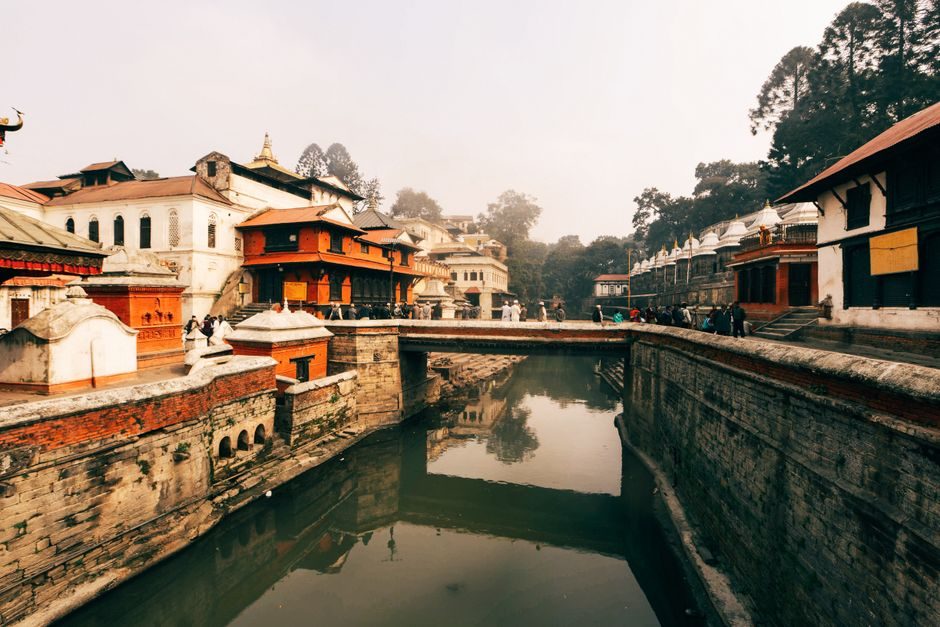
The river is the first thing you hear. Before the light comes over the eastern hills, the Bagmati is only a sound below the stone terraces, and the air smells of wet stone, marigolds and the smoke of a fire that has been burning since long before you arrived. A bell rings somewhere inside the temple walls. A man in a white cloth walks down the steps to the water, cups it in his hands and pours it back three times. On the far bank, a sadhu with ash on his forehead sits wrapped in a blanket and watches him without expression.
Nobody is performing anything. This is simply how the day begins at Pashupatinath, as it has begun for something like fifteen centuries. A Pashupatinath luxury tour, as we design it, is built around arriving at that hour, standing in the right place, and having beside you someone who can explain what you are seeing, and who also knows when to fall silent.
Why Pashupatinath Is Unlike Anywhere Else in Nepal
Pashupatinath is the most sacred Hindu temple in Nepal and one of the most important shrines to Shiva anywhere in the world. It stands on the banks of the Bagmati River on the eastern edge of Kathmandu, a short drive from the international airport, and it forms part of the Kathmandu Valley World Heritage Site.
Shiva is worshipped here as Pashupati, the lord of all living beings. Pilgrims come from across Nepal and India, some of them walking for weeks, to stand before him once in their lives. Nepali families come to name their children, to marry, to make offerings for the sick, and, at the end, to bring their dead to the river.
That last fact is what makes Pashupatinath so different from the other great monuments of the valley. Boudhanath is a place of circling and prayer. Patan and Bhaktapur are royal cities of art. Pashupatinath is all of life at once, including the part most of us are taught never to look at directly. It is not a museum, and it asks to be approached with a certain seriousness. Visited that way, it can be one of the most quietly profound mornings of a lifetime.
Reading the Temple Complex
Pashupatinath is not a single building but a sacred landscape: temples, shrines, ghats, ashrams and a small forest, spread over both banks of the river and up the wooded hill behind them.
The main temple
At the centre stands the great pagoda of Pashupatinath, with its two tiers of gilded roofs, its silver-plated doors and its carved roof struts. Before the western door kneels Nandi, Shiva's bull, a vast gilded figure looking steadily towards the sanctum, as he has for centuries. Inside is the lingam of Pashupati, with four faces turned to the four directions and a fifth turned towards the sky.
Entry to the main temple courtyard is reserved for Hindus. This is not a formality, and we never try to work around it. For everyone else, the finest view of the temple lies across the river, from the terraces on the eastern bank, where the whole complex unfolds in front of you: the golden roofs, the ghats, the steps descending into the water. A good guide turns that apparent limitation into an advantage. From the eastern bank you see Pashupatinath as a living whole rather than a single shrine.
The priests
By long tradition, the principal priests of Pashupatinath come from South India, a custom often traced back to the reforms of the philosopher Adi Shankaracharya. It is one of those details that tells you how far the temple's influence has always reached: a Himalayan shrine served by priests from the other end of the subcontinent, in an unbroken line.
The ghats
The stone platforms along the western bank are the cremation ghats. Hindus believe that to be cremated at Pashupatinath, beside a river that flows on to the Ganges, is a profound blessing. The families arrive, wash the body in the river, wrap it in cloth and marigolds and lay it on the pyre. The eldest son lights the fire. When it is done, the ashes are given to the Bagmati.
There is nothing hidden about it, and nothing staged. For travellers who have only ever known death behind closed doors, watching it here, from the far bank and at a respectful distance, can be unsettling. It is also, for many, unexpectedly consoling. The rituals are unhurried, the families are together, and the river simply carries on.
The shivalayas and the eastern terraces
Above the eastern bank stands a long row of small, white, stone shrines, each sheltering a Shiva lingam. Sit on the steps among them in the early morning and the whole complex is laid out below you. This is where we bring travellers first, before anything else, so that they can simply look for a while before anyone says a word.
Guhyeshwari and Mrigasthali
A short walk upstream, through the wooded hill of Mrigasthali, lies the temple of Guhyeshwari, dedicated to the goddess as Shakti, the feminine power of the divine. In Hindu tradition it is one of the Shakti Peethas, the sacred places where parts of the body of the goddess Sati are said to have fallen to earth. Pilgrims often visit Pashupatinath and Guhyeshwari together, as two halves of a single devotion.
Mrigasthali itself, "the place of the deer", is a quiet forest on the hill between the two, home to small temples, troops of monkeys and a small herd of deer, and a welcome stillness after the intensity of the river. On its crest stands the temple of Gorakhnath, one of the great ascetic teachers of the Himalaya.
The Sadhus of Pashupatinath
Among the temples you will meet the sadhus, Hindu holy men who have renounced home, property and family to follow Shiva. Some live at Pashupatinath for years; others pass through on lifelong pilgrimages from one end of India to the other. Their faces are painted, their hair is often matted into long ropes, and some wear nothing but ash.
It is easy to treat them as a photograph. We would gently ask you not to. Some of the men in brightly painted faces around the main walkways have made a living from posing, which is honest enough. The genuine ascetics are usually elsewhere, quieter, often in the ashrams on the hillside. With the right guide, and the right introduction, it is sometimes possible to sit with one of them for a while, through an interpreter, and ask what has brought him here. Those conversations are rarely what travellers expect. They are often the part of the day they remember longest.
The Evening Aarti on the Bagmati
Every evening, as the light goes, the ghats come alive for the aarti, the ceremony of light offered to Shiva and to the river. Priests stand in a line facing the water, moving great brass lamps in slow arcs, while bells, drums and chanting rise over the crowd gathered on the terraces. Smoke from the lamps drifts across the river and catches the last of the light.
It is open to everyone, Hindu or not, and the terraces fill quickly, especially on Mondays, Shiva's day. This is where design matters most. We arrive early, with a guide who knows which part of the eastern terrace gives the clearest view of the ceremony without placing you in the middle of a family's prayers. On many evenings we arrange for you to make a small offering of your own: a leaf boat with a flame and a few flowers, set onto the river at the end of the ceremony. It is a very old way of marking a journey, a birthday, or the memory of someone you have lost.
What Makes a Pashupatinath Journey Truly Private
Luxury at Pashupatinath is not about comfort in the ordinary sense. It is about time, timing, quiet and understanding.
The right hours
The temple complex is at its most beautiful and its most real at dawn and at dusk. At midday it is hot, crowded and flat. We design the visit around the early morning and the evening aarti, sometimes on two different days, and keep the middle of the day for rest, lunch or the other sites of the valley.
A guide who reads the rituals
The guides we work with at Pashupatinath are chosen for knowledge and, above all, for tact. They know the meaning of every gesture at the river, the difference between a funeral and a memorial rite, the stories of the shrines on the hillside, and the families who have kept small temples here for generations. They also know when a moment belongs to someone else, and when to step back.
A private puja
For travellers who wish it, we can arrange a private puja, a Hindu ritual of offering, led by a priest at one of the shrines open to visitors of all faiths. It might be a blessing for a journey, for a marriage, or for someone at home who is unwell. The priest explains each step as it unfolds. You do not need to share the belief to be moved by the care with which it is done.
Rest, afterwards
Pashupatinath can leave you full. We always plan what comes next with that in mind: breakfast in a quiet garden, a few hours at a hotel spa, or simply a slow walk among the monasteries of Boudhanath, a short drive away. Our guide to luxury Kathmandu explains how we choose where travellers stay in the valley, room by room.
Festivals at Pashupatinath
The temple's calendar follows the Hindu lunar year, and a festival changes it completely.
- Maha Shivaratri, the great night of Shiva, falls in late winter, usually February or early March. Hundreds of thousands of pilgrims and sadhus from across Nepal and India gather here, fires burn through the night and the whole complex becomes a vast vigil. It is extraordinary, and it is intense. We design these visits with particular care.
- Teej, in late summer, fills the temple with women dressed in red, who fast, sing and dance for the wellbeing of their husbands and families.
- Bala Chaturdashi, in late autumn or early winter, is a night and a morning of remembrance, when families keep vigil and scatter seeds across the forest of Mrigasthali in memory of those they have lost.
- Mondays throughout the year, and especially during the holy month of Shrawan, draw larger crowds of the devout to the temple.
Our wider guide to Nepal's festivals explains how we plan around the national calendar.
How to Build Pashupatinath Into a Nepal Journey
Pashupatinath sits between the airport and the heart of Kathmandu, a short drive from Boudhanath. It belongs naturally to a journey through the valley's sacred and royal sites, and it pairs well with almost anything.
- The sacred valley. Pashupatinath at dawn, Boudhanath in the afternoon and at dusk, and the hilltop stupa of Swayambhunath on another morning, together with the royal cities of Patan and Bhaktapur. Few places on earth let you see two great faiths so closely entwined in a single valley, and this is the heart of our Elysian Classic journey.
- The pilgrimage. For travellers drawn to the spiritual side of Nepal, Pashupatinath can be the first chapter of a longer pilgrimage, to the sacred temple of Muktinath, revered by Hindus and Buddhists alike, or to a spiritual retreat in the mountains.
- The quiet beginning. Two or three nights in the valley at the start of a journey, before the mountains, give time to settle and to see Nepal from the inside before seeing it from above. Our Premium journeys are often shaped this way, before travelling on to the destinations further from the city.
When to Visit Pashupatinath
- October to November: clear skies, soft light and the classic season in the valley. Busy, but at dawn still deeply peaceful.
- December to February: cold, very clear mornings, the fires on the ghats more visible in the winter air, and Maha Shivaratri towards the end of the season.
- March to May: warm days, blossom in the valley, and long evenings for the aarti.
- June to September: the monsoon season. The Bagmati runs high, afternoons are often wet, and the temple is quieter for visitors. Teej usually falls in this period.
Whatever the month, the finest hours at Pashupatinath are before eight in the morning and the hour of the evening aarti.
How a Private Pashupatinath Journey Is Costed
A journey of this kind is costed only once it is designed, because no two are the same. What shapes it is how long you stay in the valley and where, whether you wish to include a private puja, a festival or a longer pilgrimage, and how Pashupatinath fits into the rest of your time in Nepal. If you would like a figure, that conversation starts on our design a journey page.
Frequently Asked Questions
Can non-Hindus visit Pashupatinath?
Yes. Visitors of every faith are welcome in the wider temple complex, on the eastern terraces, at the shrines on the hillside, at Mrigasthali and at the evening aarti. Only the main temple courtyard is reserved for Hindus. The best views of the main temple and the ghats are, in any case, from the eastern bank.
Is it respectful to watch the cremations?
From the eastern bank and at a respectful distance, yes. Cremations at Pashupatinath are public and families are accustomed to visitors. Do not photograph mourners or the deceased, keep your voice low, never walk onto the ghats themselves, and follow your guide's lead.
What should I wear?
Modest clothing that covers the shoulders and knees. Leather items, particularly belts and bags, are best left behind when visiting Hindu shrines. Remove your shoes where asked.
When is the evening aarti?
Every evening around dusk, so the exact time moves with the seasons. We plan to arrive early and confirm timings for your dates.
How long should I spend at Pashupatinath?
A dawn visit of two or three hours, and a return for the evening aarti, gives you the place at its truest. Most travellers who rush it say afterwards they wish they had not.
Begin Your Pashupatinath Journey
I have been to Pashupatinath more times than I can count, and I still find it hard to describe. There is the smoke, the bells, the river, the grief and the celebration happening a few metres apart. And there is the strange calm of a place where people have been saying goodbye to one another, in the same way, for a very long time. It does not change you by explaining anything. It changes you by letting you watch. If you would like to know how a Greek came to call this valley home, the story is on the founder page.
If you would like to see Pashupatinath as it deserves, at first light, with the right guide, from the right terrace, tell us how you like to travel and we will design the rest. Your journey begins on our design a journey page.