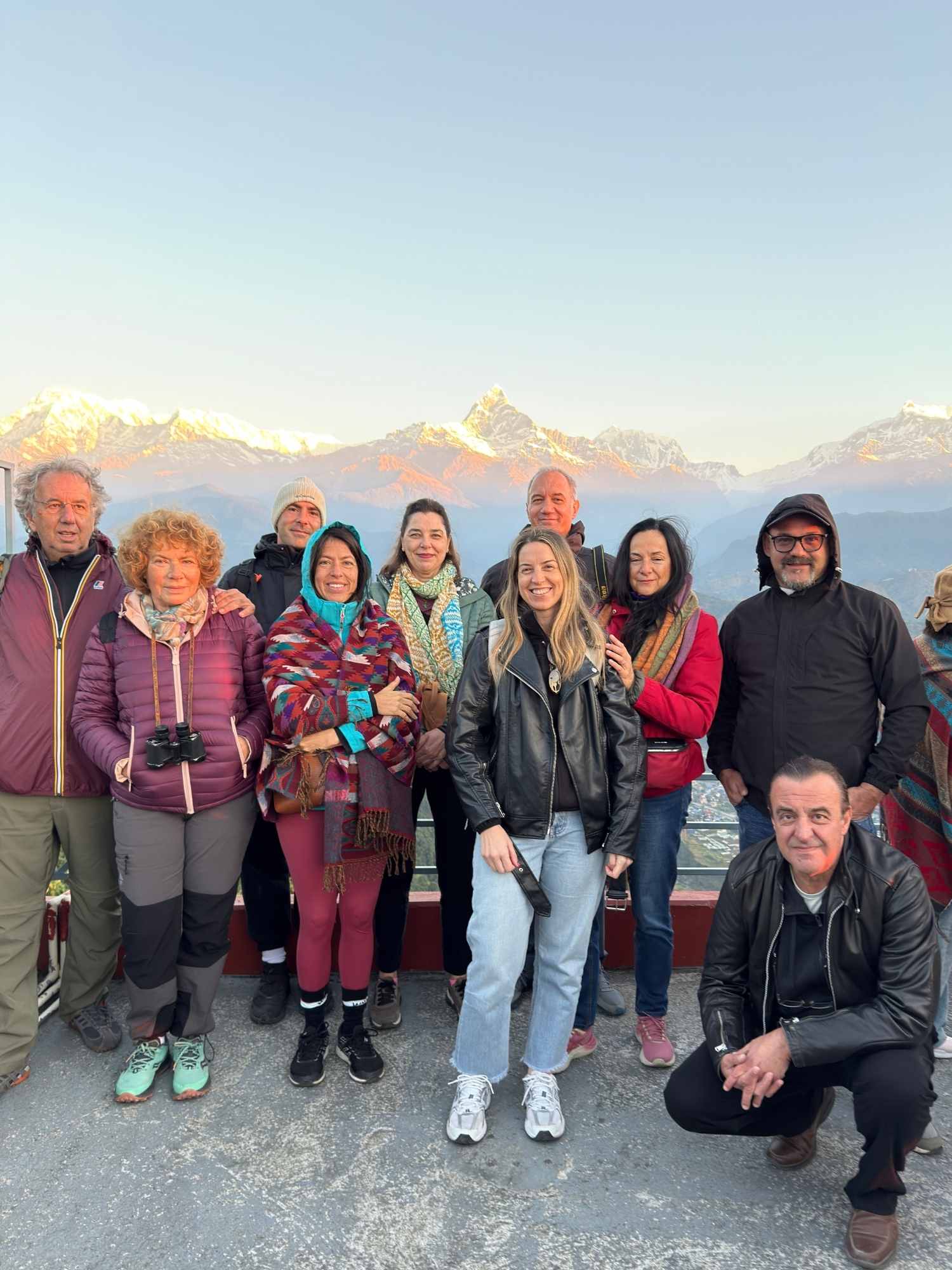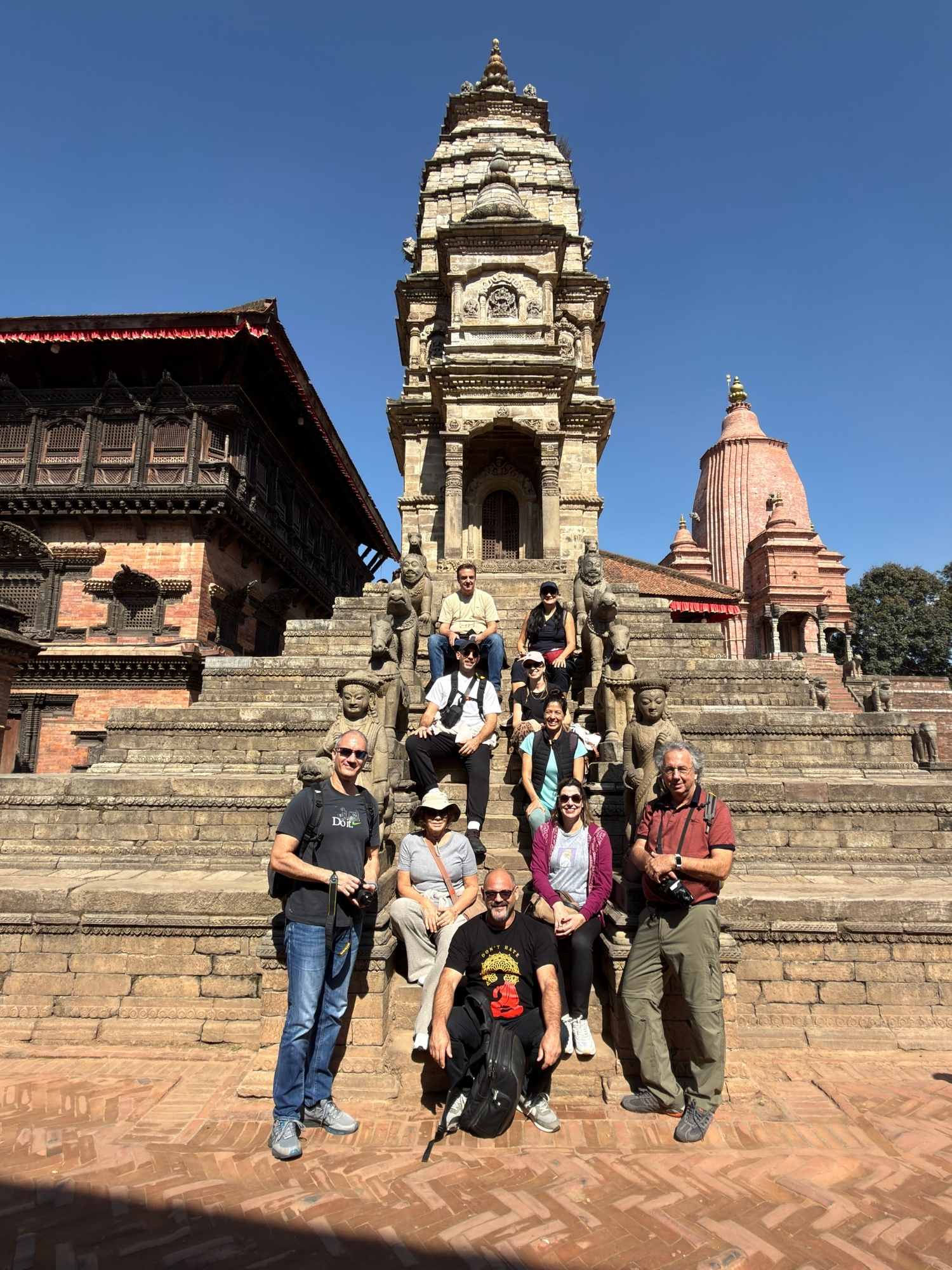
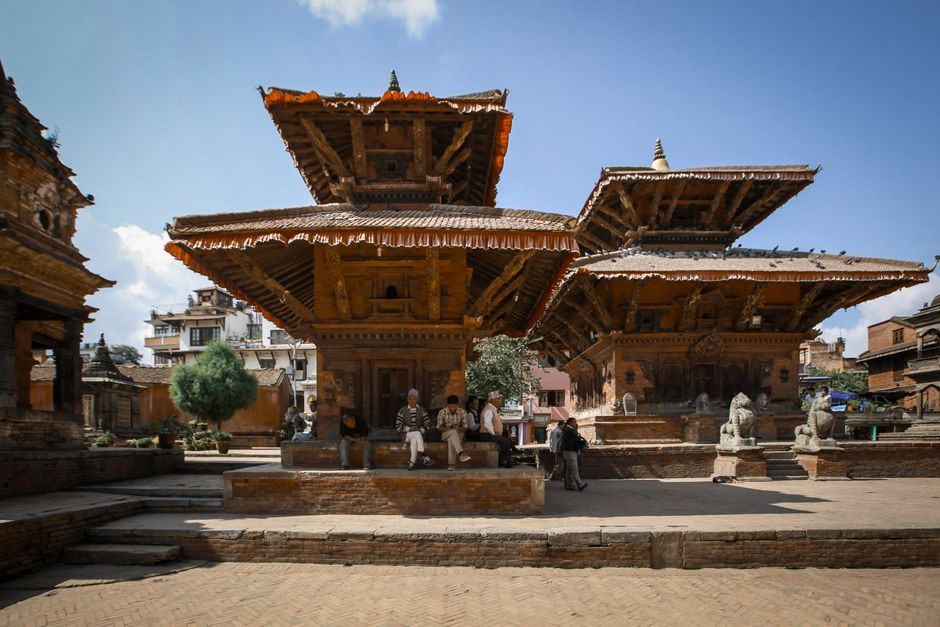
The last part of the climb is on foot. The lane narrows between brick houses with carved windows, a woman is spreading chillies to dry on a straw mat, a boy goes past with a brass jug of milk, and then the lane opens into a courtyard and there it is: a two-tiered pagoda of timber and gilded copper, standing alone on the top of a hill, older in its foundations than anything else you will see in the Kathmandu Valley. A bell rings once. Someone has lit a butter lamp in front of a stone figure that was carved more than fifteen hundred years ago. Below the courtyard wall, the whole valley lies open to the west, and on a clear morning the snow peaks stand along the northern horizon like a second, paler range of clouds.
This is Changu Narayan. Of the seven monument zones that make up the Kathmandu Valley UNESCO World Heritage Site, it is the one most travellers leave out. It is a little out of the way, it does not fit neatly into a city itinerary, and its greatest treasures are not buildings but pieces of stone that need someone to explain them. For exactly those reasons, a Changu Narayan luxury tour, done privately and done properly, is one of the most rewarding mornings we know how to design.
Why Changu Narayan Matters
Most of what you see in Kathmandu, Patan and Bhaktapur was built by the Malla kings between the fourteenth and eighteenth centuries. Changu Narayan belongs to an earlier world. It sits on a ridge called Dolagiri at the eastern edge of the valley, and it is widely regarded as the oldest Hindu temple in the valley still in active worship. Its sacred history reaches back to the Licchavi dynasty, which ruled here from roughly the fourth to the ninth centuries, and the courtyard still holds sculpture from that period of a quality you will not find anywhere else in Nepal.
The temple you see today is not the original structure. Fire and earthquake have taken it more than once, and the present pagoda dates from a rebuilding at the beginning of the eighteenth century. The 2015 earthquake damaged parts of the complex again, and careful restoration followed in the years after. But the platform, the sacred site and much of the stone sculpture around it are far older than the timber above them. Standing in the courtyard, you are standing in a place that has been continuously sacred for longer than most of the cathedrals of Europe have existed.
The oldest inscription in Nepal
Near the western door of the temple stands a stone pillar. It is easy to walk past. It is also, by most accounts, the single most important historical object in the country. Carved on it is an inscription of King Manadeva I, dated to 464 CE, and it is the earliest dated inscription yet found in Nepal. It records the king's victories and his devotion to his mother, who, according to the text, wished to follow her late husband in death and was persuaded by her son to live.
Think about what that means. Before this stone, the history of the valley is legend. After it, it is written. A good guide will stand with you at the pillar for some time, and you will understand why.
The Sculpture: A Museum Without Walls
The real reason we bring guests to Changu Narayan is the stone. The courtyard is crowded with images, some in shrines, some simply standing in the open, worn by centuries of rain and touched by centuries of hands. Three of them deserve your full attention.
Vishnu Vishwarupa: the god who contains everything
In a small shrine in the courtyard is a relief of Vishnu in his universal form, Vishwarupa. It illustrates the moment in the Bhagavad Gita when the god reveals himself to the warrior Arjuna as the whole of creation at once: many heads, many arms, worlds and beings emerging from his body, the heavens above and the underworld below. It is usually dated to the Licchavi period, and art historians count it among the finest works of early Himalayan sculpture.
It is not large. It is overwhelming. Bring time to it.
Vishnu Vikranta: three steps across the universe
Nearby is a depiction of Vishnu as Trivikrama, the dwarf who grew to cosmic size and claimed the earth, the sky and the heavens in three strides. The leg is raised mid-stride, the body is coiled with energy, and the smaller figures at his feet give you the scale of what is happening. It is a story told in stone for people who could not read, and it still works.
Garuda, kneeling
Facing the main door is a kneeling figure of Garuda, the half-man, half-bird mount of Vishnu, his hands joined in devotion and a serpent wound around his neck. He has been kneeling there, looking at the door of his god, since the Licchavi period. Of all the figures in the courtyard, he is the one guests tend to come back to at the end of the visit, often without quite knowing why.
The struts, the doors and the smaller shrines
Then look up. The roof struts of the pagoda are carved with multi-armed deities, the doors are gilded, and the courtyard holds smaller shrines to Shiva, to Lakshmi and to the goddess Chhinnamasta. Gilded statues of a Malla king and his queen kneel in a small cage of their own. You could spend a whole morning in a space the size of a tennis court and still not see everything, which is the point.
The Legend of the Hill
Every temple in Nepal has its story, and Changu Narayan's is told in the village with some relish. As it goes, a cowherd noticed that one of his finest cows was giving her milk not to him but to a champak tree on the hill. A Brahmin was called to cut the tree down. When his axe struck, the tree bled, and Vishnu appeared, explaining that he had been living in the tree under a curse, and that the blow had released him. In gratitude, a temple was raised on the spot.
The Brahmin's grief, the cow's devotion, the god hidden in plain sight: it is the kind of story that makes the hill feel less like a monument and more like a place where something happened. Your guide will tell it better, and more than once you will hear a slightly different version from someone in the village. That, too, is part of it.
Changu Village: The Quiet Around the Temple
The temple is reached through Changu itself, a small Newar village of brick houses, carved windows and courtyards that see far fewer visitors than the squares of Bhaktapur below. There is no traffic in the upper lanes. Families sit on their doorsteps in the late morning sun, threshing grain, oiling children's hair, arguing pleasantly about nothing. There is a small, family-run museum of everyday Newar life, with tools, textiles and household objects that tell you more about how people lived here than any palace could.
This is the part of the visit that a hurried tour misses entirely, and the part we build the most time for. Changu is one of the places in the valley where the line between heritage and ordinary life is still almost invisible.
How We Design a Private Changu Narayan Tour
Changu Narayan rewards a particular kind of visit: early, unhurried, and in the company of someone who knows the stone. Here is how we usually shape it.
Arrive early, before the day begins
We aim to be in the courtyard shortly after the light comes up. At that hour the temple belongs to the people who worship there: a priest preparing the morning rites, a few women from the village with offerings of flowers and rice, the first butter lamps being lit. The air on the ridge is cool and clear, and in October and November the mountains to the north are at their sharpest. By the time the day visitors arrive from the city, you will already have had the best of it.
With a guide who reads stone
The single most important decision in this visit is the guide. Changu Narayan needs someone who can read Licchavi sculpture the way a good guide in Rome reads a Bernini: an art historian, or a Newar scholar who grew up with these images, rather than a generalist reciting dates. We work with a very small number of such people in the valley, and we match them to guests with care. A curious ten-year-old needs a different companion from a retired professor of classics.
Walk down to Bhaktapur through the terraces
For guests who enjoy walking, there is no better way to leave Changu than on foot. A path leads down from the ridge through rice terraces, small farms and patches of forest, crossing the Manohara river towards Bhaktapur. It takes a couple of hours at an easy pace, and it is one of the loveliest short walks in the valley. Your vehicle meets you at the bottom, and if you choose, the afternoon continues in Bhaktapur's medieval squares, where we have a private lunch waiting in a restored Newar house.
Or walk up the ridge towards Nagarkot
For stronger walkers, the ridge continues east towards Nagarkot, through pine and village and with the Himalaya on your left for much of the way. It is a longer day, a few hours of steady walking, and it ends somewhere very good: an evening at one of the hotels on the rim at Nagarkot, with the sunrise over the range the following morning.
A private ritual, if you wish
With the guidance of the temple's priests, and only where it is appropriate, we can arrange for guests to take part in a simple morning puja, an offering of flowers, rice and light. Nothing is staged and nothing is performed for an audience. It is an invitation, not a show, and it is offered only to those who want it.
Changu Narayan Within a Longer Journey
Changu Narayan is rarely a journey in itself. It is a morning, sometimes a day, inside a larger design. These are the combinations that work best.
The seven monument zones, completed
Our guests who love history often ask to see all seven of the valley's World Heritage monument zones. Changu Narayan is the one that completes the set, alongside Patan's Durbar Square, Bhaktapur, Kathmandu Durbar Square, Swayambhunath, Boudhanath and Pashupatinath. Done properly, that is four or five unhurried days in the valley, and it forms the cultural core of many of our Classic journeys.
The valley, then the mountains
More often, Changu Narayan is part of the opening days of a longer journey: a few days in Kathmandu to settle in, adjust and understand the culture before the mountains, and then the flight west to Pokhara and beyond. Starting a Himalayan journey with the oldest sacred site in the valley has a certain logic to it. You see where the story of this country begins before you go to see the landscape it grew from. Our Premium journeys are often built this way.
Where to stay
Changu Narayan is easily reached from the heritage hotels of Kathmandu, and even more easily from Bhaktapur or from the eastern rim of the valley. For a journey built around early mornings at the temples, we often suggest moving east for two or three nights, so that the dawn in the courtyard does not begin with a long drive through the city. It is a small decision, and it changes the whole rhythm of the visit.
When to Visit Changu Narayan
The temple is open all year, and worship goes on through every season. For the experience we have described, the best time is:
- October and November, when the monsoon has cleared the air and the views from the ridge to the snow peaks are at their finest.
- February to April, when the days are warm, the terraces below are green with winter wheat, and the rhododendrons begin to flower on the higher slopes.
- Early morning, in any season, before the day visitors arrive and while the temple is still in the hands of the village.
In winter the mornings are cold but often brilliantly clear. During the monsoon the hill is green and the stone glistens, but the mountain views usually disappear behind cloud.
What It Costs
A private morning at Changu Narayan is never priced on its own, because it is never designed on its own. It depends on the guide you need, how many days you spend in the valley, where you stay and what comes before and after. A journey of this kind is costed only once it is designed, because no two are the same. If you would like a figure, that conversation starts on our design a journey page.
Frequently Asked Questions
Where is Changu Narayan?
Changu Narayan stands on a hilltop at the eastern edge of the Kathmandu Valley, a few kilometres north of Bhaktapur. It is one of the seven monument zones of the Kathmandu Valley UNESCO World Heritage Site.
How old is Changu Narayan temple?
The sacred site dates back to the Licchavi period, and the stone pillar inscription of King Manadeva I in the courtyard is dated 464 CE, the oldest dated inscription found in Nepal. The present pagoda was rebuilt at the beginning of the eighteenth century.
How long should I spend at Changu Narayan?
At least two to three hours in the temple and the village, and ideally a full morning. Combined with the walk down to Bhaktapur, it makes a superb day.
Can non-Hindus visit Changu Narayan?
Yes. Visitors of all faiths may enter the courtyard and see the sculpture. The inner sanctum is reserved for Hindu worship, and your guide will show you how to move through the temple respectfully.
Can Changu Narayan be combined with Bhaktapur and Nagarkot?
Yes, and it should be. The walk down through the terraces to Bhaktapur and the ridge walk towards Nagarkot are two of the finest short walks in the valley.
The Morning That Stays With You
Most travellers remember the great squares of the valley for their crowds, their colour and their sheer scale. Changu Narayan is remembered differently. Guests tell us, months later, about the quiet: the kneeling Garuda, the old woman with her flowers, the bell, the light coming across the valley, the feeling of having stood somewhere where people have been praying for fifteen centuries and are praying still. That is what we mean by experiential wealth. It is not something you buy. It is something you are given, if you arrive at the right hour, with the right person, and without hurrying.
I live in Nepal, and I still go back to Changu whenever I can. If you would like to know why a Greek ended up designing journeys here, that story is on my founder page. If you would like a morning like this built into your own journey, with the guide, the timing and the walk down to Bhaktapur arranged around you, begin your design here.