Update, 16 October 2026: some details in this article date from 5 September and have changed. The Kathmandu–Pokhara road is open again: Krishnabhir since 17 September, while a new subsidence at Galaundi on 9 October closed the road for two days. Langtang is gradually reopening from Thulo Syabru, with no official announcement yet. Manaslu was hit by a new flood on 11 October: the lower trail is damaged and Tsum Valley is closed. See what applies today.
There is a particular sound the wind makes in Langtang valley around four in the afternoon, when the day's clouds are beginning to settle into the high cirques and the light has turned that specific Himalayan amber. It is not the romantic howling of cinema, nor the gentle alpine sigh that European mountains have taught us to expect. It is something stranger — a long, low resonance that travels down the glacial corridor, carrying with it the smell of juniper smoke and the distant clang of yak bells. The first time you hear it, you stop walking. Most travellers do.
This is the moment, more than any photograph, that defines what the Langtang luxury trek actually is. Not a journey to a famous mountain. Not a checklist of summits. A return to a quality of attention that the modern world has, almost without anyone noticing, taken from us.
We design these journeys for travellers who have begun to suspect this loss, and who want it back.
Why Langtang, Why Now
For most international travellers, Nepal still means three names: Everest, Annapurna, Mustang. The marketing of the country, for forty years, has been built on those three syllables. Langtang has remained, by comparison, almost invisible — the third major Himalayan region of Nepal, with the third highest concentration of seven-thousand-metre peaks, and yet, on any given day in autumn, perhaps a tenth of the foot traffic of the famous routes.
There is a reason for this, and it is worth saying clearly. In April 2015, a massive earthquake triggered a glacial avalanche that buried the village of Langtang almost completely. Hundreds of villagers and trekkers died. The valley closed for almost a year. For an entire generation of travellers, Langtang became, in the imagination, a place of grief.
What has happened since is one of the quieter miracles of modern Nepal. The Tamang communities of the valley, working with carefully chosen partners and on their own terms, have rebuilt — not as a tourist destination, but as a living place that happens to welcome visitors. The new lodges are built to seismic standards. The trail has been repaired and, in places, redesigned. The yak cheese factory at Kyanjin Gompa, which has run since 1955 with Swiss assistance, is producing again at full capacity. And the silence — the great gift of any Himalayan valley — has, if anything, deepened.
In 2026, Langtang is not yet on the algorithm's map. For our travellers — the ones who have read our overview of luxury Nepal travel and have begun to ask what comes after the obvious — this matters more than they often initially realise.
The Geography of the Hidden Valley
What makes Langtang unusual, even by Himalayan standards, is its accessibility. Unlike Everest or Mustang, which require domestic flights into mountain airstrips of considerable temperament, Langtang begins with a road. A genuinely beautiful road — winding north from Kathmandu through the terraced rice paddies of Trishuli, past cliffside villages of pink rhododendron and into the Langtang National Park entrance at Syabrubesi. For our Premium and Ultimate-tier travellers, we cover this stretch in a private Land Cruiser with a curated lunch stop at a Tamang family home in Dhunche, where the cardamom honey is local and the conversation, conducted through our guide, is unhurried.
By late afternoon of day one, you are at the trailhead. By day two, you are walking through old-growth rhododendron forest, with langur monkeys on the upper branches and the sound of the Langtang Khola beneath you, milky with glacial flour. There are no airport delays. There are no weather-grounded flights. There is only the path, and the slow vertical conversation between you and the mountain.
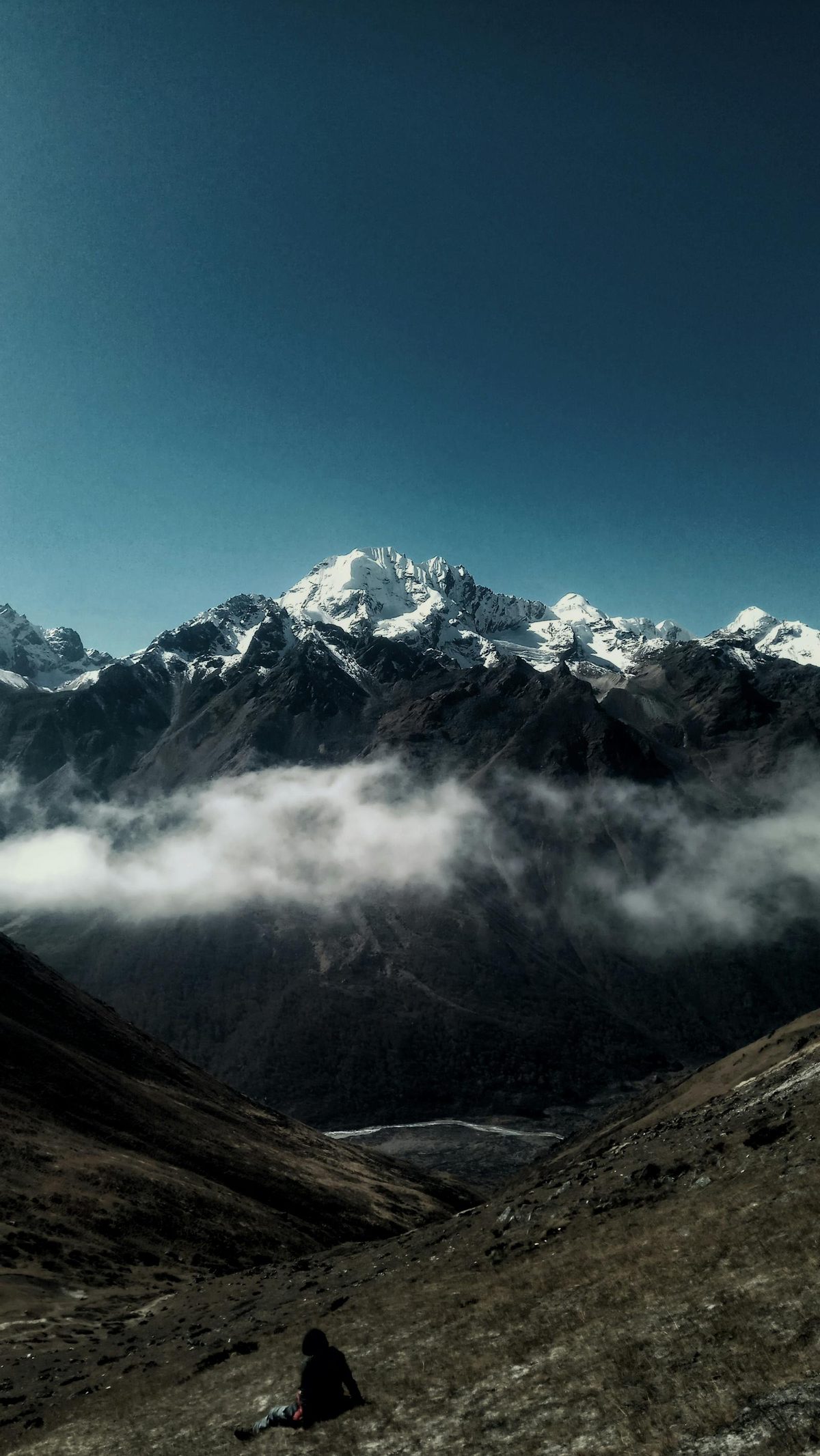
The classical Langtang route ascends in stages — Lama Hotel, Langtang village, Mundu, Kyanjin Gompa — gaining roughly 1,800 metres over four days of walking. Our 11-day Premium itinerary builds in two acclimatisation nights at Kyanjin (3,870 metres) and includes an optional summit attempt of Tserko Ri (4,985 metres), the local high-altitude lookout from which, on a clear morning, you see Langtang Lirung (7,234m), Langshisha Ri, Naya Kanga, and the Tibetan border ridges in a single panoramic sweep.
For the Ultimate tier, we extend the journey to 14 days and add a helicopter component: a return flight from Kyanjin Gompa over the Langtang Glacier, with optional set-down at a remote viewpoint above Langshisha Kharka, before continuing to the sacred lakes of Gosaikunda and the long descent through the Helambu valley to Kathmandu. This is, in our judgement, the single finest week-and-a-half-long Himalayan circuit in Nepal — and one that almost nobody in the international luxury market has yet discovered.
We have written elsewhere about the philosophy behind our bespoke design process. Langtang is, perhaps, the clearest expression of it.
A Day in the Yak Country
There is a morning at Kyanjin Gompa that almost every Langtang traveller carries home. You are at 3,870 metres, in a stone-walled lodge that has been rebuilt with proper insulation and high-thread-count linens we pre-position before your arrival. The first light arrives slowly — first the snowfields of Langtang Lirung in pink, then the long glacial tongue descending from the Yala Peak shoulder, then, finally, the valley itself, still in shadow, still in silence.
You walk the ten minutes to the Kyanjin yak cheese factory. The grandson of the original Swiss-trained cheesemaker is already at work. He cuts you a slice of three-month-aged hard cheese — pale gold, sharp, faintly grassy — and a square of fresh yak butter. You eat it with Tibetan bread, still warm, on a wooden bench overlooking the river. The temperature has not yet risen. Your guide, a young Tamang man who grew up in the valley below and lost cousins in the 2015 avalanche, sits with you in companionable quiet. There is nothing to say.
This is the texture the Langtang luxury trek offers, and that no five-star resort, anywhere on earth, can replicate: ordinary life of extraordinary depth, encountered without performance. The cheese is not for you specifically. The light is not staged. The man at the factory does not introduce himself as your host. He is simply the cheesemaker, doing what he and his family have done for seventy years, and you happen to be there.
We spend two such mornings at Kyanjin on most itineraries. They are, almost universally, what travellers describe afterwards as the moments they remember most.
What Luxury Means in This Valley
Luxury at altitude is a precise word, and we use it carefully. There are no five-star hotels at 4,000 metres. There will not be, in our lifetimes. The lodges of the Langtang valley are family-run, mostly Tamang-owned, and remain modest by the standards of European or Himalayan resort hospitality.
What we add, with care, is the layer that converts modest into refined.
We pre-position our own bedding — Egyptian cotton sheets, down-filled duvets, silk pillowcases — in the lodges where we host you, transported in advance by porter teams who have walked these trails for generations. We carry our own kitchen kit and travel with a private chef trained in adapting Newari and continental cuisines to the constraints of altitude cooking and limited ingredient sourcing. We bring oxygen and pulse oximeters, monitored daily, and our guides hold wilderness medical certification beyond the standard government requirement. We design rest days into the itinerary that other operators omit, because we have learned, over years in this country, that altitude is not a problem to be conquered — it is a process to be respected.
We also retain helicopter capability throughout the trek. This is not a feature most travellers exercise. It is the feature that makes the journey accessible to clients in their fifties and sixties, and to clients with cardiology requiring pre-departure clearance. It is the quiet centrepiece of our Ultimate journey tier — the assurance that, at any point on the trail, weather permitting, you can be back in Kathmandu within ninety minutes.
The remainder of luxury, in this valley, is what the place itself provides. The yak bells. The chanting from Kyanjin Gompa monastery at dawn. The blue sheep on a far ridge. The taste of buckwheat pancakes with Himalayan honey, eaten at 3,800 metres in a sunlit kitchen built from the stones of an older lodge. None of these things can be staged. They simply happen, when you are still enough to receive them.
The Tamang Heart and the Earthquake's Aftermath
It is impossible to walk Langtang and not engage with the story of what happened here, and how the valley has come back. We do not sentimentalise this. We also do not pretend it isn't part of what gives this trek its specific moral weight in 2026.
The Tamang people of Langtang are of Tibetan ethnic origin. Their language is Tibeto-Burman. Their Buddhism is older and more shamanistic than the more widely known Sherpa traditions of Solu Khumbu. They have lived in this valley for at least seven hundred years, salt-trading with Tibet, herding yak, milling barley, building the stone-walled gompas you pass on the trail. The 2015 earthquake nearly extinguished a community that had survived plague, famine, and the long Maoist civil war.
What you see now, walking the rebuilt trail, is not recovery. It is something braver. It is the visible work of a people who have decided to continue, on their own terms, with their own architecture, with their own forms of welcome. The new lodges are larger and warmer than what came before. The chortens have been rebuilt. The annual festivals — Lhosar in January, Yartung in August — are observed with a confidence that survivors earn.
In Langtang village itself, where the avalanche fell, there is now a memorial — quiet, stone, well-kept. We pass it on the second walking day. Travellers who wish to leave a butter lamp do so. Travellers who do not, walk on. Our guides, almost without exception, lost family in 2015. They speak about it only when asked, and then with the particular dignity of people for whom grief has become structural rather than dramatic.
We have written elsewhere about the art of cultural immersion as a luxury experience in Nepal. Langtang is, in our view, where this principle is most sharply tested — and where it is most fully rewarded for travellers who arrive ready to listen.
The Practical Architecture of the Journey
A few notes for the traveller seriously considering Langtang as their next Himalayan journey.
Best seasons. Spring (mid-March to mid-May) brings the rhododendron bloom — the upper forest turns crimson, magenta, and white over a four-week window, and the air is fragrant with it. Autumn (mid-October to late November) offers the clearest skies and the most stable weather, with cold but cloudless mornings at high camp. Winter is possible up to Kyanjin Gompa for hardy travellers; the high passes close. Monsoon is not viable. Physical preparation. Langtang is the most accessible of Nepal's major luxury treks, but it is still a high-altitude undertaking. We require six weeks of structured cardiovascular and hill-walking preparation. Travellers comparing this against the Annapurna luxury trek will find Langtang slightly less demanding but with a steeper acclimatisation curve. Permitting. Langtang National Park entry permits and TIMS cards are arranged entirely by our Kathmandu operations team. Travellers do not interact with permitting offices. Insurance. Comprehensive high-altitude insurance with helicopter evacuation cover is mandatory and arranged before final booking confirmation. Group size. All Langtang journeys we design are private and bespoke. Most parties are two to four guests, accompanied by a registered lead guide, an assistant guide, a private chef, and a porter team of four to six. Combinable journeys. Langtang pairs naturally with the Gosaikunda sacred lakes and the Helambu valley descent. For travellers wanting a longer Himalayan arc, we sometimes design a 19-day combined Langtang–Gosaikunda–Helambu loop that finishes at Sundarijal, a one-hour drive from Kathmandu. This is the route for which we feel the strongest editorial enthusiasm; few clients regret it.For those who want to understand how this kind of itinerary is built end-to-end, the philosophy behind our bespoke design goes into the working method. For the brand origin, the founder's story explains why Greek travellers, in particular, have responded to this country in the way they have.
A Word on Cost, Honestly
A Langtang luxury trek of the quality we describe here is meaningfully more affordable than its Everest, Mustang or Kanchenjunga equivalents, for one reason: there are no expensive domestic flights. The road access from Kathmandu cuts the largest single cost line out of the budget.
The 11-day Premium itinerary — private guide team, pre-positioned amenities, private chef, all permits, two-night recovery at Dwarika's Resort Dhulikhel on conclusion — sits in the mid range of our journey pricing. The 14-day Ultimate version, with helicopter logistics and the Gosaikunda extension, sits closer to the top of our Ultimate tier but remains, on a per-day basis, one of the better-value Himalayan luxury products we offer.
For those weighing this against other Himalayan options, our definitive 2026 cost breakdown for luxury Nepal travel gives further context.
What You Bring Home
The travellers who come back from Langtang most changed are, almost always, the ones who arrived with the lowest expectations. They had heard of Everest. They had heard of Mustang. They had not heard of Langtang, and they came largely on our recommendation, often after a longer conversation about what they were actually looking for in a Himalayan journey.
What they bring home is not a summit photograph. It is a different relationship to silence. A new tolerance for slow mornings. A specific memory of a yak cheese sandwich at 3,870 metres, eaten beside a glacial river, in the company of a guide whose family rebuilt a village from stone. They tell us, often, that this was the trip they didn't know they were waiting for.
This is the deepest form of experiential wealth. It cannot be transferred, copied, or communicated to those who were not there. It is yours, and only yours, for as long as you carry it.
Begin the Conversation
If the Langtang luxury trek has begun, in some quiet part of your imagination, to feel like the right next chapter, we would be honoured to design it for you. Every itinerary we build is a collaboration — between you, your circumstances, and the country itself. The valley decides much of what is possible. We decide the rest.
To begin, tell us about the journey you are imagining. The conversation that follows is unhurried, considered, and entirely without obligation. As with all things in this valley, what matters most is the quality of attention you bring.
Some valleys are walked. Others — the rare ones — are listened to.