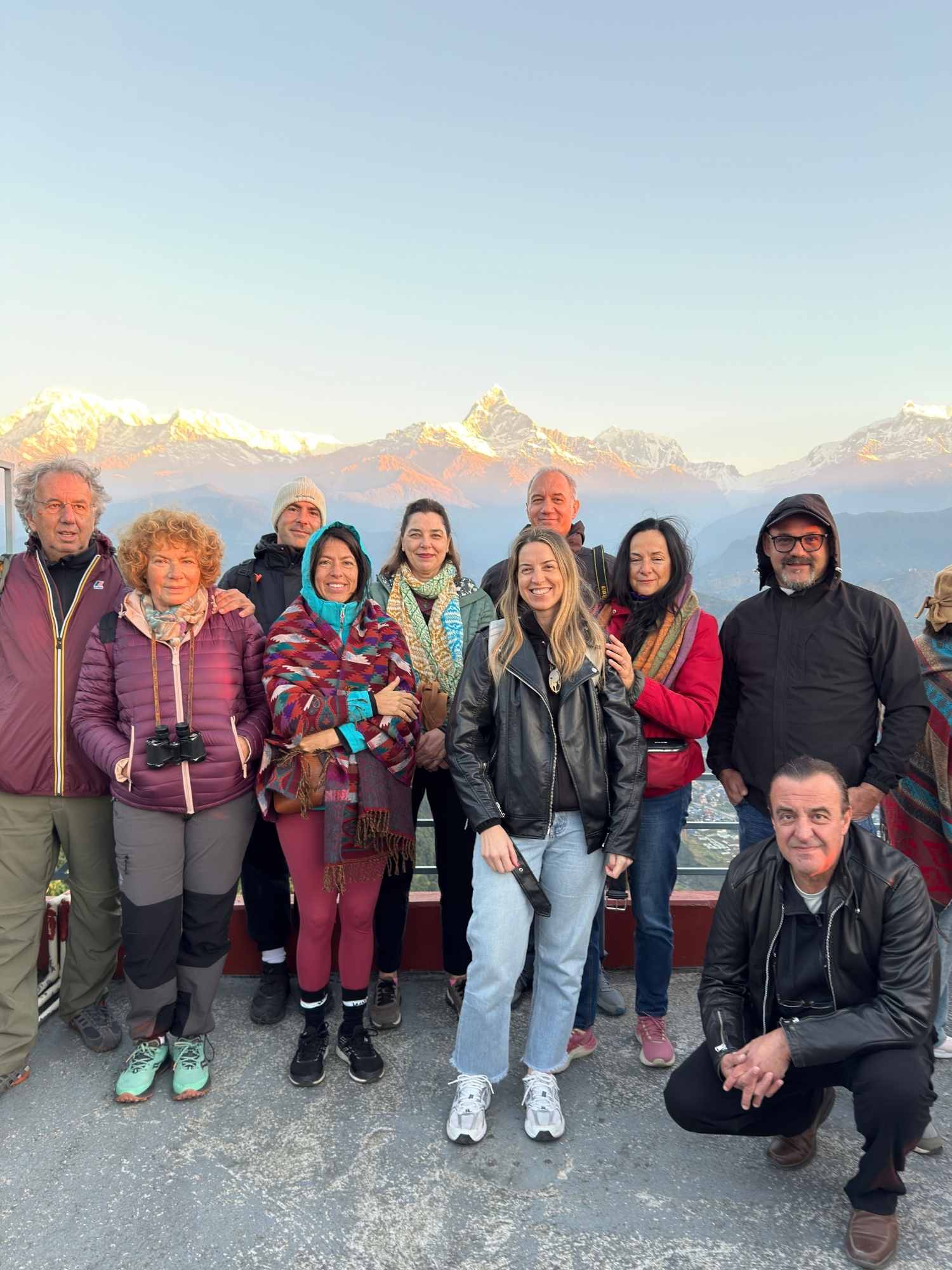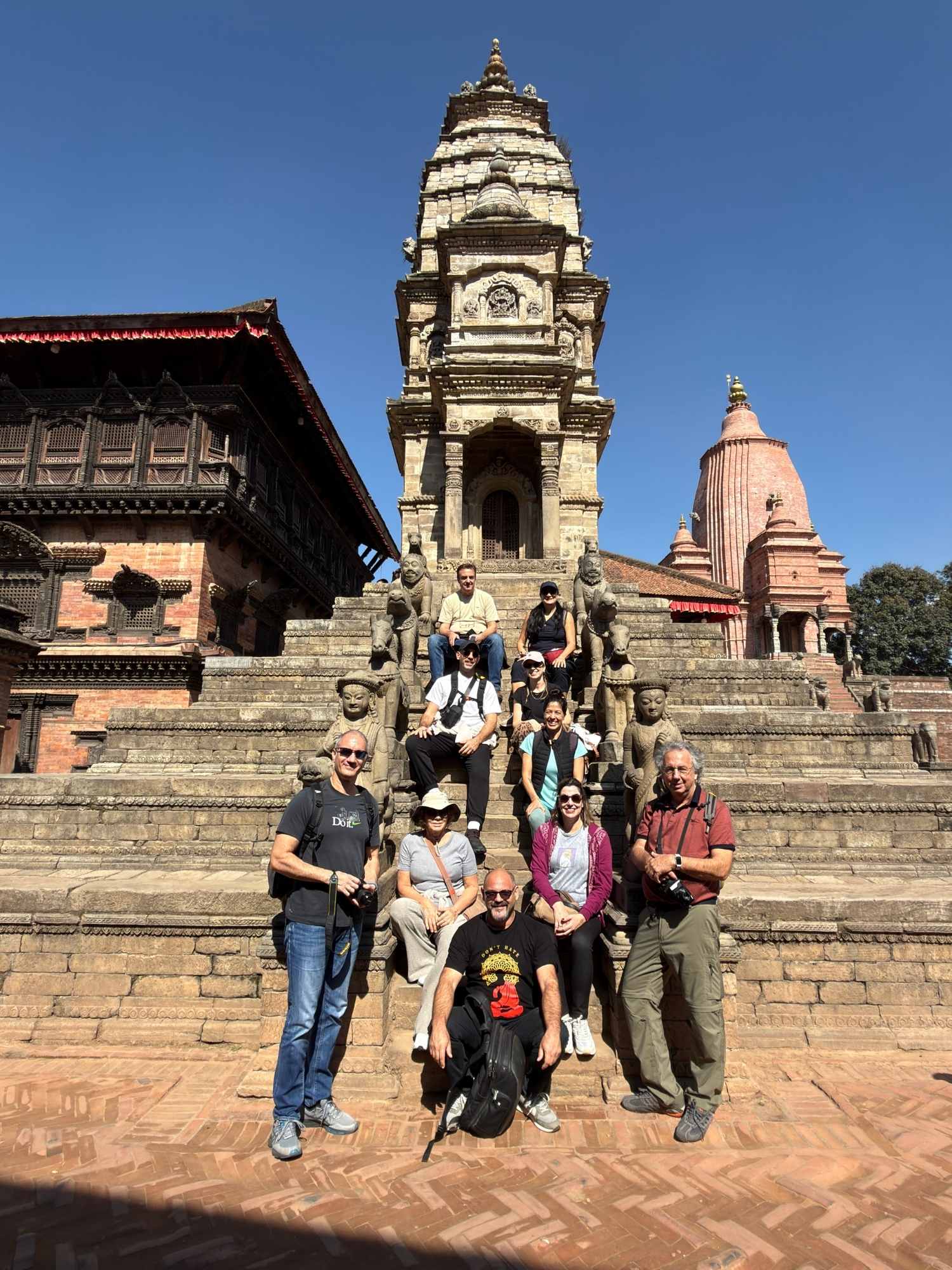
The first sound in Panauti is water. Before the shutters go up on the brick lanes, before the first motorbike, before the bells of the great temple, you hear the two rivers meeting below the town, a low, steady murmur that has been there longer than anything built beside it. An old man in a black topi walks down the stone steps to the ghat with a brass pot. A woman lays marigolds on a shrine that is little more than a carved stone polished smooth by hands. Mist sits on the paddy fields. Behind it, if the morning is clear, the white line of the Himalaya appears over the hills like something remembered rather than seen.
This is Panauti, a small Newari town some thirty kilometres south-east of Kathmandu, just beyond the rim of the valley. It is one of the oldest settlements in Nepal, it sits on UNESCO's tentative list of World Heritage sites, and most visitors to the country never hear its name. That is precisely why we love it. A Panauti luxury tour, designed privately and slowly, offers what the great Durbar Squares of the valley increasingly cannot: a living medieval town that still belongs entirely to the people who live in it.
Why Panauti Belongs in a Private Journey
Our guests often arrive having read about Bhaktapur, Patan and Kathmandu. They are right to want them, and we design for them with great care. But after a few days among the great squares, many tell us the same thing: they would like to see a place where the heritage is not a destination, but simply where people live.
Panauti is that place. It is small enough to walk in a morning and rich enough to fill several days. Its lanes are laid out in the old Newari manner, with courtyards, rest houses, water spouts and shrines at every turn. Its temples are not cordoned off; they are where neighbours meet, where children play and where the elderly sit in the sun. There are no ticket booths at every corner and no crowds of tour groups. There is a town, going about its life, and a small number of travellers lucky enough to be welcomed into it.
A town older than its kingdoms
Panauti was once a small kingdom of its own, and later an important trading post on the old route between the Kathmandu Valley and Tibet. Merchants, pilgrims and goods passed through here for centuries. Local tradition holds that the town stands on a single great rock, which is why, people will tell you, it has weathered earthquakes better than its neighbours. Whatever the geology, the belief says much about how the town sees itself: rooted, enduring and a little apart.
Indreshwar Mahadev: The Great Temple of Panauti
At the heart of the town, close to the confluence, stands the Indreshwar Mahadev temple, dedicated to Shiva. It is a three-tiered pagoda of brick and timber, traditionally dated to 1294, and it is counted among the oldest and largest temples of its kind in Nepal. Some believe it to be older than anything of its type in the Kathmandu Valley itself.
What makes it extraordinary is the woodwork. The roof struts are carved with figures of deities, guardians and attendants, many of them centuries old, weathered to a soft grey-brown and so finely made that you can stand beneath them for an hour and still be finding new faces. Within the temple courtyard are smaller shrines to Bhairav, to Vishnu and to Nandi, Shiva's bull, along with a cluster of lingams that have been worshipped here for generations.
A private reading of the carvings
We arrange for our guests to see Indreshwar Mahadev with a guide who reads Newari temple art fluently, and, when we can, with one of the craftsmen who work on its restoration. To have someone explain what each figure is, how the struts were carved and why a particular goddess stands where she does is to see a building change in front of your eyes. What looked like decoration turns out to be a complete theology carved in wood.
Greeks often notice something familiar here. Like the old churches of our own villages, the temple is not a museum of faith but a place of daily use, where the sacred and the ordinary have never been separated.
Triveni Ghat: Where Three Rivers Meet
Below the temple, the Roshi and the Punyamati rivers join. Tradition says a third river joins them here as well, the Rudravati, which flows invisibly, underground, and can be seen only by the faithful. The meeting of three rivers makes this a triveni, a sacred confluence, and the stepped ghats along the bank are lined with small temples, shrines and cremation platforms.
The best hour here is the earliest. We bring our guests down to the water before the town is fully awake, when the only people at the ghat are those who come every morning to bathe, to pray and to fill their pots. It is quiet and unhurried. Nobody performs for anyone. You simply watch a town begin its day in the way it has begun it for centuries.
Makar Mela: the festival of twelve years
Once every twelve years, in the Nepali month of Magh, in the depth of winter, Triveni Ghat becomes the scene of the Makar Mela, a great pilgrimage festival that draws devotees from across Nepal and India for a month of bathing and worship at the confluence. It is one of the rare occasions when the inner sanctum of Indreshwar Mahadev is opened for the sight of its lingam. Few travellers will ever coincide with it, but you will hear about it from everyone in town, and the scale of the preparations for it, even years in advance, tells you how much this confluence means.
Walking the Old Town
The real pleasure of Panauti is in simply walking it, slowly, with someone who knows every lane.
The town is laid out around a series of squares and courtyards, connected by narrow brick streets lined with three- and four-storey Newari houses. Many still have their original carved wooden windows, some of them so intricate that they rival anything in Bhaktapur. Stone water spouts, the hiti, still run in places. Small rest houses, the pati, offer shade to anyone who needs it. Every few steps there is another shrine: a Ganesh at a corner, a Bhimsen above a doorway, a small Buddhist stupa in a courtyard.
On these walks we pause where the town pauses: at a potter's courtyard, where the wheel is still turned by hand; at the doorway of a house where wool is being spun; at a small shop selling yomari, the sweet, fig-shaped rice dumplings filled with molasses and sesame that Newari families make in winter. The guide translates, and conversations begin.
The Panauti Jatra
In early summer, the town holds its great chariot festival, the Panauti Jatra, when the deities of the town's temples are carried through the streets in wooden chariots, accompanied by music, crowds and a great deal of joy. If your journey falls in that season, we will arrange for you to witness it with a local family, from a balcony above the procession.
A Seat at a Newari Family Table
Panauti was one of the first places in Nepal where community homestays took root, and the tradition of welcoming guests into family homes remains strong here. For most of our guests, this is the experience they remember above all.
We do not ask our guests to spend the night in a homestay unless they wish to; the comfort we design around them comes first. What we arrange instead is a private afternoon and evening with a Newari family we know well. You are welcomed into their courtyard, shown around their home, taught to fold a momo or shape a yomari, and then seated at their table for a traditional Newari meal: beaten rice, spiced buffalo or vegetables, black lentils, pickles, a little homemade rice wine for those who would like it, served on leaf plates and eaten as the family eats it.
This is what we mean by experiential wealth. You are not observing a culture from behind glass. You are sitting in someone's home, being fed by people who have chosen to share it with you, and leaving with something no object could give you.
Namo Buddha: The Monastery of the Tigress
A short distance from Panauti, on a ridge above terraced fields, stands Namo Buddha, one of the most sacred Buddhist sites in Nepal.
The story told here is one of the most moving in Buddhist tradition. A young prince, walking in these hills, came upon a starving tigress who was too weak to feed her cubs. Moved by compassion, he offered her his own body. The prince, according to the legend, was a former life of the Buddha. A stupa marks the place where the story is said to have happened, and on the ridge above it stands the Thrangu Tashi Yangtse Monastery, a great Tibetan Buddhist monastery whose golden roofs catch the light against the snow of the Himalaya.
We arrange for our guests to visit in the late afternoon, when the young monks gather for their evening prayers. The sound of chanting, the deep horns and the cymbals in the great prayer hall, and then the walk out onto the terrace as the mountains turn pink, is an hour of the kind that stays with people for years.
How We Design a Private Panauti Journey
Panauti does not have grand heritage hotels within the town itself, and I would rather say so plainly. What it has is proximity to some of the most beautiful places to stay on the eastern rim of the valley, and that is where we base our guests.
Where to stay
Most of our guests stay on the ridge at Dhulikhel, a short distance away, where the finest retreats look straight across the valley to the Himalaya. From there, Panauti is an easy morning's excursion, and Namo Buddha an afternoon's. For guests who prefer to stay closer to the old town, we can arrange a carefully chosen boutique guesthouse with a private courtyard, or, for the curious, a single night in a homestay we know well.
The right guide
As in all the old Newari towns, the guide makes the journey. We pair our guests with someone who speaks Newari, who knows the families of the town, and who can explain the iconography of a temple strut as easily as the rules of a festival. Many of our guides grew up in towns like this one.
How many days
One full day allows the confluence at dawn, Indreshwar Mahadev, the old town and an evening meal with a Newari family. Two days add Namo Buddha, a more leisurely pace and time simply to sit in a square and watch the town go by. That, to my mind, is the right length.
Panauti Within a Longer Journey
Panauti is rarely a journey on its own. It is a chapter, and these are the combinations that work best.
The Newari towns of the valley
For guests who want to understand the civilisation of the Kathmandu Valley, Panauti makes the perfect counterpoint to its grander neighbours. Begin with the royal squares of Bhaktapur and Patan, then step into the quieter, more intimate world of Panauti, and the difference between a monument and a living town becomes clear. This is the kind of cultural sequence we build into our Classic journeys.
The valley, then the mountains
More often, Panauti and Namo Buddha form part of a few days on the eastern rim of the valley, before guests fly on to Pokhara, the Everest region or Mustang. The calm of these hills is the ideal way to begin a longer Himalayan journey, and it is often how we open our Premium journeys.
When to Visit Panauti
The temples and the confluence are there every day of the year, but the seasons shape the experience.
- October to November brings clear skies, the rice harvest and the finest Himalayan views from Namo Buddha and the surrounding ridges.
- December to February is cool, often misty in the mornings and very quiet. It is the season of yomari, and, once every twelve years, of the Makar Mela.
- March to May is warm and bright, with the rhododendrons in bloom on the hills and, at the end of the season, the Panauti Jatra.
- June to September is the monsoon season. The fields are a vivid green and the town is at its quietest, but the mountain views disappear behind cloud.
What It Costs
A Panauti journey is never priced on its own, because it is never designed on its own. It depends on where you stay, how long you linger, which guides and families you meet, whether a festival is involved and what comes before and after. A journey of this kind is costed only once it is designed, because no two are the same. If you would like a figure, that conversation starts on our design a journey page.
Frequently Asked Questions
Where is Panauti?
Panauti lies in Kavrepalanchok district, some thirty kilometres south-east of Kathmandu, just beyond the eastern rim of the Kathmandu Valley and close to Dhulikhel and Namo Buddha.
What is Panauti famous for?
Panauti is famous for the Indreshwar Mahadev temple, traditionally dated to 1294 and counted among the oldest pagoda temples in Nepal, for the sacred confluence at Triveni Ghat, for its well-preserved Newari old town and for the Makar Mela, held once every twelve years.
Is Panauti worth visiting?
Yes, especially for travellers who have seen the great Durbar Squares and would like to experience a living Newari town without the crowds. It combines naturally with Dhulikhel and Namo Buddha.
How long should I spend in Panauti?
One full day is enough to see the main sights. Two days, combined with Namo Buddha and a stay on the ridge at Dhulikhel, allow a slower and more rewarding pace.
The Town That Stayed
Most of Nepal's heritage is now known to the world, photographed, listed and visited by the busload. Panauti has somehow remained a town first and a sight second. The water still meets below the temple, the carvings still look down on the courtyards, and families still invite a stranger to their table as if it were the most natural thing in the world. To spend a slow day here is to understand something about Nepal that no guidebook can explain.
I live in Nepal, and Panauti is the place I suggest to guests who want to feel the country rather than see it. If you would like to know why a Greek ended up designing journeys here, that story is on my founder page. If you would like Panauti woven into your own journey, with the guides, the families and the timing arranged around you, begin your design here.