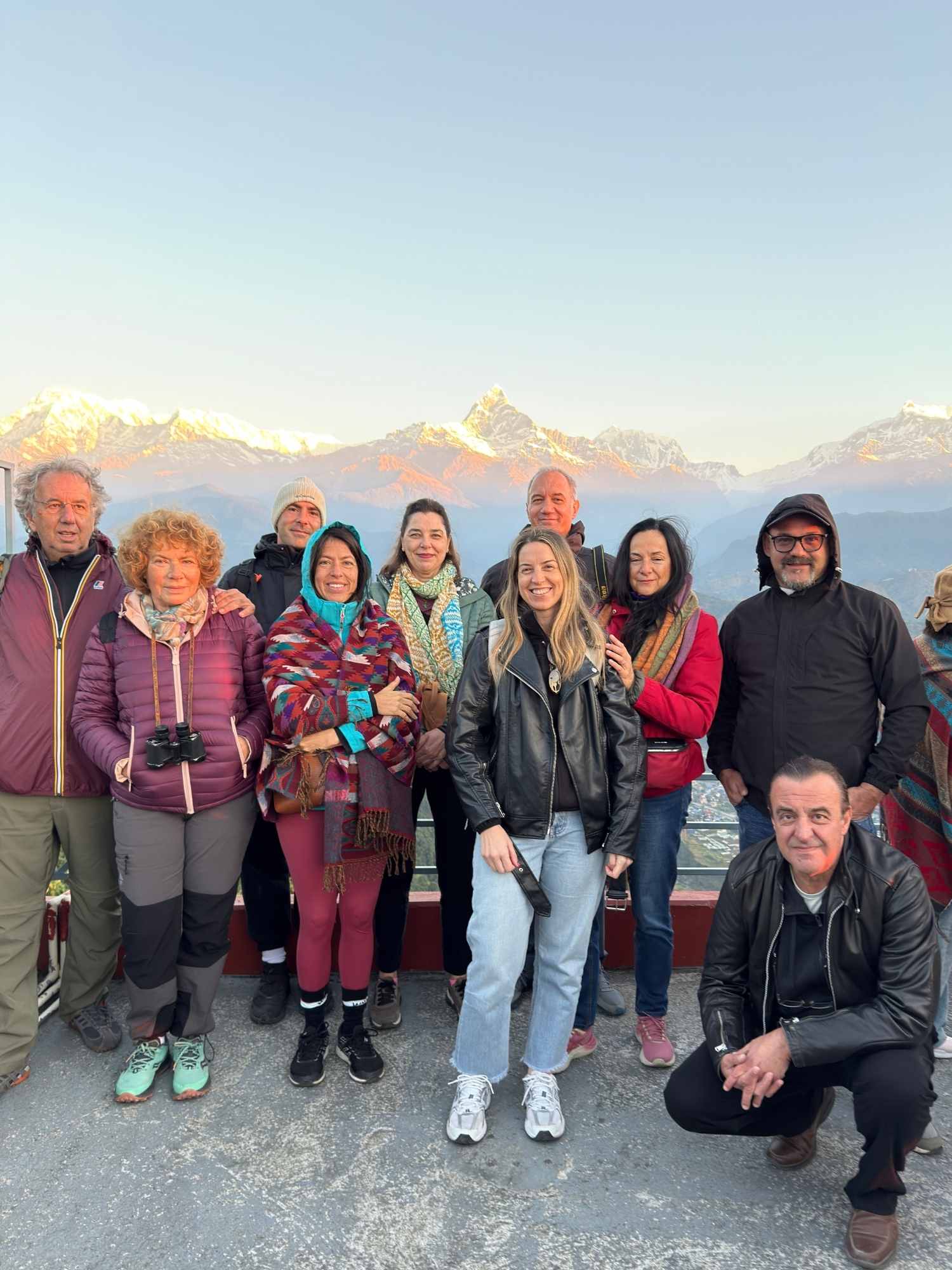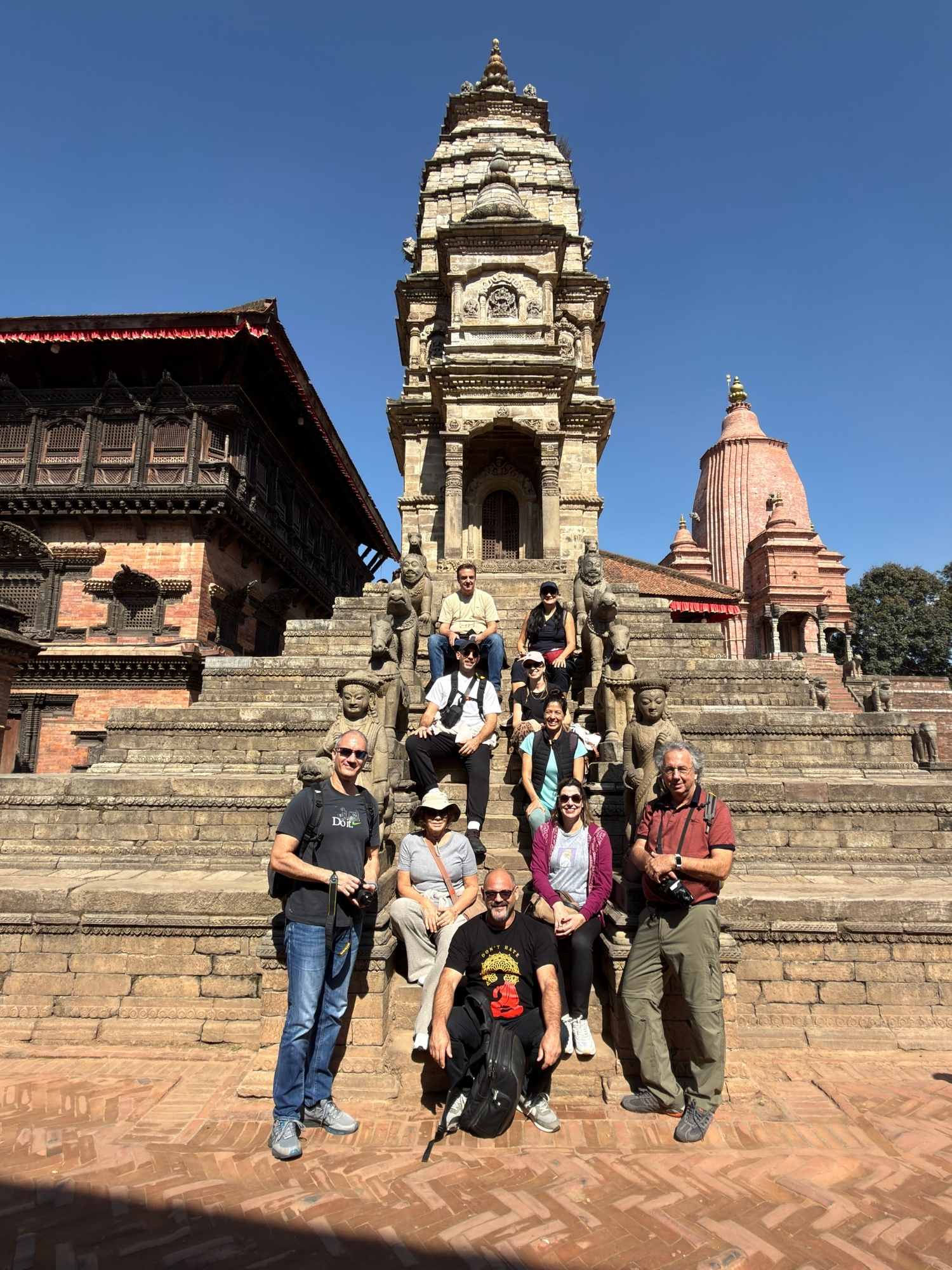
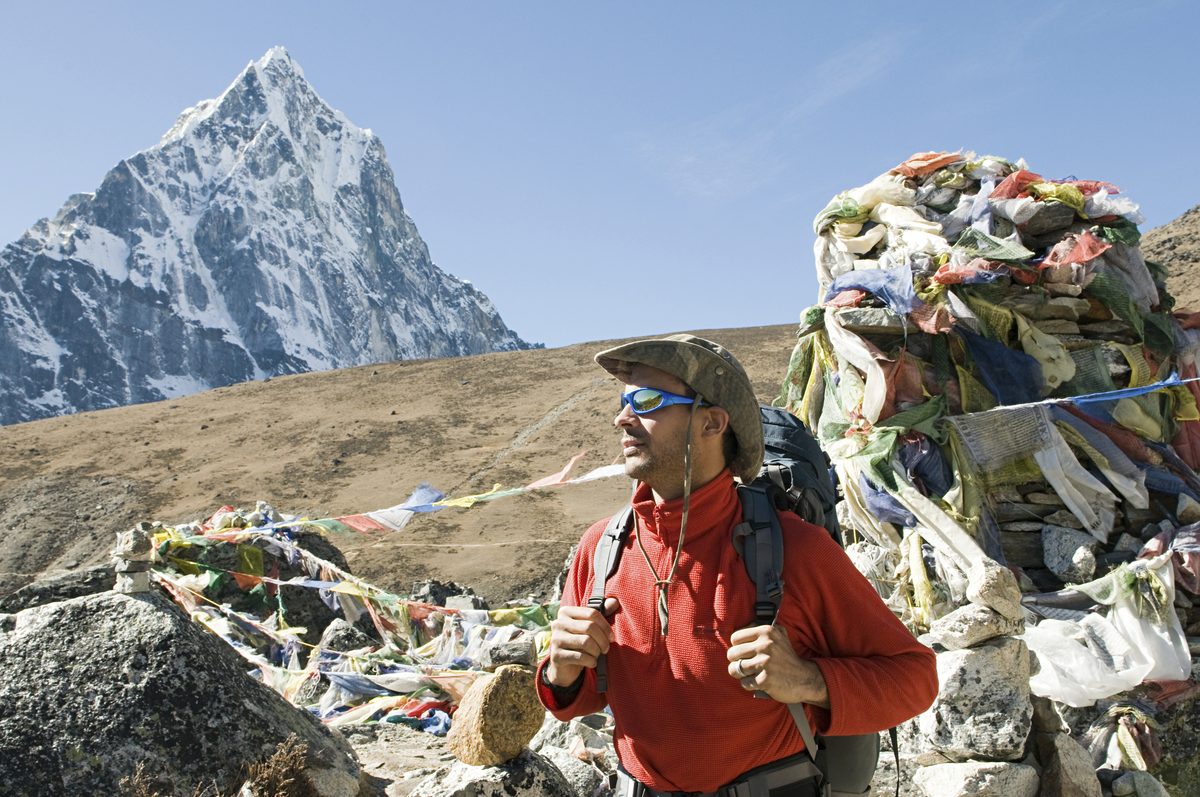
There is a moment on the Kongma La — somewhere past five thousand four hundred metres, where the trail stops pretending to be a trail and becomes a suggestion scratched across scree — when you understand why almost nobody comes here.
Below you, the Khumbu Glacier grinds through its valley like something alive and patient. Ahead, a cairn strung with prayer flags marks a saddle in the sky. Behind, three hours of switchbacks you cannot quite believe you walked. And around you: nothing. No queue. No line of matching duffel bags. No one at all, most days.
Fifty thousand people walk to Everest Base Camp each year. A few hundred cross all three passes.
That gap is the entire point of this article.
What the Everest Three Passes Trek Actually Is
The Three Passes is the Khumbu's complete sentence — the version of the Everest region that includes everything the standard route leaves out.
It links the three high saddles that separate the Khumbu's parallel valleys:
- Kongma La — 5,535 m. The highest, the hardest, the emptiest. It connects Chhukhung to Lobuche across a boulder field and a small glacier.
- Cho La — 5,420 m. The most technical, with a glacier crossing and, on the eastern side, an ice ramp that demands crampons and a rope in the wrong conditions.
- Renjo La — 5,360 m. The most beautiful, and the one people photograph for the rest of their lives. Everest from the west, framed like an argument you cannot win.
Between them, the route threads Everest Base Camp, Kala Patthar (5,545 m), the Gokyo Lakes, Gokyo Ri, and the Ngozumpa — the longest glacier in the Himalaya, a five-kilometre-wide river of rubble and buried ice.
It takes eighteen to twenty-one days. It is not a harder version of Base Camp. It is a different proposition entirely.
Three Passes vs Everest Base Camp: The Honest Comparison
If you have read our Everest Base Camp luxury guide, you already know the standard route's character: a pilgrimage up a single valley, magnificent, and increasingly busy.
The Three Passes inverts that. On the classic route you look at the Khumbu. On the Three Passes you look across it, repeatedly, from three different heights and three different angles — and you spend most of your days somewhere the crowds structurally cannot reach, because crossing a 5,500-metre pass filters people more effectively than any permit system ever devised.
The trade is real, and I will not pretend otherwise. You need more days, better legs, and a genuine tolerance for cold mornings and thin air. What you get is the Khumbu without the theatre.
Why This Trek Rewards Being Done Properly
Here is where I must be direct with you, because the luxury travel industry is not always honest about this.
Above Namche, five-star hotels do not exist. They cannot. There is no road, no grid, and no way to build them without violating the very thing that makes the Khumbu worth crossing. Anyone who promises you marble bathrooms at Lobuche is selling you a photograph of somewhere else.So what does luxury mean at 5,000 metres? It means everything that is actually scarce up there:
Air. A private guide holding a pulse oximeter who knows your baseline, watches your numbers each evening, and has the authority — and the incentive — to turn you around. Supplementary oxygen carried as standard. A portable altitude chamber on the high sections. Most altitude emergencies in the Khumbu are not bad luck; they are schedule pressure meeting ego. Time. Three extra acclimatisation nights that a fixed-departure group cannot afford to give you. This is the single greatest luxury on the mountain, and the only one that reliably determines whether you finish. Exit. A helicopter on standby and the insurance to use it. Not for convenience — for the morning when someone's oxygen saturation reads 74% and the correct answer is to be at 1,300 metres within the hour. Weight. Your pack carried, always, so that the day's work is walking rather than hauling. Refuge. The best bed available at every point on the route — the finest lodges in Lukla, Namche and Thame, where genuine comfort exists and we take all of it; a private room with a heated blanket and a hot water bottle at Chhukhung and Gokyo, where that is the ceiling and pretending otherwise is a lie.That is the honest architecture of a luxury Three Passes trek. Not opulence — margin. The difference between a hard thing done well and a hard thing survived.
The Route, Day by Day
We walk it counterclockwise: Kongma La first, Renjo La last. This is deliberate. It puts the hardest pass on the freshest legs, builds altitude progressively rather than in a single lunge, and — not incidentally — saves the most beautiful view on the entire circuit for your final morning up high.
Days 1–5: Lukla to Chhukhung
The flight into Lukla, then two days to Namche Bazaar, the Sherpa capital wrapped in its amphitheatre bowl. We rest here properly — two nights, not one, with a day walk up to the Everest View Hotel at 3,880 m for your first sight of the mountain and a slow coffee in front of it.
Then Tengboche, where the monastery sits on its ridge with Ama Dablam behind it like a piece of deliberate stagecraft. Then Dingboche and Chhukhung, at the foot of the Lhotse wall.
Days 6–9: Kongma La, Base Camp, Kala Patthar
The Kongma La is the day everyone underestimates. Nine hours, a thousand metres of ascent from Chhukhung, a boulder field, a small glacier, and a descent onto the Khumbu Glacier that goes on longer than you want it to. There is a reason we put a rest day before it.
Then Base Camp — smaller and stranger than the photographs suggest, and best understood in season, when it is a temporary city of the ambitious. And Kala Patthar at dawn, 5,545 m, the finest view of Everest's southwest face on earth, at the coldest hour you will ever willingly stand still in.
Days 10–13: Cho La and the Gokyo Lakes
Dzongla, then the Cho La — an alpine start, crampons on the ice ramp, and a glacier crossing that puts you briefly and legitimately in mountaineering territory. It is not technical for anyone with a guide and a rope. It is not trivial for anyone without.
Then Thagnak, and Gokyo: six turquoise lakes at 4,700 metres, held between the Ngozumpa Glacier and the mountains, the water an impossible mineral blue against all that grey. Gokyo Ri at sunrise gives you four eight-thousanders in one frame — Everest, Lhotse, Makalu and Cho Oyu — and it is, for my money, the best single viewpoint in Nepal.
Days 14–17: Renjo La, Thame, Namche
The Renjo La is the gift at the end. You climb from Gokyo in the dark, reach the saddle as the sun hits, and Everest is simply there across the lakes — the view that makes the previous fifteen days retroactively make sense.
Then down into the Bhote Koshi valley and Thame, where the trail empties out almost completely. Thame is old Khumbu: Tenzing Norgay's home village, a monastery on the hillside, the tourist economy thinned to almost nothing. After two weeks above the treeline, it feels like the world exhaling.
Then Namche, Lukla, and a flight out over the foothills you had forgotten were green.
When to Go
Two windows, and they are not equal.
Late September to early November is the finest. Post-monsoon air is scrubbed clean, the passes are reliably open, and the visibility is the best of the year. Late October is the sweet spot: the Base Camp corridor has thinned out, the Cho La is in good condition, and the light is extraordinary. March to May is the second window, warmer and greener, with rhododendron in bloom low down and Base Camp alive with expedition season. The air is hazier, but the mountain is at its most human — full of people preparing to climb it. December to February is possible and largely empty, but the Cho La and Renjo La can close on snow, and −25 °C at Gokyo is a serious proposition. June to August is monsoon: the passes are unsafe, Lukla flights collapse, and you should be in Upper Mustang instead, in the rain shadow, where the sky stays open.Our seasonal guide to Nepal goes deeper on the year as a whole.
What It Costs
A properly supported private Three Passes trek runs €9,000–€16,000 per person for eighteen to twenty-one days, based on two travellers.
Budget operators advertise the same route at $1,300–$1,600. The difference is not marble. It is the guide-to-guest ratio, the acclimatisation days, the oxygen, the evacuation cover, the standby helicopter, and the fact that no one on your team has a commercial reason to push you over a pass on a bad morning.
At 5,500 metres, that margin is not a comfort. It is the product.
Our full breakdown of luxury Nepal costs shows where every euro goes.
Who This Is For — And Who It Isn't
The Three Passes asks for genuine fitness: six to nine hours of walking on consecutive days, three crossings above 5,300 m, and the ability to be uncomfortable without becoming unpleasant company. If you have done Base Camp, Kilimanjaro, or serious alpine days in the Alps, you have the frame for it.
If you have not — that is not a rejection. It is a sequence. Start with the Everest View Trek, or the Gokyo Lakes on its own, and come back for the passes with the altitude already in your body. The mountain is not going anywhere, and the worst reason to attempt this trek is that someone sold it to you.
We build this journey within our Ultimate tier, because it requires the full apparatus: private guides, heli support, and the flexibility to rewrite a week around one bad forecast. Those who want the Khumbu's beauty without its passes are usually better served by the Premium journey — a shorter route, the same care, none of the ice.
The Thing Nobody Tells You
You will not remember the summits.
You will remember the fifteen minutes on the Renjo La when nobody spoke. The Sherpa guide who noticed your breathing had changed before you did. The tea at Thame that tasted like the first warm thing in your life. The particular silence at 5,400 metres, which is not the absence of sound but the absence of everything that usually fills it — and which, once you have heard it, quietly rearranges what you consider urgent for the rest of your life.
This is what we mean by experiential wealth. Not the acquisition of a place, but the loan of a perspective from it. Nobody arrives home from the Three Passes and describes the mountains first. They describe who they turned out to be at altitude, at five in the morning, three hours from anywhere, when it would have been easier to stop.
That is not tourism. That is the oldest transaction there is: you carry yourself somewhere very hard, and the mountain hands back a version of you that you had not met.
I have crossed these passes myself, in October, and I design every Elysian journey personally — which is why I will tell you honestly when a trek is wrong for you. You can read more about why I do this, or explore the rest of Nepal if the ice is not calling.
The Three Passes is not a trek you book. It is one you prepare for.
If the Khumbu's complete circuit is somewhere in your next two years, let us begin the conversation now — with your fitness, your window, and your appetite for thin air, honestly assessed.
Design your journey →