There is a precise moment on this journey when the trip changes character, and everyone who has done it can tell you exactly where it happened.
It is somewhere around two in the morning. You have been walking uphill in the dark for three hours, in a cone of headtorch light, on scree, and it has been unglamorous work. Then the ground turns to ice, you stop, and you sit down on a rock to put crampons on. There is a small ritual to it — the guide checking each strap, the front points ringing against stone when you stand up again — and when you take your first step onto the glacier, the sound underfoot changes completely. It goes from a shuffle to a bite.
That is the moment. Everything before it was a trek. Everything after it is a climb.
This is the case for climbing Island Peak in luxury — Imja Tse, 6,189 metres, the mountain that has introduced more people to Himalayan mountaineering than any other summit on earth. I want to make the case honestly, which means being clear about what the mountain actually asks of you, because this is the one journey in our portfolio where flattery would be genuinely dangerous.
What Island Peak Actually Is
The Nepali name is Imja Tse. The English one comes from Eric Shipton's party in 1951, who looked at it from Dingboche and said it resembled an island rising out of a sea of ice — which, when you stand there yourself, is not poetic licence but plain description. The peak sits at the head of the Imja Valley, east of Dingboche, in a cirque so extravagant that the mountain itself is arguably the least impressive thing in it: the south face of Lhotse forms a three-thousand-metre wall directly above you, with Nuptse to one side and Baruntse and Ama Dablam holding the rest of the horizon.
It was first climbed in 1953 by a British team, as training for what happened on Everest a few weeks later. The route those climbers found is essentially the route you will follow. There is a pleasing continuity in that.
Officially it is a "trekking peak" — a Nepal Mountaineering Association classification, and one of the most misleading phrases in the entire vocabulary of travel. It does not mean you trek up it. It means the permit is administered differently from an expedition peak. What you are climbing is a glaciated 6,000-metre mountain with crevasse fields, at least one ladder crossing in most seasons, a steep headwall of ice and snow that is fixed with rope, and a corniced summit ridge along which you are, briefly and unforgettably, an actual mountaineer.
That is the honest description. It is also precisely why it is such a superb objective.
The Real Difficulty — Told Plainly
Let me set out what the mountain demands, because the gap between the marketing and the reality is where people get into trouble.
The altitude is the hard part, not the technique. At 6,189 metres you have roughly half the oxygen available at sea level. Summit day begins between one and two in the morning and runs twelve to sixteen hours round trip to high camp or base camp. Nothing about it is technically desperate; everything about it is long, cold and thin. Fitness matters, but acclimatisation matters more, and the two are not the same thing. The technical sections are short but genuine. You need to be competent — not expert, competent — with crampons and an ice axe, comfortable walking roped on a glacier, able to use a jumar to ascend a fixed line and an abseil device to come back down it. The headwall below the summit ridge runs somewhere between one hundred and one hundred and fifty metres at an angle that averages around forty-five degrees and steepens near the top. It is fixed. It is not difficult climbing. It is, however, unarguably climbing, and doing it for the first time at six thousand metres in the dark is not the ideal introduction.The answer to that is simply training, and it is the part most operators treat as a formality. We do not. Two full days of glacier school at Chukhung — real practice on real ice, with a real IFMGA-qualified guide, until crampon technique and rope work are automatic rather than remembered — transforms both the summit success rate and, far more importantly, how the day feels while you are living it.
The summit ridge is airy. It is a snow arête with a substantial drop on the Lhotse side. You are secured throughout. If a genuine fear of exposure is something you know about yourself, tell me before we plan, not on the ridge. Who this is for: someone in genuinely good hill-fitness who has trekked at altitude before, ideally to 5,000 metres, and who wants a real summit rather than a viewpoint. Who it is not for: someone looking for a comfortable walk with a certificate at the end. For that traveller — and it is a completely legitimate preference — the Everest View Trek delivers the same mountains with none of the glacier.The Route, and Why the Shape of It Matters
Most operators sell an eighteen- to twenty-day itinerary. Ours typically runs nineteen or twenty days door to door, and the reason is not padding. It is that everything which determines whether you stand on the summit is decided in the first two weeks.
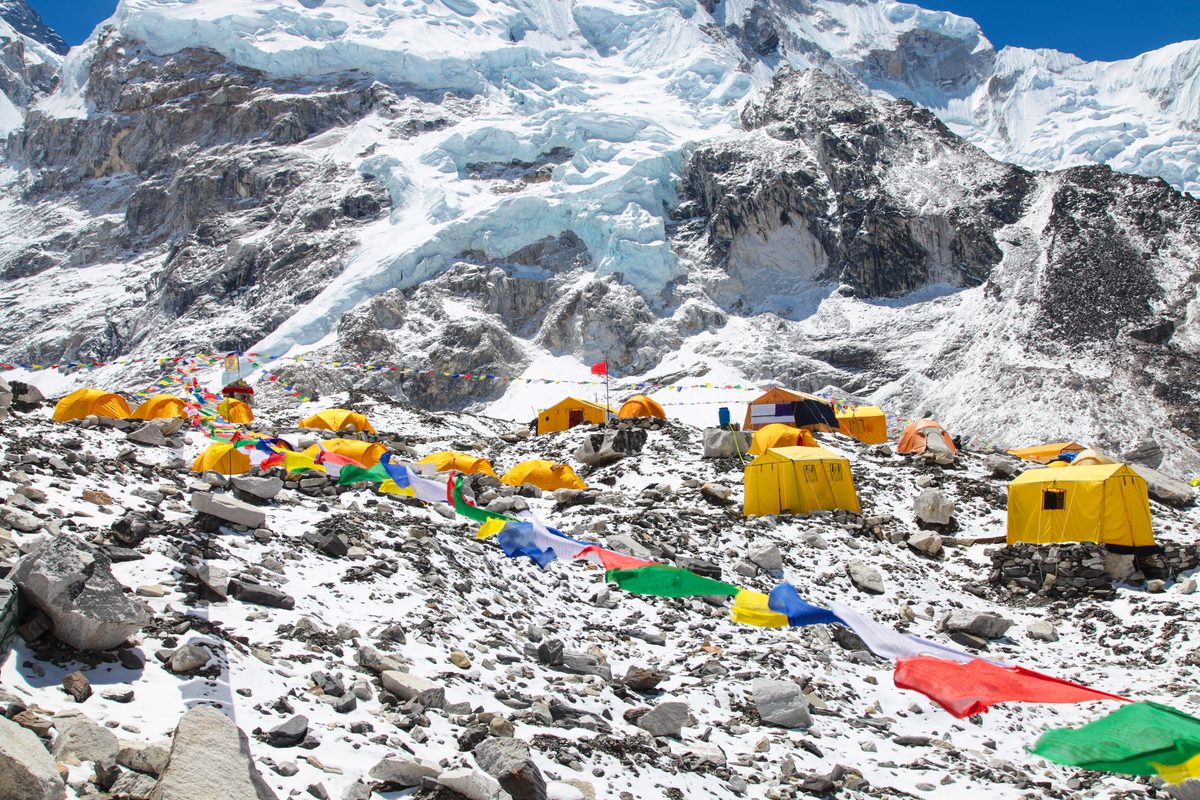
Kathmandu, two nights. Briefing, a full equipment check — which we do properly, item by item — and enough time to arrive rather than merely land. Our full guide to the city and where to stay in it is here. Into the Khumbu. Lukla by fixed-wing, or — increasingly our preference — direct by private helicopter, which removes the single most unpredictable variable in the whole itinerary. Lukla flights cancel; helicopters fly windows that fixed-wing cannot, and when weather closes the strip for two days at the end of a trip, that is your international connection gone. Then Phakding, Namche Bazaar, and the classic ascent through Tengboche and Dingboche. The acclimatisation loop. This is the part I will not compromise on. The strongest itineraries route via Everest Base Camp and Kala Patthar, or over the Cho La to the Gokyo Lakes, before turning east into the Imja Valley. It adds days. It also adds several thousand metres of climb-high-sleep-low, which is the only thing that reliably produces a summit. Our Gokyo Lakes journey covers that western arm in full, and it makes an exceptional acclimatisation phase precisely because it is beautiful enough to justify itself. Chukhung, and glacier school. Two days of technique on real ice at around 4,700 metres. Base camp, 5,100 metres. A full private camp — not a shared tent village. Dining tent, proper cook, heated mess, individual sleeping tents with real mattresses, and a toilet arrangement that does not require a sense of humour. Summit day. Wake at midnight. Move at one. Scree, then rock, then the crampon point on the glacier, then the roped crossing of the crevasse field with the ladders, then the headwall in the last of the dark, then the ridge — and then sunrise on Lhotse from a place where you have to keep turning around because there is too much in every direction. Down by afternoon, and there is no shame at all in the fact that most people cry somewhere on the descent. Extraction. Two spare days built in for weather — non-negotiable — and, for those who want it, a helicopter out from base camp or Pangboche instead of four days of retracing your steps. After summit day, that option is worth more than almost anything else in the itinerary.When to Climb
Two seasons work, and they are not equivalent.
Late September to late November is the finest window. Post-monsoon air is at its clearest, the snow is settled, temperatures are cold but stable, and visibility on summit morning is at its most reliable. Mid-October to mid-November is the heart of it. It is also the busiest period on the mountain, which is an argument for private logistics rather than for staying home. March to May is the second season and has its own character: warmer, longer days, rhododendron in bloom lower down, and the Khumbu alive with the Everest expeditions staging through. Snow conditions vary more, and the headwall can hold deeper snow early in the season. December to February is climbable and spectacularly empty, but genuinely cold — nights at base camp well below minus twenty — and only worth it for someone who actively wants that. June to August is the monsoon. We do not run it. If you want the Himalaya in those months, the answer is the rain shadow, and it is Upper Mustang.The full seasonal picture for Nepal is worth reading before you fix dates around anything else.
What Luxury Means at 5,100 Metres
This is where I want to be most precise, because "luxury mountaineering" sounds like a contradiction and is very often sold as one — a five-star hotel in Kathmandu bolted onto an otherwise ordinary expedition.
Above five thousand metres, luxury stops being about finish and becomes about margin. Here is what it actually consists of, in the order that matters:
Guide ratio. One IFMGA or NMA-certified climbing guide per client on summit day. Not one to four. This is the single largest determinant of both safety and success, and it is the first thing budget operations cut. With a one-to-one ratio you climb at your own pace, you get rope work managed for you at the transitions, and if you need to turn around, you turn around — without ending anyone else's summit. Oxygen and medical provision on site. Supplementary oxygen, a pulse oximeter used properly and recorded twice daily, a comprehensive medical kit, and — on our Ultimate itineraries — a portable hyperbaric chamber at base camp. Most 6,000-metre climbers never need any of it. The value is in the fact that it is thirty metres away rather than four days. Helicopter contingency, pre-arranged and pre-funded. Not a phone number. An actual standing arrangement with insurance verified before departure. Altitude problems are solved by descent, and the fastest descent in the Khumbu has rotors. A private camp with a real kitchen. Appetite disappears above five thousand metres, and calories are what carry you up on summit day. A dedicated cook producing food you actually want to eat is not indulgence — it is fuel logistics. Hot water bottles in the sleeping bag at nine, tea brought to the tent at five, and expedition-grade down and mats that mean you sleep rather than endure. Weather intelligence. Daily forecasting from a specialist mountain service, and an itinerary with the slack in it to move summit day by forty-eight hours. Most failed summits are not fitness failures. They are calendar failures. Recovery afterwards. The most underrated element of the entire journey. Come off the mountain and into a genuinely excellent hotel — a long bath, a proper dinner, a bed that does not require a headtorch. Consider two nights somewhere warm and horizontal afterwards; a great many of our clients pair the climb with time in Pokhara or at a lowland lodge, and not one of them has regretted it.This is the architecture of our Ultimate journeys, and Island Peak sits naturally within that tier. A more conventional supported ascent, with a strong guide ratio and comfortable but less elaborate camp logistics, works within the Premium structure.
What It Costs
Prices in this category vary more wildly than in any other kind of Nepal travel, and the variance is not marketing — it is a genuine difference in what you are buying.
A budget group ascent, advertised at somewhere between €2,000 and €3,000 per person, exists. It buys you a shared guide on summit day, basic camp catering, a rescue plan that consists largely of optimism, and a group whose pace is not yours.
A properly private, fully supported Island Peak journey of nineteen to twenty days — one-to-one certified climbing guide on the mountain, private base camp with a dedicated cook, all technical equipment, permits and NMA fees, two days of glacier school, private helicopter transfers in and out of the Khumbu, oxygen and full medical provision on site, best-available lodges throughout the trek, and luxury hotels in Kathmandu — typically falls between €11,000 and €18,000 per person, based on two travelling together, excluding international flights.
At the top of that range sit the additions that genuinely change the experience: a hyperbaric chamber at base camp, a private helicopter summit-day standby, a dedicated expedition photographer, or extending the acclimatisation phase to include the full Everest Base Camp and Gokyo circuit. Our broader breakdown of what luxury travel in Nepal costs sets this in context against the rest of the country.
The line I would never economise on is the guide ratio. Everything else on this list improves the journey. That one determines it.
Why This Journey Changes People
I have spent years designing journeys in Nepal, and I have watched a particular thing happen on this one that happens on almost no other.
Most luxury travel — including a great deal of what I design — is an experience delivered to you. It is beautifully done, it is deeply felt, and it is fundamentally received. Island Peak is not that. Nobody can carry you up the headwall. The one-to-one guide, the oxygen, the chamber, the helicopter on standby — every element exists to remove risk and friction, and not one of them removes the twelve hours of your own effort in the dark.
That is a rare thing to buy at any price. You arrive at the summit having been given every possible advantage, and having still had to do it yourself. People come off that ridge changed in a way that no hotel, however extraordinary, has ever changed anyone.
That is what we mean by experiential wealth. Not comfort. Transformation, with comfort deployed intelligently in its service. If you would like to know why I build journeys this way, and how a Greek came to spend his life designing them in the Himalaya, my story is here. The wider range of what Nepal makes possible is set out across our destinations.
Begin
The autumn 2026 window runs from late September to late November, and the certified climbing guides worth having are booked eight to twelve months in advance. If you are considering next autumn, now is the correct time to start the conversation — and if you are considering spring, it is close to the last.
Tell me where your altitude experience currently stands, honestly. If the mountain is right for you, I will design the ascent around your acclimatisation, your calendar and your temperament — and if it is not yet right, I will tell you that too, and design the journey that gets you there.
Let us begin designing yours. The ice is waiting, and it makes a very particular sound.