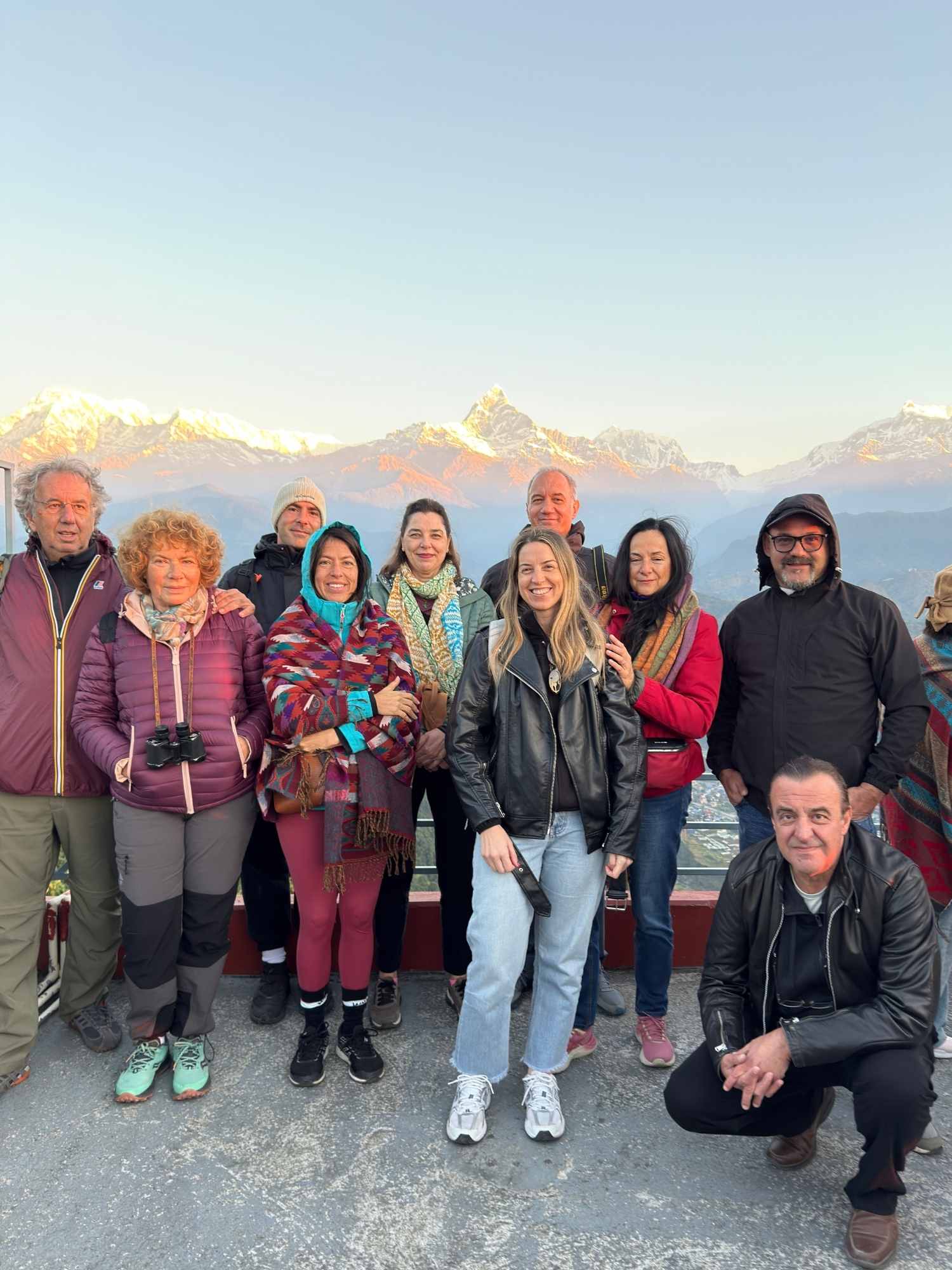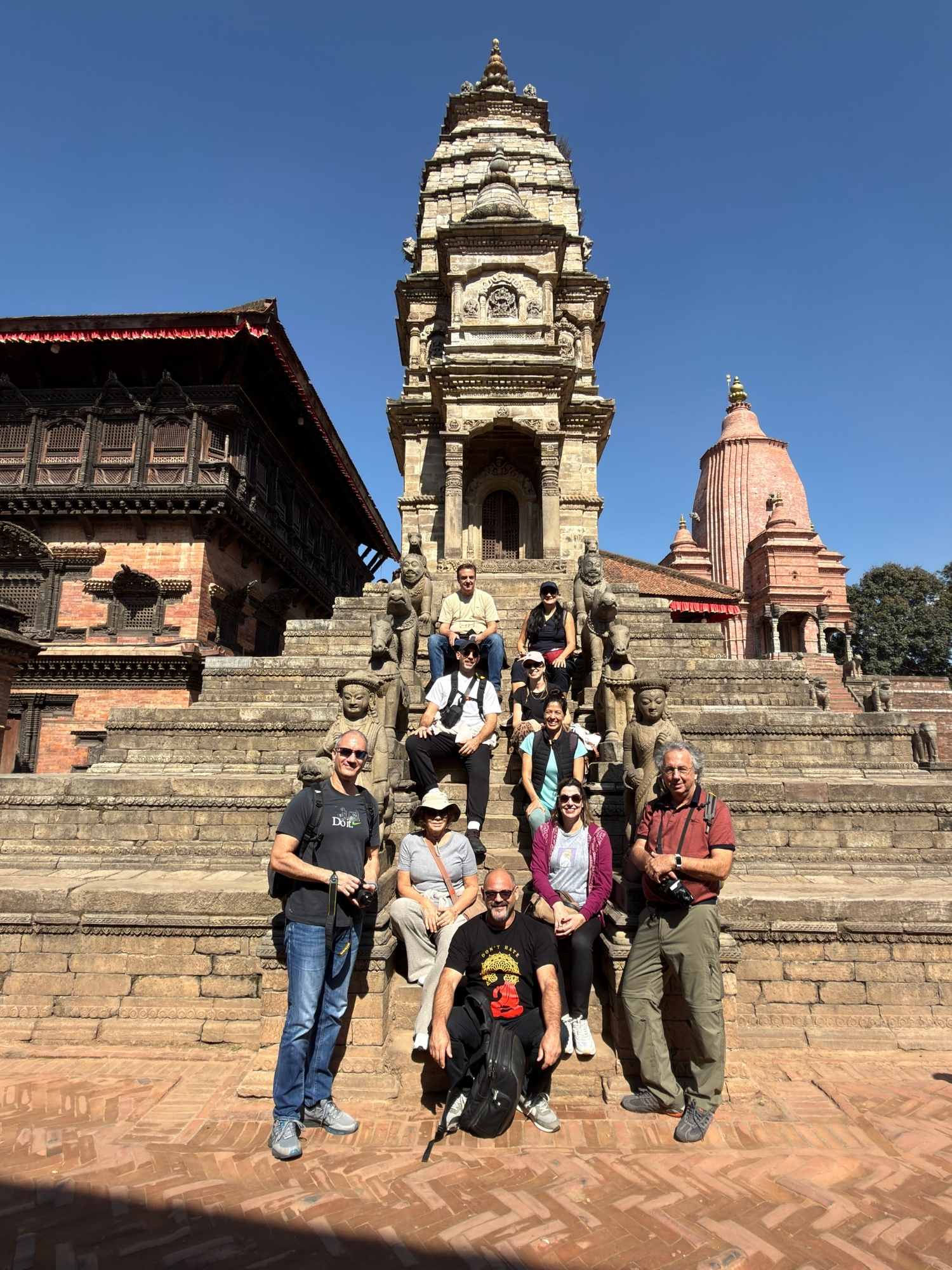
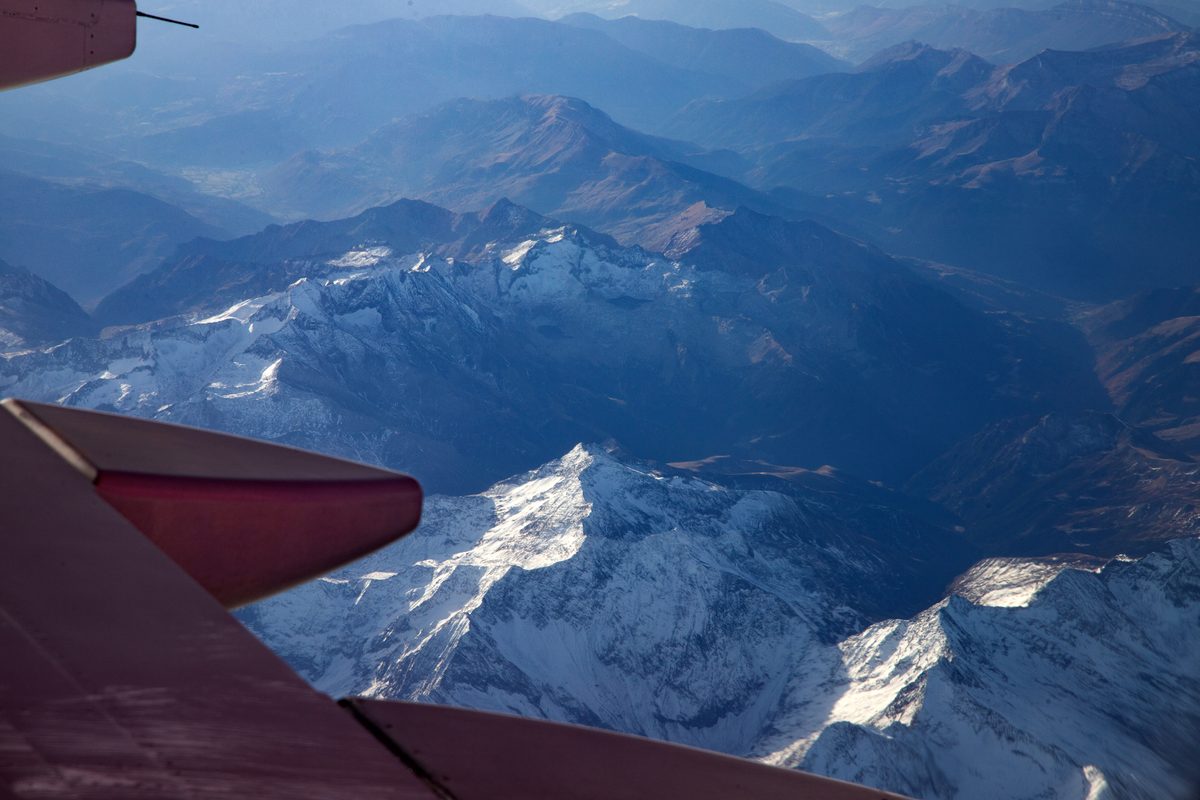
There is a particular quality to the light over the Himalayas at around eleven thousand metres, an hour out of Kathmandu. The range does not appear the way mountains usually appear from an aircraft — as texture, as a wrinkling of the earth below. It appears at your altitude. Eight-thousand-metre peaks stand level with the window, close enough that you register the wind scouring snow from the summit ridges, and you understand for the first time that you are not flying over the Himalayas at all. You are flying among them.
On a scheduled flight, you will likely miss this. You will be on the wrong side of the aircraft, or the cabin lights will be up for the meal service, or you will be somewhere over the Bay of Bengal at the hour when the light is worth having. On a private aircraft, this moment is not left to chance. It is a routing decision, made weeks earlier, by someone who knew to make it.
That, in a sentence, is the case for chartering privately into Nepal. Not the champagne. Not the absence of a queue. The recovery of the moments that ordinary travel spends on your behalf without asking.
Why Private Aviation and Nepal Are a Particular Kind of Match
Most destinations do not especially reward private aviation. If you are flying to Paris or Dubai, a private jet buys you convenience, discretion and time — real goods, but marginal ones. The city is the same city when you land.
Nepal is different, for three structural reasons.
The country is not a hub, and pretending otherwise costs you days. There are no direct flights to Kathmandu from Athens, from London, from most of Europe. The commercial route involves a connection — typically Doha, Dubai, or Istanbul — with a layover that is rarely elegant and sometimes punishing. A journey that should be nine hours in the air becomes an eighteen-hour ordeal with a four-hour interval in a terminal at three in the morning. You arrive in Kathmandu depleted, and you spend your first day in Nepal recovering from the act of getting to Nepal. Nepal's interior runs on aviation, not roads. This is the point most travellers miss. Getting to Kathmandu is only the first movement. The places worth reaching — Lo Manthang in Upper Mustang, the Khumbu, Jomsom, Bardia in the far west — are separated from the capital by mountain ranges, not by highways. Nepal's domestic aviation is therefore not a luxury add-on; it is the circulatory system of the country. A traveller who has already committed to private aviation for the international leg finds that the logic extends naturally and powerfully into the interior. The weather does not negotiate. Himalayan flying operates within windows — morning air, before the thermals build and the valleys close in. Scheduled domestic flights in Nepal are delayed and cancelled with a regularity that startles first-time visitors. Private aviation does not exempt you from weather, but it does something almost as valuable: it makes your schedule responsive to weather rather than hostage to it. When the window opens at 6:40 instead of 9:00, you go at 6:40.What It Actually Costs
I would rather be direct about this than gesture vaguely at exclusivity, because the numbers are more interesting than the mystique.
Private jet charter into Kathmandu's Tribhuvan International runs broadly between $2,000 and $17,000 per flight hour, depending almost entirely on the aircraft. A light jet — a Citation, a Learjet — sits at the bottom of that range but lacks the range for a non-stop from Europe. A super-midsize aircraft, a Challenger 350 or a Gulfstream G280, will do Athens to Kathmandu with one technical stop and sit somewhere in the middle. A heavy jet — a Gulfstream G650, a Global 6000 — will fly it non-stop, and will price accordingly.
For a realistic Athens–Kathmandu round trip on a super-midsize aircraft, you are looking at something in the region of €90,000 to €140,000 for the aircraft, depending on routing, positioning and season. On a heavy jet flying non-stop, meaningfully more.
Two things are worth understanding about that figure. The first is that it is priced per aircraft, not per person. For a party of six or eight — a family travelling together, or two couples — the arithmetic changes character entirely, and the comparison to eight business-class tickets on a connecting itinerary becomes far less lopsided than the headline number suggests.
The second is that the aircraft is the smaller half of the problem. What makes private aviation into Nepal work or fail is ground handling: overflight permits for Indian and Chinese airspace, slot coordination at Tribhuvan, customs and immigration handled planeside rather than in the terminal, fuel uplift arranged in a country where jet-A availability is not infinite, and crew accommodation for the days your aircraft sits on the ground. Charter brokers who quote you a flight hour rate and stop there are quoting you the easy part.
We generally advise booking one to two weeks ahead for sensible pricing, though a competent operator can turn a Kathmandu charter around in four to six hours if circumstances demand it. What cannot be compressed is permit lead time for the more remote onward legs — Upper Mustang in particular requires restricted-area documentation that no amount of money accelerates past a certain point.
The Onward Legs: Where the Real Argument Lives
Here is where a private-aviation approach to Nepal stops being about comfort and becomes about access.
Lukla, and the Everest Approach
Lukla's Tenzing–Hillary airport is the gateway to the Khumbu and one of the most demanding airfields in commercial aviation — a 527-metre runway on a slope, with a mountain wall at one end and a drop at the other. It is served by twin-otters and helicopters, not by jets, and the flights operate in a narrow morning window.
The traveller flying privately into Kathmandu does not land at Lukla in their jet. What they do is arrive at Tribhuvan on their own schedule, transfer directly to a waiting helicopter, and reach Lukla or Syangboche while the morning air is still stable — rather than overnighting in Kathmandu and joining the 6am scramble for a domestic seat that may or may not depart. We explore this approach in depth in our writing on the luxury Everest Base Camp journey and the Everest helicopter breakfast.
Jomsom and Upper Mustang
The former Kingdom of Lo — Upper Mustang — is the single strongest argument for private aviation in Nepal. It sits behind the Annapurna and Dhaulagiri massifs in the rain shadow of the Himalayas, a high desert of ochre cliffs and Tibetan Buddhist monasteries that remained closed to outsiders until 1992 and remains restricted today.
Reaching Lo Manthang commercially means a flight to Pokhara, a second flight to Jomsom in a weather window, and then two days of driving or riding up the Kali Gandaki gorge. Reaching it by private helicopter means a morning. This is the flight that anchors our Ultimate journey, and it is not an indulgence — it is the difference between three days of transit and three days in Lo Manthang. Our full account of the region is in the Upper Mustang luxury tour guide.
Bardia, Chitwan and the Terai
Nepal's southern lowlands — the tiger country of Bardia and the more accessible grasslands of Chitwan — are a full day's drive from Kathmandu on roads that will remind you why aviation matters here. By air, they are under an hour, which converts a two-night safari from a logistical compromise into something genuinely worth doing.
The Cabin as an Instrument, Not an Ornament
There is a version of private aviation writing that dwells on the leather and the stemware. I find it beside the point.
What matters about the cabin on a long sector into Nepal is what it lets you do with the twelve hours. You can arrive having slept properly on a flat bed, which means your first morning in Kathmandu is a real morning rather than a fog. You can bring your own food — which sounds trivial until you have watched a client with a serious dietary constraint navigate a connecting itinerary through two airports. You can hold a conversation, at length and in private, with the people you are travelling with, which for families who rarely occupy the same room for twelve consecutive hours is not a small thing.
And you can control the routing. A daylight approach into Kathmandu from the west, timed correctly, gives you Annapurna and Manaslu and Ganesh Himal along the left side of the aircraft in afternoon light. It is one of the great sights in aviation and it costs nothing extra — it simply requires that someone thought to ask for it.
When Private Aviation Is the Wrong Answer
I would not be honest if I did not say this plainly: for a solo traveller or a couple on a two-week journey, chartering internationally into Nepal is usually a poor allocation of budget. The same money, directed at private helicopter access within Nepal, at the finest lodges, at a longer stay and a better guide, will buy a more transformative journey. Getting to Nepal in first class on a well-chosen scheduled routing and then flying privately once you are there is, for most travellers, the more intelligent structure — and it is what we recommend more often than not.
International charter becomes genuinely compelling in three situations: a party of six or more travelling together; a traveller with a hard schedule constraint where the days saved have real value; and multi-country Himalayan itineraries — Nepal with Bhutan, or Nepal with Tibet — where the connections between countries are the actual bottleneck. We discuss the first of these in the Nepal and Bhutan two-kingdom journey.
The philosophy that runs through everything we design at Elysian Himalaya is that wealth, applied to travel, should buy depth rather than display. Sometimes a private aircraft is exactly that. Sometimes it is the most expensive way to arrive somewhere you could have arrived rested anyway. The work is in knowing which, and we would rather tell you honestly than sell you the aircraft.
Practical Notes
Airports. Tribhuvan International (VNKT) in Kathmandu is the entry point for jets. Pokhara's new international airport can accept smaller business aircraft. Everything beyond is turboprop and helicopter country. Permits. Overflight clearances for Indian airspace are routine but not instant. Restricted-area permits for Upper Mustang and Dolpo require lead time and cannot be arranged on arrival. Season. October–November and March–April give the most reliable flying weather and the clearest mountain views. The monsoon months of June–September make Himalayan flying unpredictable and are best avoided for aviation-dependent itineraries — our seasonal guide sets this out in full. Ground time. If your aircraft waits in Kathmandu for ten days, you are paying for it to wait. For longer journeys, a one-way charter in and a scheduled or repositioned return is frequently the better economics.An Invitation
I designed my first Nepal itinerary for myself, badly, more than a decade ago, and I have spent the years since learning what actually makes the difference between a holiday in the Himalayas and a journey that reorders something in you. Aviation, it turns out, is often the hinge — not because flying privately is luxurious, but because in a country shaped by mountains, the ability to move at the right hour on the right morning is the thing that puts you in the right place.
If you are considering Nepal and wondering whether private aviation belongs in the plan, I would rather talk it through with you than have you guess. Some journeys need it. Many do not. Either way, the conversation begins the same way — with what you want the journey to do for you.
Begin designing your journey, or read more about how I approach this work.