The workshop has no sign. You reach it through a low doorway off a lane in Patan, across a courtyard where someone's washing is drying beside a small shrine to Ganesh, and up a wooden staircase so steep it is closer to a ladder. At the top, in a room lit by a single north-facing window, a man in his sixties is pressing warm wax around the fingers of a Buddha no taller than your hand. He has been doing this since he was eleven. His father did it before him, and his grandfather before that. He does not look up when you come in, and you will not want him to.
That room is what luxury shopping in Kathmandu really means. Not a mall, not a boutique with air conditioning and a price on every shelf, but a few hours spent with the people who still make the most beautiful objects in the Himalaya, by hand, in the same streets where their families have made them for centuries. You leave with something extraordinary. More importantly, you leave knowing exactly who made it, how, and why it looks the way it does.
Why Kathmandu Is One of Asia's Great Craft Cities
The Kathmandu Valley has been a workshop for the whole Himalayan world for well over a thousand years. Its Newar artisans cast the bronzes, carved the temple struts and painted the scrolls that filled monasteries from Lhasa to Ladakh. In the thirteenth century a young Newar craftsman named Araniko was sent to the court of Kublai Khan, where he built the White Stupa that still stands in Beijing. Few cities of this size have exported so much beauty.
That tradition never stopped. The lost-wax casters of Patan, the woodcarvers of Bhaktapur, the Tibetan thangka masters who settled around Boudhanath after 1959: they are all still working, most of them within a few kilometres of one another. What has changed is the noise around them. Walk through Thamel and you will pass hundreds of shops selling "thangka", "pashmina" and "antique" bronzes. Some of it is good. Much of it is machine-printed, blended, or made last month to look old.
The difference between a souvenir and an heirloom here is not where you shop. It is who is beside you when you do.
The Thangka: Painting as Prayer
What a true thangka is
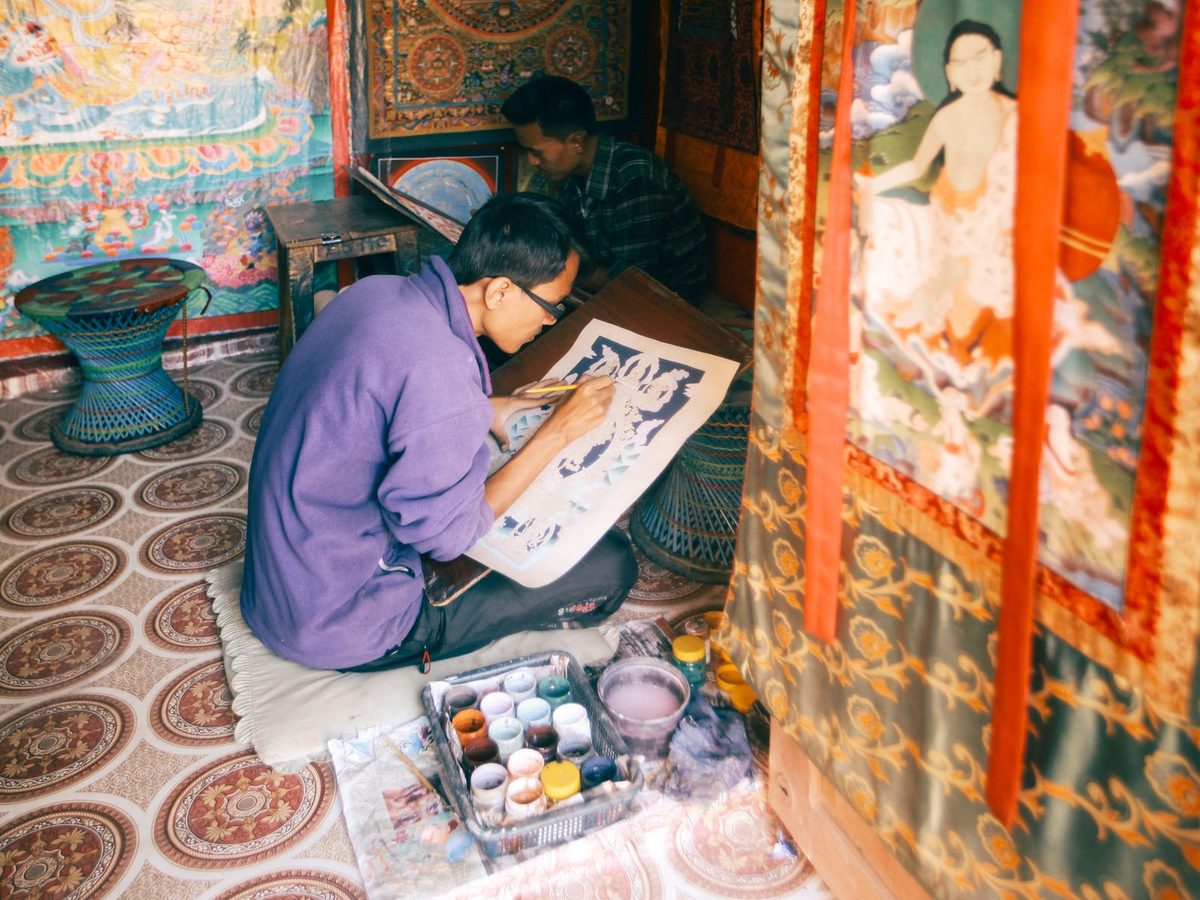
A thangka is a Buddhist scroll painting, made to be hung, rolled and carried. It is not decoration in the Western sense. It is a support for meditation, and every proportion is prescribed: the width of the Buddha's face, the angle of a hand, the colours of each deity. A painter who departs from the grid is not being creative. He is making a mistake.
A serious work begins with cotton canvas stretched on a frame and primed with a mixture of chalk and animal glue, then burnished with a smooth stone until the surface is as fine as ivory. The figure is drawn on a geometric grid. The colours are ground by hand from minerals: lapis for blue, malachite for green, cinnabar for red. Gold is applied as real gold, then burnished with an agate tip so that it catches the light differently from every angle. The finest detail, the eyelashes, the strands of a deity's hair, is painted with brushes of only a few hairs.
A large thangka by a master can take many months. Some take more than a year.
Where we take you
We work with a small number of studios in Boudhanath and Bhaktapur run by recognised masters, some of whom train young painters in the old way, over many years. A private visit means sitting beside the painters at work, learning to read the iconography of a finished piece, and, if you wish, commissioning a thangka of your own: a deity, a mandala, or a Wheel of Life chosen with the master's guidance, which will be finished and shipped to you months after you have gone home. If you have read our guide to Boudhanath, you will know that the studios around the stupa are part of the same morning as the kora.
How to tell the difference
A guide who knows painting will show you in a minute what would take you years to learn alone. Look at the gold: real gold, properly burnished, has depth and a soft glow, while gold paint is flat and brassy. Look at the faces under magnification: a master's work stays perfect at the smallest scale. Turn the canvas over: hand-primed cotton feels different from printed fabric. And ask who painted it. In a good studio, the answer is a name.
Patan's Bronze Casters: The Lost-Wax Masters
Patan, the old city of Lalitpur, has been the valley's centre of metalwork for centuries, and its lost-wax casting is among the finest in Asia. The process has not changed in a thousand years. The artisan sculpts the figure in wax, encases it in clay, and heats the mould until the wax runs out. Molten metal is poured into the hollow it leaves behind. Then the clay is broken away, and the real work begins: weeks of chasing, engraving, polishing and, for the finest pieces, fire-gilding and setting with semi-precious stones.
The families who do this work, many of them from the Shakya and Bajracharya castes, live and cast in the lanes around the Golden Temple and the old Durbar Square. We usually begin at the Patan Museum, housed in a restored royal palace and one of the finest small museums in Asia, so that you see what the tradition is capable of before you meet the people who carry it. Then we walk into the lanes. Our journey through Patan covers the city in full. On a shopping day, the museum is the lesson and the workshops are the conversation.
What you buy there is not a copy of a museum piece. It is the same piece, made by the same hands, from the same tradition.
Pashmina: The Real Thing, and How to Know It
No word in Kathmandu is used more freely than "pashmina". In much of the market it simply means "a soft scarf". True pashmina is something very specific: the fine winter undercoat of the Himalayan mountain goat, the chyangra, combed out by hand in spring when the animals moult. The fibre is extraordinarily fine, and there is very little of it per animal. Nepal's industry protects the genuine article under its own collective trademark, Chyangra Pashmina, which is a useful starting point when you are looking for the real thing.
A fine pashmina is warm out of all proportion to its weight. It feels slightly dry and alive in the hand, not slippery. Pure hand-woven pieces have small irregularities that a machine would never make. Blends with silk are legitimate and beautiful, but they should be described honestly as blends.
We take you to producers who spin, weave and dye in the valley, where you can see the raw fibre, watch a shawl come off the loom, and choose colour and weight for a piece made to your order. A pashmina chosen this way, for yourself or for someone at home, is not a scarf. It is something you will still be wearing in twenty years.
Hand-Knotted Carpets: A Tibetan Inheritance
When Tibetan refugees arrived in the Kathmandu Valley in the 1960s, they brought the craft of hand-knotted carpet weaving with them. The handicraft centre at Jawalakhel, in Patan, was established to give the new arrivals work. It still operates, and the sound of the weavers beating each row of knots into place, while singing softly, is one of the quiet pleasures of the valley.
Today Tibetan-style carpets from Nepal are among the most respected in the world, woven from Himalayan wool, often blended with silk, and frequently dyed with natural vegetable colours. The best workshops will weave to your own design and dimensions. If you are furnishing a house, or restoring one, this is one of the most rewarding commissions you can make anywhere in Asia: a carpet made for one particular room, and nowhere else.
The Smaller Treasures
Not everything worth taking home is large. Some of our favourite objects in the valley are modest in size and immense in character.
Singing bowls
The genuine article is hand-hammered from a bell-metal alloy and tuned by ear. A good bowl, struck lightly, keeps sounding for a remarkably long time and carries more than one tone at once. Our guides take you to a maker rather than a stall, so you can hear the difference between a hammered bowl and a cast one. Once heard, it is not forgotten.
Lokta paper
Handmade from the inner bark of the lokta bush, which grows in the Himalayan forests and regenerates after harvesting, this is one of Nepal's oldest crafts. It was once used for government documents because it lasts for centuries. Today it becomes notebooks, wrapping, lampshades and fine stationery.
Dhaka cloth and Newar silver
Dhaka, the woven cotton of the Nepali hills, still made on hand looms, is the fabric of the traditional topi cap, and in the hands of contemporary designers it has become something genuinely fashionable. Newar silversmiths and goldsmiths, meanwhile, still make ritual and personal jewellery to patterns their great-grandparents would recognise.
Himalayan tea
Nepal's eastern hills produce orthodox teas that are increasingly prized by connoisseurs, grown on the same ridges that run on into Darjeeling. If you would rather visit the gardens themselves, we describe them in our journey to Ilam. In Kathmandu, a private tasting with a specialist merchant is an elegant way to end an afternoon.
Asan, Indra Chowk and the Old Bazaar
Even the most private shopping day should include an hour in the old bazaar, not for buying but for seeing. Asan and Indra Chowk are where the city has traded for centuries: diagonal lanes that meet at small squares, each with its temple, its spice sellers, its brass merchants and its glass-bead stalls, where women choose the strings of green beads they wear after marriage. It is crowded, loud and utterly alive.
With a guide beside you, it stops being chaotic and becomes legible: this lane for brass, this one for textiles, this temple for this festival, this family selling the same thing on the same corner since before anyone can remember. It is the best possible context for everything else you will see.
For a contrast, the boutiques of Jhamsikhel and Durbar Marg are where contemporary Nepali designers work with traditional materials: dhaka, pashmina, lokta, hand-beaten metal. It is a small scene, but a serious one, and it tells you where the valley's craft is going rather than where it has been.
How We Design a Private Shopping Journey
Fewer stops, longer visits
Our shopping days are built around three or four visits, not fifteen. An hour with a thangka master is worth more than a dozen shopfronts. We arrange introductions in advance, so you are expected, and so the artisans can show you work in progress, not only what is finished.
No commissions
This matters more than anything else in this article. In much of Kathmandu, the guide who takes you shopping is paid by the shop you enter. Our guides are not. Their only job is to help you find the best piece and understand it. If the best piece is in a workshop with no sign and no card machine, that is where you go.
On the question of cost
People often ask what a shopping day, or a commissioned piece, will cost. A day of this kind is shaped around what you want to find and is costed only once it is designed, because no two are the same. The same is true of commissions, which are agreed directly with the artisan. If you would like to talk it through, that conversation starts on our design a journey page.
Shipping and paperwork
Large pieces such as carpets, bronzes and framed thangkas are packed and shipped by specialists we trust, insured and tracked to your door. Objects that could be antiques require clearance from Nepal's Department of Archaeology before they can leave the country, and anything genuinely old and of religious significance should, in our view, stay where it belongs. We will tell you plainly if something is not what it claims to be, or should not be bought at all.
Woven into a wider journey
A shopping day is rarely a journey on its own. For most of our travellers it is one day woven into a longer stay in the valley, alongside the temples of Patan and Bhaktapur and the stupa at Boudhanath, or a pause before the mountains. Our Premium journeys leave room for exactly this kind of unhurried day, and the destinations we design around Kathmandu make it easy to fold in.
Frequently Asked Questions
What is the best thing to buy in Kathmandu?
For a serious collector, a hand-painted thangka by a recognised master or a lost-wax bronze from a Patan workshop. For a lasting personal piece, a genuine chyangra pashmina or a hand-knotted Tibetan carpet woven to your design. All four are made in the valley by artisans whose families have practised the craft for generations.
How can I tell if a thangka is hand-painted?
Look for real burnished gold with depth rather than flat gold paint, faces and fine detail that stay perfect under magnification, and hand-primed cotton canvas. Above all, buy from a studio where you can see the painters at work and learn the name of the artist.
How do I know a pashmina is genuine?
True pashmina comes from the undercoat of the Himalayan chyangra goat. It is extremely light, very warm, slightly dry to the touch, and hand-woven pieces show small irregularities. Look for the Chyangra Pashmina trademark and buy from producers who can show you the fibre and the loom.
Where are the best artisan workshops in Kathmandu?
Patan for bronze casting and metalwork, Boudhanath and Bhaktapur for thangka painting, Jawalakhel for Tibetan carpets, and Bhaktapur for woodcarving and pottery. The finest workshops are rarely signposted, which is why a well-connected private guide makes such a difference.
Can I ship large purchases home from Nepal?
Yes. Carpets, bronzes and framed paintings can be professionally packed, insured and shipped internationally. Items that may be antiques need clearance from Nepal's Department of Archaeology before export.
Bring Something Home That Carries a Name
Most of what we buy when we travel is forgotten within a year. What stays is the object with a story attached: the bronze whose maker you watched pressing wax with his thumbs, the thangka whose painter explained why the deity's left hand is raised, the carpet woven for one room in your house by a woman in Patan whose grandmother crossed the Himalaya on foot.
That is the kind of wealth we care about at Elysian Himalaya: not possessions, but objects that carry an experience inside them. If you would like to know more about why we travel this way, and why a Greek ended up designing journeys from Nepal, the story is on the founder page.
And if you would like a day in the valley's workshops woven into your own journey, with introductions made, the right doors opened and no one taking a commission, begin designing it here.