The steps begin in the dark. At the foot of the eastern stairway, three stone Buddhas sit painted in faded gold and red, and an old woman is already lighting a butter lamp in front of them. Above you the staircase rises straight into the trees, steep, worn smooth in the middle, and somewhere near the top a bell is being rung by someone who started climbing long before you did. A monkey watches from the balustrade with the air of a doorman who has seen everyone come and go.
By the time you reach the summit the sky over the eastern hills has turned the colour of weak tea, and the city below is still mostly fog and rooftops. Then the light finds the gilded spire, and the painted eyes of the stupa open onto the valley as they have every morning for something like fifteen centuries.
A Swayambhunath luxury tour, as we design it, is built around that hour: arriving before the crowds, walking the circuit with the people who come here every day to pray, and having beside you someone who can tell you why this hill matters so much to the story of the valley itself.
Why Swayambhunath Matters
Swayambhunath is one of the oldest and most sacred Buddhist sites in Nepal. It crowns a wooded hill on the western edge of Kathmandu, and it forms part of the Kathmandu Valley World Heritage Site, alongside Boudhanath, Pashupatinath and the royal squares of Patan, Bhaktapur and Kathmandu.
Travellers know it as the Monkey Temple. Nepalis rarely call it that. To the Newar Buddhists of the valley it is Swayambhu, the self-arisen, and to Tibetan pilgrims it has its own name meaning something like the place of the sublime trees. Whichever name you use, it is the place where, in the valley's own telling, Kathmandu began.
Boudhanath is vast and open, a great white dome on the flat ground where caravans from Tibet once arrived. Pashupatinath is the river, the fire and the whole of a human life. Swayambhunath is different again: it is a hill, a climb, a view, and a dense cluster of shrines in which Buddhist and Hindu worship have grown together so closely that it is often hard to say where one ends and the other begins.
The Legend of the Lake and the Lotus
You cannot understand Swayambhunath without the story that the valley tells about its own birth, and a good guide will begin with it.
Long ago, the story goes, the whole Kathmandu Valley was a lake. On its waters a lotus bloomed, and from the lotus rose a flame of pure light that was the Buddha nature itself: Swayambhu, appearing of its own accord. Sages came from far away to meditate on its shores. Among them was the bodhisattva Manjushri, who wished to let pilgrims reach the light more easily. With his sword of wisdom he cut a gorge through the southern hills, the lake drained away, the fertile valley floor appeared, and the hill where the lotus had stood became the hill of Swayambhu.
Geologists will tell you that the valley really was once a lake, which gives the story a peculiar resonance. Stand on the summit at dawn, with fog still lying in the low ground like water, and it is not hard to imagine.
The monkeys, incidentally, have their own place in the legend. They are said to have grown from the lice in Manjushri's hair when he let it grow long during his meditation. Whether or not you believe it, they are treated as holy, and they behave accordingly.
Reading the Hilltop
Swayambhunath is not one building but a crowded sacred summit: a stupa, temples, shrines, monasteries, prayer wheels, votive chaityas and the homes of the families who have looked after it for generations. A first visit can feel like noise. A good guide turns it into a story.
The eastern stairway
The traditional approach is the long stone stairway that climbs the eastern face of the hill. It is steep, often said to have 365 steps, and it is the way pilgrims have always come. We almost always begin here, at an hour when the steps belong to the faithful rather than the crowds, and we take it slowly. There is a car approach to a gate near the top for anyone who prefers it, and no one should feel the climb is a test.
The great vajra
At the top of the stairway, before the stupa itself, sits an enormous gilded vajra, the thunderbolt that in Vajrayana Buddhism stands for the indestructible clarity of enlightened mind. It rests on a circular stone base carved with the animals of the Tibetan calendar. Many visitors walk straight past it to photograph the stupa. It is worth pausing here first.
The stupa and its eyes
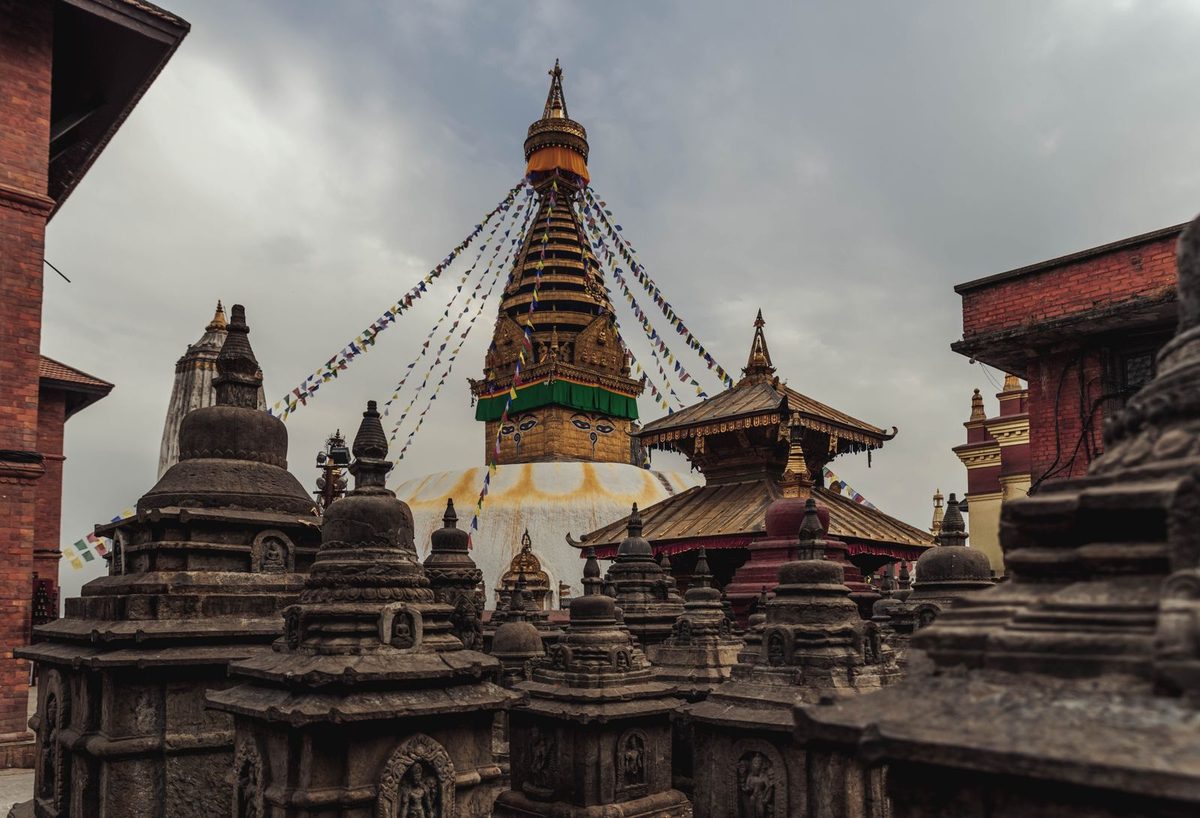
The stupa is the heart of the hill. Its whitewashed dome represents the world, and the square gilded tower above it, the harmika, carries the famous painted eyes on all four sides, gazing out in every direction across the valley. Between the eyes, where a nose might be, is a curling symbol that looks like a question mark. It is the Nepali numeral one, a reminder of unity and of the single path to awakening. Above rise thirteen tapering tiers, the stages a soul passes through on the way to enlightenment, and above those, the gilded parasol at the summit.
Around the base, set into the dome, are shrines to the Buddhas of the five directions, each with its own colour, gesture and meaning. Prayer wheels line the circuit, and strings of prayer flags run from the spire down to the surrounding roofs, carrying their printed blessings into the wind.
Pratappur and Anantapur
Flanking the stupa stand two slender white towers in the Indian shikhara style, Pratappur and Anantapur, built in the seventeenth century under King Pratap Malla of Kathmandu. They are Hindu in form on a Buddhist summit, and they are one of the clearest small lessons in how the two faiths share this valley.
The Harati temple
Behind the stupa, in a small pagoda, is the shrine of Harati, the goddess who protects children. Newar mothers come here with their babies, and for generations families have brought offerings when a child fell ill. Buddhists and Hindus worship her alike. It is one of the most tender places on the hill, and one of the least noticed.
Shantipur
On the northwestern side of the summit is Shantipur, the place of peace, a small, old and rather mysterious shrine connected in legend with a great tantric master who is said to have sealed himself inside to meditate. It is associated with rain and the welfare of the valley. It is not a place to linger noisily, and it is exactly the sort of shrine that a visitor without a guide never knows is there.
The monasteries
Tibetan monasteries cling to the edges of the summit. In the early morning and late afternoon you may hear the deep horns and the chanting of the monks drifting across the courtyards. With the right introduction, and the right timing, it is sometimes possible to sit quietly at the back during prayers. We arrange that only when it is welcome, and never as a performance.
The Kora: Walking With the Pilgrims
Every morning, before the city wakes properly, hundreds of local people walk the kora, the clockwise circuit of the stupa and the hill. Some spin every prayer wheel as they pass. Some carry malas and murmur mantras under their breath. Old men in topis and grandmothers in shawls do it the way other people take a morning walk, which, in a sense, is exactly what it is.
There is a longer kora too, around the base of the whole hill, with its own long row of prayer wheels. Walking either circuit with the pilgrims, rather than standing still and photographing them, is the single best way to understand Swayambhunath. You are no longer looking at the place. You are, for an hour, part of its rhythm.
The View Over the Valley
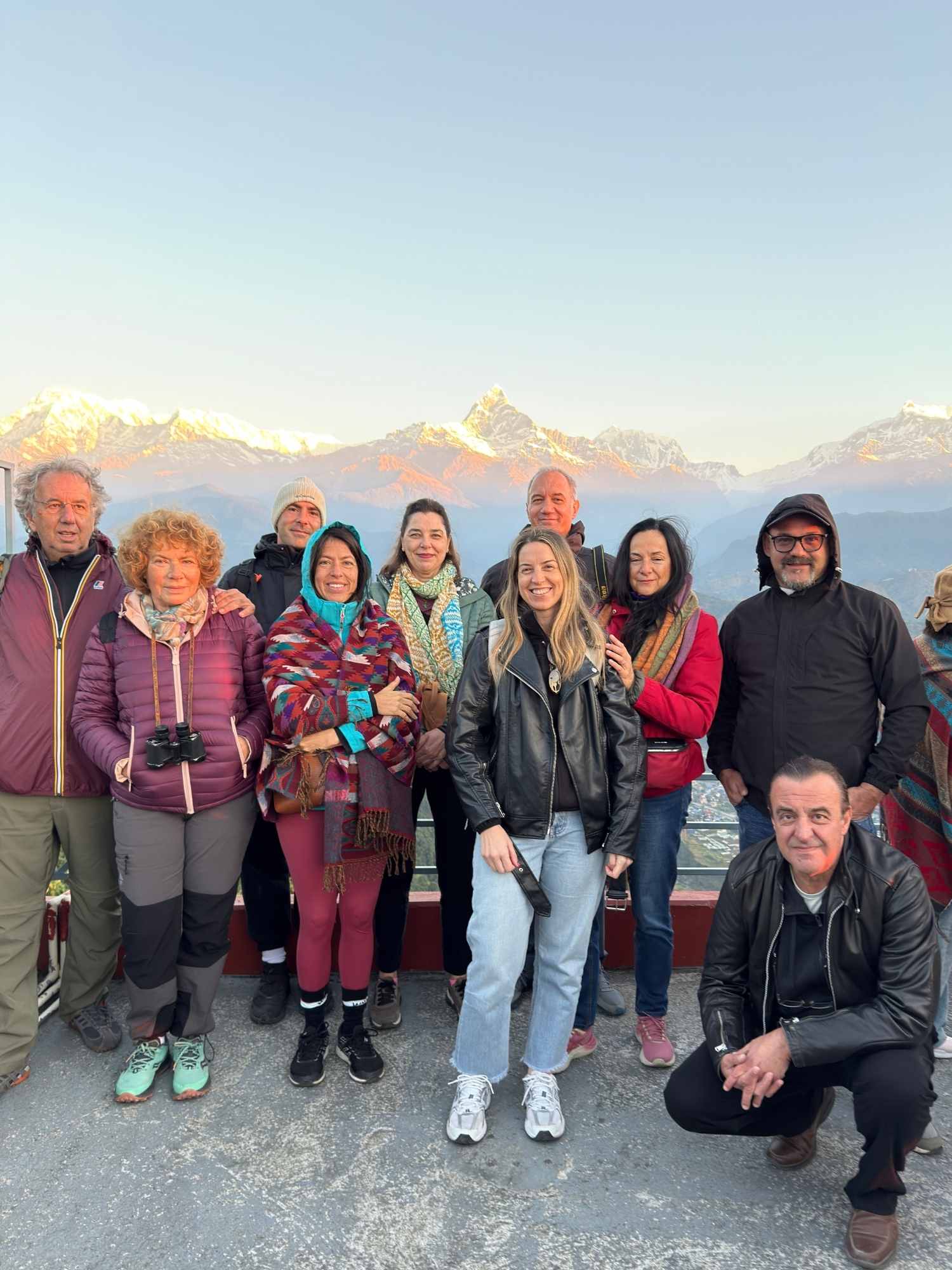
Swayambhunath is also, quite simply, one of the finest viewpoints in Kathmandu. From the western terraces you look out across the entire valley, the rooftops of the old city, the temple pagodas, the green ring of hills, and on a clear morning in the dry season the snow peaks of the Himalaya floating far behind them.
At sunrise the light comes from behind you and falls across the city. At sunset it does the reverse, and the lamps begin to come on one by one below. We choose between them depending on the season and the rest of your day, and sometimes we come twice.
What Makes a Swayambhunath Journey Truly Private
The right hours
The difference between Swayambhunath at seven in the morning and Swayambhunath at eleven is the difference between a living sanctuary and a busy monument. We plan around the first light and the last, when the pilgrims outnumber the tour groups and the hill feels as it is meant to.
A guide who knows the hill
Our guides for the Kathmandu Valley are chosen for their knowledge of Newar and Tibetan Buddhism as much as for their English. They know which shrine belongs to which tradition, which family keeps which lamp, and when a conversation should be paused. A guide like that turns a crowded summit into a coherent story.
A private blessing
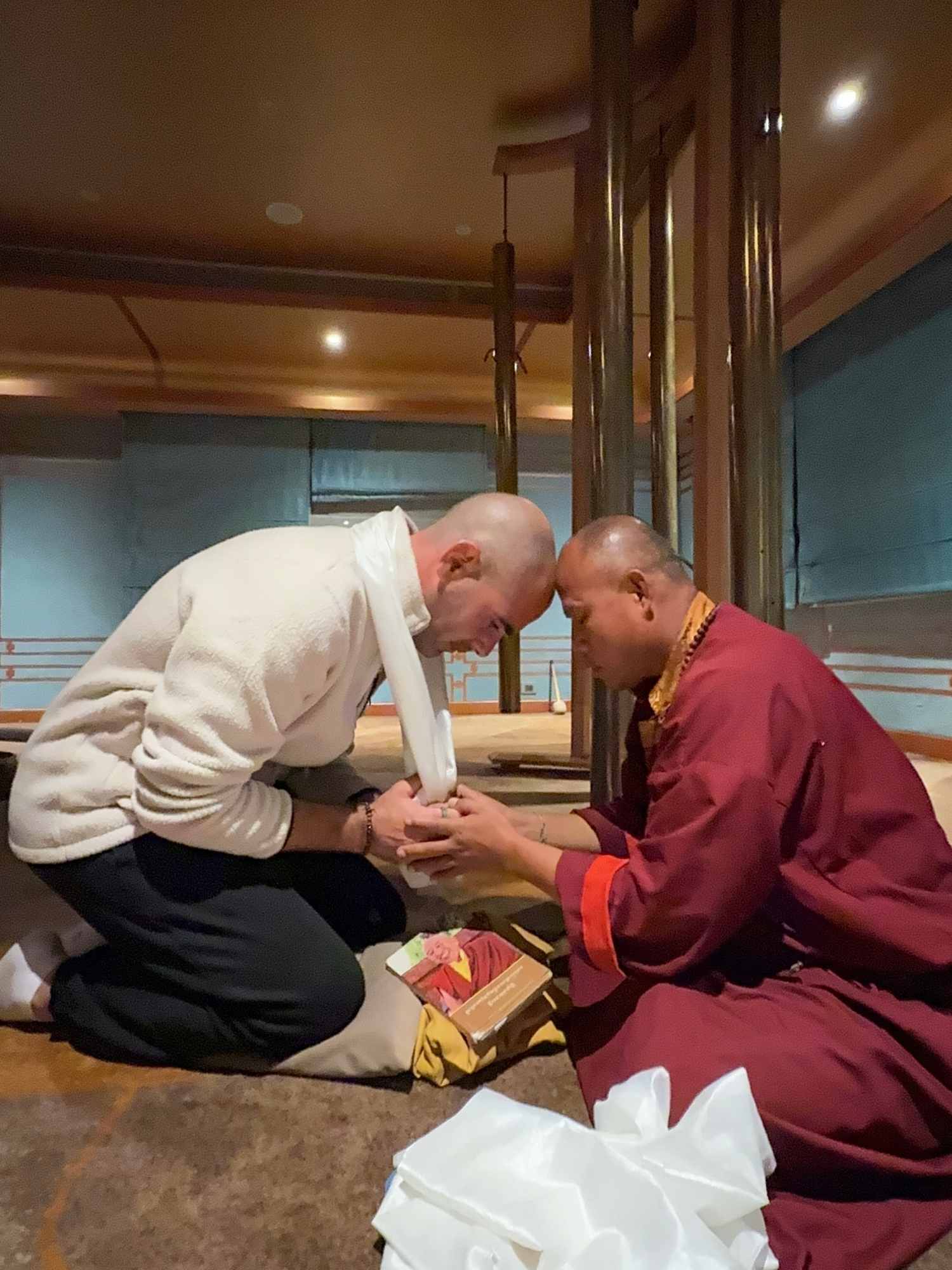
For travellers who would like it, we can arrange a quiet butter-lamp offering or a short blessing with a monk or a Newar Buddhist priest. It is done simply and respectfully, at a time that suits the monastery rather than the itinerary.
Rest, afterwards
A dawn climb deserves a slow breakfast. We bring you back to a heritage hotel in the city for a long, quiet morning, or on to a garden courtyard in Patan, so that the hill is something you absorb rather than tick off. Our guide to luxury Kathmandu describes the places we choose for that rest.
Festivals at Swayambhunath
The hill is busy with ritual all year, but some days transform it entirely.
- Buddha Jayanti. The full moon of spring that marks the birth, enlightenment and passing of the Buddha. The stupa is decorated, the steps fill with pilgrims, and butter lamps burn through the night.
- Gunla. The Newar Buddhist holy month during the monsoon, when Newar families climb the hill each morning with music, devotional songs and offerings.
- Losar. The Tibetan New Year, when the monasteries on the summit come alive with ceremony, colour and celebration.
If your dates are flexible, a festival morning at Swayambhunath is extraordinary. It is also crowded, and we plan accordingly, with the right vantage point and an exit route that keeps the day calm. Our article on Nepal's festivals covers the wider calendar.
Nearby: The Quieter Corners
Swayambhunath is often visited in a hurry, which means its surroundings are almost always missed.
- Manjushri's hill. A short walk from the main summit is a smaller rise dedicated to Manjushri, the bodhisattva of the legend, whom Hindus here also honour as Saraswati, the goddess of learning. Students come to pray before their examinations.
- The World Peace Pond. At the foot of the hill, a pond with a standing Buddha at its centre, where visitors toss coins in the hope of a lucky landing in the offering bowl.
- Amideva Park. Just below the western side, three great golden Buddha statues stand in a row, an unexpectedly serene place to sit for a quarter of an hour.
How to Build Swayambhunath Into a Nepal Journey
Swayambhunath is rarely a journey on its own. It belongs to the sacred valley, and it reads best alongside the other great sites.
- The sacred valley. Swayambhunath at dawn, Pashupatinath on another morning, Boudhanath in the afternoon and at dusk, and the royal cities of Patan and Bhaktapur. This is the heart of our Elysian Classic journey, and it gives the valley the time it deserves.
- Valley and mountains. Two or three days in Kathmandu followed by the lakes and mountain views of Pokhara, and perhaps a few days of walking. This is the shape of many of our Elysian Premium journeys.
- A spiritual thread. For travellers drawn by meditation and Buddhist philosophy, Swayambhunath pairs naturally with time at a monastery, with Lumbini, and with our spiritual retreats.
You can explore where else the valley leads on our destinations page.
When to Visit Swayambhunath
Swayambhunath is open every day of the year, and it is worth visiting in every season.
- October and November. The clearest air of the year, with the best chance of seeing the Himalaya from the western terraces.
- December to February. Cool, bright mornings and the quietest hill. The early light can be magnificent, and you will want a warm layer at dawn.
- March to May. Warm days, blossom, and Buddha Jayanti. Haze sometimes softens the mountain views.
- June to September. The monsoon. Showers usually come in the afternoon, the hill is green, and Gunla brings the Newar community out in force.
Whatever the season, the hours matter more than the month. Come at first light or in the last hour of the day.
How a Private Swayambhunath Journey Is Costed
A journey of this kind is costed only once it is designed, because no two are the same. The guide, the hours, the hotel you return to, whether a blessing is arranged and how Swayambhunath fits into the rest of your time in Nepal all shape it. If you would like a figure, that conversation starts on our design a journey page.
Frequently Asked Questions
Why is Swayambhunath called the Monkey Temple?
Because a large population of rhesus monkeys lives on the hill. Local legend holds that they grew from the lice in the hair of the bodhisattva Manjushri, and they are regarded as holy. They are also bold. Keep food and loose items out of sight and do not feed them.
How many steps are there to Swayambhunath?
The eastern stairway is often said to have 365 steps. It is steep but manageable at a slow pace. For those who prefer not to climb, a road reaches a gate close to the summit on the other side of the hill.
Is Swayambhunath Buddhist or Hindu?
It is above all a Buddhist site, sacred to both Newar and Tibetan Buddhists. But Hindu shrines stand on the same summit, and Hindus worship there too. That sharing is one of the most beautiful things about it.
What should I wear?
Modest clothing that covers the shoulders and knees, and comfortable shoes for the steps. Walk clockwise around the stupa and the prayer wheels, and remove your shoes where asked inside the shrines.
How long should I spend at Swayambhunath?
Two to three hours at dawn gives you the climb, the kora, the shrines and the view without hurrying. Some travellers return at sunset for the second light.
Begin Your Swayambhunath Journey
I still climb those steps whenever I am in Kathmandu with a morning to spare. Not because there is anything new to see, but because there is something reassuring about joining a crowd of people who have been doing the same small, devoted thing every morning of their lives. The eyes on the tower look out across the whole valley without judgement and without hurry, and after an hour up there you find yourself, briefly, doing the same. If you would like to know how a Greek came to call this country home, the story is on the founder page.
If you would like to see Swayambhunath as it deserves, at first light, on the pilgrims' stairway, with a guide who can read the hill, tell us how you like to travel and we will design the rest. Your journey begins on our design a journey page.