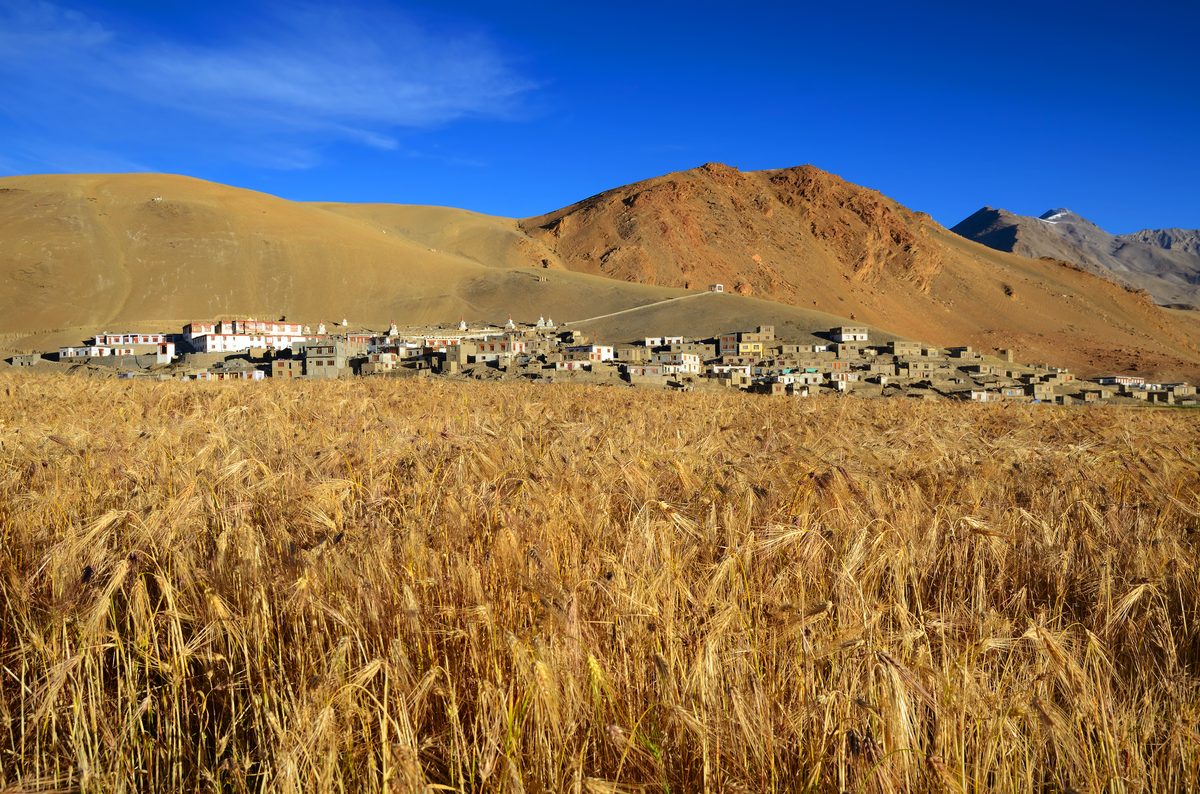
There is a particular sound in the Limi Valley that I have not heard anywhere else in Nepal, and it took me two visits to work out what it was.
It is the sound of nothing arriving. No engine, no rotor, no generator, no distant road. In the villages of Til and Halji and Jang, at around four thousand metres, what you hear at four in the afternoon is barley being threshed, a dog somewhere, water in an irrigation channel that someone's great-great-grandfather cut into the hillside, and — if the wind drops completely — a monk in the gompa working through a text out loud. That is the entire soundscape, and as far as anyone can honestly tell it has been the entire soundscape for about a thousand years.
I have designed journeys in this country for two decades. The Limi Valley is the only place in Nepal where I have felt, unmistakably, that I had walked out the back of the modern world and would need permission to return. This is the case for it as a luxury journey — the hardest thing we build, the fewest people who ask for it, and the one I would take myself if I were only allowed one more trek.
Where Limi Actually Is
Open a map of Nepal and put your finger on the far top-left corner. That is Humla, the most remote district in the country, in Karnali Province. There is no road connecting Humla to the rest of Nepal's road network — none, still, in 2026, to its district headquarters. You arrive by aircraft or you do not arrive.
Simikot, the administrative seat, sits at roughly 2,950 metres on a shelf above the Karnali river. From there the Limi Valley lies north and east, beyond two high passes, in a trans-Himalayan pocket that geographically and culturally belongs to the Tibetan plateau rather than to Nepal. From Til, the easternmost village, Tibet is a morning's walk.
This is the key to the place. Limi sits behind the main Himalayan chain — the great wall of peaks that catches the monsoon is south of you. What lies here instead is high, arid, ochre and enormous: barley fields the colour of struck brass in September, cliffs of raw rock, and a sky in a shade of blue I have only otherwise seen in Upper Dolpo.
Three villages hold the valley: Til, the highest and closest to the border, in a bowl of barley at around four thousand metres; Halji, the cultural and spiritual centre; and Jang, the westernmost, with its own gompa and its own long memory. Between them, perhaps a few hundred households. They speak a Tibetan dialect, read Tibetan, and their calendar, architecture, kitchens and gods are Tibetan. The Limi are also renowned across the plateau as woodcarvers — for generations their carpenters were sought out on the far side of the border.
The Permit Wall — Why Almost Nobody Walks This
Humla is a restricted area. That single administrative fact is the reason Limi has stayed as it is, and the reason you cannot simply decide to go.
To enter, you need a Humla Restricted Area Permit, which cannot be issued to an individual. It comes only through a government-registered trekking operator in Nepal, only for a group of at least two trekkers, and only with a licensed guide accompanying you throughout. There is a separate conservation-area fee, and paperwork in Kathmandu that has to be done properly and in the right order, weeks ahead.
I know how that reads to someone accustomed to travelling wherever they like. I would ask you to read it the other way round. The permit wall is not an obstacle to the experience — it is the experience. It is precisely the reason that in Halji nobody will try to sell you anything, why there is no guesthouse with a laminated menu, why the children look at you with curiosity rather than calculation. Restriction has done here what money never could: it has kept a place intact.
Anyone who has spent time on Mount Athos will recognise the mechanism instantly. A permit, a limit, a boat that only goes so often — and behind it, a thousand years that simply continued.
Halji, and the Monastery That Is Losing a Race
The reason to walk into Limi rather than merely look at it from a helicopter stands in the middle of Halji.
Rinchenling Gompa is among the oldest monasteries in Nepal. Sources vary on the precise founding, but it is generally placed in the eleventh century and associated with the great translator Rinchen Zangpo, whose foundations are scattered across the western Himalaya from Ladakh to Spiti to here. It belongs to the Drikung Kagyu school. It is not a ruin, not a museum, and not restored for anybody's benefit: it is a functioning monastery in a functioning village, with butter lamps lit this morning and floorboards worn concave by nine centuries of prostration. Standing inside it, in the dark, with the smell of juniper and rancid butter and old wood, is one of the two or three most powerful interiors I have entered anywhere — and I say that as a man who grew up among Byzantine churches.There is also something urgent about it. The glacier above Halji has produced repeated outburst floods in recent decades, and the village and the monastery have been directly threatened. The community has built defences and continues to fight for the ground the gompa stands on. When you understand that the thing in front of you has survived a millennium and may not survive the century, the visit stops being sightseeing and becomes something closer to witness — a shift from looking at a place to being answerable to it, and the same instinct behind our journeys built around living culture rather than monuments.
The Passes, and the Lake Between Them
The route into Limi is defined by two crossings, and they are the drama of the trek.
Nara La, at roughly 4,620 metres, is the first. It rises out of the Karnali gorge on the approach toward Hilsa, and it is the pass over which pilgrims have moved toward Mount Kailash for centuries. The view from the top is the first moment the journey declares itself: Nepal behind you, the brown immensity of the plateau ahead. Nyalu La is the high point of the circuit, generally cited at around 4,950 to 5,000 metres. It earns you the single most beautiful hour of the route — the descent past Selima Tso, a turquoise high-altitude lake set in an enormous bowl of nothing at all. No village, no shelter, no sound. On a still morning it holds the mountains upside down with total accuracy, and the temptation to stop walking and sit there for the day is one I have twice given in to.For travellers who have already walked the great named circuits, this is where Limi separates itself. The Annapurna and Everest routes give you spectacle with company. Limi gives you scale with silence.
Snow Leopard Country
The Limi Valley and the wider Humla highlands are documented habitat for the snow leopard, and the ecosystem that supports one is intact here in a way it no longer is across most of the range. You share this landscape with Himalayan wolf, Tibetan gazelle, Tibetan fox, blue sheep, argali, Himalayan brown bear and — on the open flats toward the border — kiang, the Tibetan wild ass, moving in loose herds across ground where nothing else moves at all.
I will be straightforward, because false promises ruin journeys: you will almost certainly not see a snow leopard. Almost nobody does. What you will see, walking with the right guide, are the things that tell you one is there — a scrape at the base of a rock, a kill on a scree slope, blue sheep watching a particular gully with more attention than usual. Knowing you are inside a snow leopard's territory does something to the quality of your attention that seeing one on a screen never will.
That is the honest reward. Those who want a higher probability of a sighting are better served in Bardia; those who come to Limi come for the wildness itself.
When to Come
Limi runs on a different calendar to the rest of Nepal, and this is one of the most useful things I can tell you.
Late May and June is the first good window. The passes have cleared of winter snow, the valley is greening, and the villages are planting. July and August, the monsoon that closes most of Nepal, is genuinely viable here. Limi sits in the rain shadow behind the main Himalayan wall and stays comparatively dry while the rest of the country floods. This is the same logic that makes Upper Mustang and Upper Dolpo summer destinations, and it makes Limi one of the very few serious Nepal journeys available in high summer. The approach flights are the weak link — Nepalgunj and Simikot weather can delay you — and we build spare days in accordingly. September and October is the finest window and my own preference. The air is scoured clean after the monsoon elsewhere, the barley is ripe and gold, the harvest is happening in every village, and the passes are at their most reliable. If you come once, come now. November onwards becomes a question of cold and snow on Nyalu La, and by deep winter the passes and the flights both become unreliable. We do not schedule it. The national picture is in our season-by-season guide.What Luxury Means Where There Are No Buildings
There are no lodges in the Limi Valley. No hotel, no teahouse circuit, no hot shower waiting at the end of the day. Anyone offering you one is describing a different valley.
Everything here is carried in. Which means luxury in Limi is not a room — it is an expedition built to a standard, and that is a far more demanding thing to deliver.
A full private mobile camp. Single-occupancy tents with real beds and expedition-grade bedding rated for the altitude, a heated dining tent, a private bathroom tent with a hot shower each evening, and a crew who move ahead so camp is standing and warm before you arrive. This is the architecture of our luxury camping journeys, at the far end of its difficulty range. A kitchen, not a stove. A dedicated expedition chef, fresh produce flown to Simikot and carried in, bread baked at altitude, and food that is genuinely good on day fourteen — the day it counts. Managing this in a valley with no resupply is the clearest measure of an operator's competence. Medical seriousness. A wilderness-trained medic with the group, portable oxygen, a hyperbaric bag, satellite communications, and a helicopter evacuation protocol arranged and funded before you leave Kathmandu. At these altitudes, in this isolation, this is not an upgrade. It is the entry price, and I will not run this trek without it. A guide who is known here. Not one who has read about Limi — one the villages know by name, who can arrange for you to be received at Rinchenling by someone who lives there, and who knows which house in Halji makes the good chhurpi. That is the difference between passing through and being let in, and I make the argument in full here. Helicopter as an instrument. Charter is what makes this journey possible for people with finite time. It can shorten the approach, lift you past a weather-bound sector at Simikot, or extract you at the end — converting a twenty-day expedition into a fourteen-day one without removing anything that matters.A journey of this complexity sits at the Ultimate end of what we build — it cannot honestly be delivered any other way. A shorter Simikot-and-Nara-La version, without the full circuit, can be constructed within a Premium journey, and for travellers whose Nepal is centred elsewhere, a Classic journey with two nights in Humla gives you the plateau without the commitment.
Getting There, and How Long It Takes
The chain is fixed: Kathmandu to Nepalgunj on the western plains, then a short-takeoff aircraft up to Simikot. It is one of the great flights in Nepal and one of the most weather-dependent. From Simikot, you walk.
The full circuit — Simikot, up the Karnali toward Hilsa, over Nara La, into the valley for Til, Halji and Jang, then out over Nyalu La past Selima Tso — is realistically a seventeen to twenty-day undertaking including acclimatisation and weather margin. With helicopter support built in at the right points, we routinely deliver a properly acclimatised, unhurried version in fourteen to sixteen days door to door from Kathmandu. I would not go shorter. The altitude does not negotiate, and Limi is not a place to be rushed through in order to say you have been.
What It Costs
Limi is expensive, and the reasons are not the usual ones. You are not paying for thread count. You are paying for restricted-area permits, a full mobile camp and crew carried into a valley with no resupply, a medic, a chef, satellite communication, evacuation cover, and charter flights into one of the least accessible airstrips in the Himalaya.
A fully supported private Limi Valley expedition — permits, private mobile camp at the standard described above, expedition chef, medic, private guiding, all domestic flights and full logistics — typically runs €11,000 to €16,000 per person, based on two travelling together, for a sixteen-day programme. Add substantial helicopter support to compress the approach and exit, a photographer or naturalist travelling with you, and full charter flexibility around Simikot's weather, and the figure moves toward €19,000 to €26,000 per person.
That is a serious number. It buys the least-shared landscape in Nepal, delivered without cutting the corners that get people hurt out here. Our broader breakdown of what luxury Nepal actually costs puts it in national context, and the full range of what else can be built is at destinations.
Why This One Stays With People
There is an evening in Halji — usually the second one, after the walking has stopped mattering and the altitude has stopped being a problem — when you sit outside as the light goes off the cliffs and the whole valley turns the colour of old bronze, and someone starts calling the animals in, and it becomes very clear that nothing here needs you at all. Nothing about that place is arranged for a visitor. It has simply been carrying on, and you have been allowed, for a few days and under permit, to sit at the edge of it.
I am Greek. I come from a country that has spent three thousand years being visited, and I know exactly what happens to a place when the visiting becomes the point. Limi has not reached that, and it may never — the passes are too high, the permits too hard, the flights too unreliable. That is its protection, and I would not change a single obstacle.
This is what I mean by experiential wealth: not comfort accumulated, but access earned. A handful of days that cannot be bought casually, in a valley that will not perform for you, among people whose lives were complete before you arrived and will be complete after you leave. If you would like to know why a Greek built a life around designing journeys like this one, my story is here.
Begin
The September and October 2026 window is the finest of the year in Limi — clean air, gold barley, the harvest in every village, and Nyalu La at its most reliable. Permits, aircraft and crew for a valley this remote are arranged months in advance, and there is no version of this journey that can be assembled quickly.
Tell me how much time you genuinely have, how hard you want to walk, and whether the point is the passes or the villages. I will build it properly: the right season, the right acclimatisation, a camp standing warm at four thousand metres, and an evening in Halji that will still be sharp in your memory in thirty years.
Let us begin designing yours. It is the furthest I can take you — and the only place I know where the modern world simply has not arrived yet.