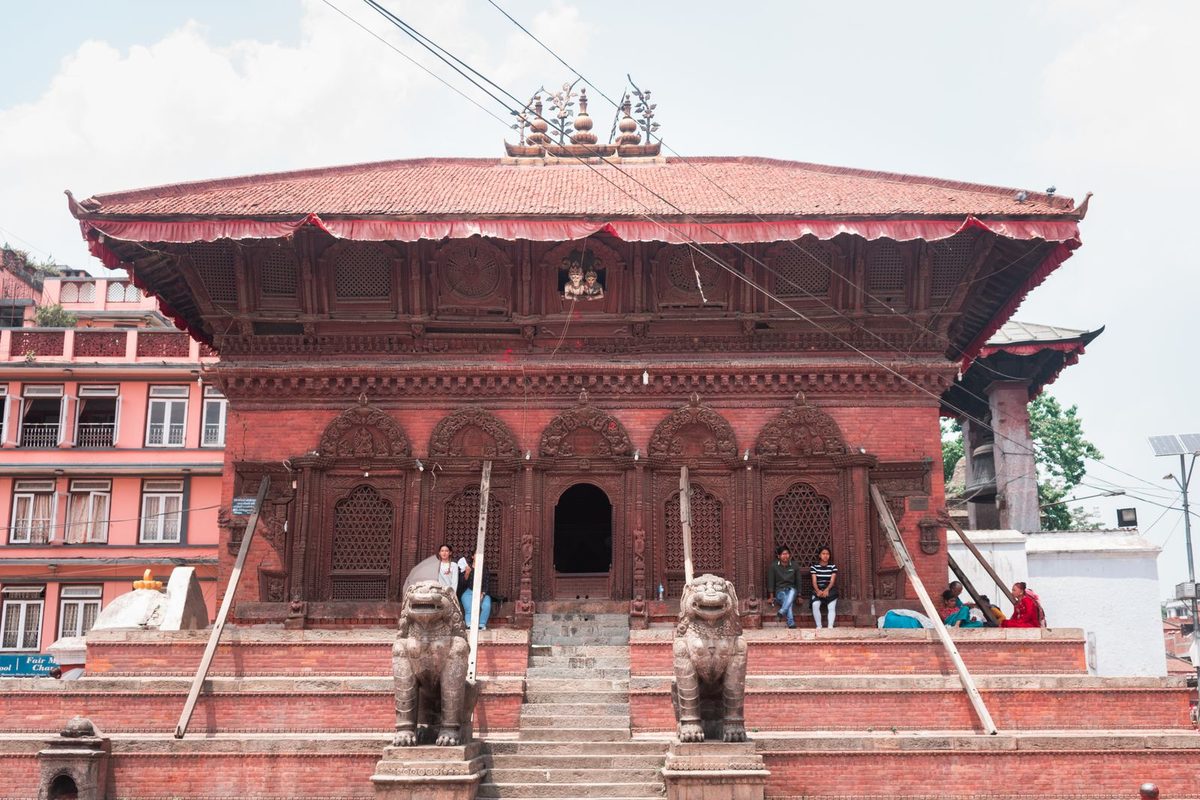
At a little after six in the morning, the square is not yet a monument. A man is sweeping the plinth of a temple with a short broom. Two women in red saris are pressing vermilion and marigold petals onto a stone god that has been receiving the same offering for three hundred years. A porter rests his load against a carved pillar and drinks tea from a glass. Above them, on the upper floor of a small brick temple, a carved wooden couple leans out of a window, as they have done every morning since the eighteenth century, watching the city come to life.
By ten o'clock the square will be loud, crowded and photographed. At six it belongs to the people who live around it.
A Kathmandu Durbar Square private tour, as we design it, is built around that difference: arriving while the square still belongs to the city, entering the courtyards most visitors never find, and walking beside someone who can tell you why every one of these buildings stands exactly where it does.
Why Kathmandu Durbar Square Matters
There are three royal squares in the Kathmandu Valley, one for each of the old Malla kingdoms. Patan is the city of fine arts, its square the most perfectly composed. Bhaktapur is the medieval city that kept its stillness. Kathmandu Durbar Square is the one that never stopped working.
For centuries this was the seat of power: first of the Malla kings, then of the Shah dynasty that unified Nepal. Nepal's kings were still crowned here, in the courtyard called Nasal Chowk, within living memory. The square is part of the Kathmandu Valley World Heritage Site, alongside Swayambhunath, Boudhanath, Pashupatinath, and the squares of Patan and Bhaktapur.
Locals call it Hanuman Dhoka, after the palace gate, or Basantapur, after the open plaza on its southern side. Whatever you call it, it is not a museum set apart from the city. It is a crossroads. Old trade routes meet here, the bazaars of Indra Chowk and Asan run off it to the north, and the life of the old town flows through it every hour of the day.
The Name of a City in One Building
Kathmandu takes its name from a building, and the building stands at the southwestern corner of the square.
Kasthamandap, the wooden pavilion, was for centuries a resting house for travellers and traders on the routes that crossed the valley. Its name means, simply, the shelter of wood. Legend holds that it was built from the timber of a single sal tree. Over time the settlement around it became known by its name, and Kasthamandap became Kathmandu.
The earthquake of 2015 brought the pavilion down. It has since been rebuilt, timber by timber, by Newar craftsmen working in the traditional manner, with the local community insisting that it be done the old way. Standing in front of it, knowing that a city was named after a place to rest, says something about what this valley has always valued.
Reading the Square
Kathmandu Durbar Square is not one space but several: an outer square crowded with temples, an inner palace of courtyards, and the open plaza of Basantapur to the south. A first visit can feel like a jumble of roofs. A good guide turns it into a sequence.
Hanuman Dhoka, the palace gate
The old royal palace takes its name from the statue beside its main gate: Hanuman, the monkey god, set here by King Pratap Malla in 1672 to protect the palace. He is draped in red cloth and shaded by an umbrella, and his face has been smeared with so many generations of orange paste that it has long since disappeared. Devotees still touch his feet as they pass.
The gate itself is painted in bright colours and flanked by stone lions. Through it lies the palace, and the beginning of the part of the square that most visitors rush.
Nasal Chowk, the coronation courtyard
Inside the gate is Nasal Chowk, the great courtyard where coronations were held. Its name refers to Nasaleshwar, the dancing form of Shiva, whose small shrine sits in one wall. Around it rise the carved wooden windows and galleries of the palace, and on the far side stands the nine-storey Basantapur Tower, from whose upper floors the kings once looked out over their city.
Parts of the palace complex house the Tribhuvan Museum, which tells the story of the Shah kings. With time, and a guide who knows the history, the courtyards say more than any exhibition.
Taleju Temple
Rising behind the palace, on a stepped plinth of twelve tiers, is the Taleju Temple, built in 1564 by King Mahendra Malla. It is the tallest temple in the square and was dedicated to Taleju Bhawani, the royal goddess of the Malla kings. It is so sacred that, by tradition, it opens to Hindu worshippers only once a year, during the Dashain festival. You will see it from the square, golden roofs stacked against the sky. That distance is part of its meaning.
Kal Bhairav
At the northern end of the square stands a huge stone image of Kal Bhairav, the fearsome form of Shiva, painted black, crowned with skulls, six-armed and trampling a corpse. According to tradition it was set here by Pratap Malla in the seventeenth century. For generations it served as a kind of court: it was believed that anyone who told a lie in front of Kal Bhairav would die on the spot, and suspects were brought here to swear to their innocence.
It is an unsettling image, and an unforgettable one. In the early morning, when worshippers leave rice, flowers and coins at its feet, it is less frightening than it looks.
The Jagannath Temple and its struts
Near the gate stands the Jagannath Temple, among the oldest in the square, built in the sixteenth century. Look up at the carved wooden struts that support its roof. Among the gods and goddesses are erotic carvings, some of them startlingly frank. Your guide will offer several explanations: that they celebrate the cycle of life, that they were thought to protect the temple from lightning, or that they reminded the devout of the world they were praying to transcend. All of them may be true.
The Shiva-Parvati Temple
On the western side of the square is the small temple you see at the top of this article. From its upper window, carved wooden figures of Shiva and his consort Parvati lean out, side by side, looking down on the square like an old married couple watching the neighbours. It is one of the most affectionate images in the whole valley, and it is the one people remember.
Maju Dega and the steps
Opposite it, the Maju Dega, a Shiva temple raised on a nine-stepped plinth at the end of the seventeenth century, is where the square sits down. In the late afternoon its steps fill with students, traders, old men, pigeons and travellers, all watching the light change. Sitting there for half an hour is one of the most rewarding things you can do in Kathmandu, and it asks nothing of you but time.
The Kumari: The Living Goddess
At the southern edge of the square stands a three-storey brick building with some of the finest carved windows in Nepal. This is Kumari Ghar, the house of the Kumari, built in 1757 by King Jaya Prakash Malla.
The Kumari is a young girl chosen from the Newar Shakya community and venerated as a living incarnation of the goddess Taleju. She lives in this house, appears at certain festivals, and leaves it only on ceremonial occasions. When she reaches puberty, she returns to ordinary life and a new Kumari is chosen.
Visitors may enter the inner courtyard, Kumari Chowk, and on some occasions she appears briefly at a carved window above it. Photographing the Kumari is strictly forbidden, and rightly so. The courtyard itself, with its carved windows and quiet, is a place to stand in silence.
It is easy to find this tradition troubling, or exotic, or both. Our guides do not ask you to accept or dismiss it. They explain it: who chooses the Kumari, what she represents to the Newar community, how former Kumaris live today, and why the custom has endured through kings, revolutions and the end of the monarchy. A tradition understood is very different from a tradition stared at.
Festivals in the Square
The square is a stage for some of the most important festivals of the Kathmandu year.
- Indra Jatra. In late summer, for eight days, masked dancers perform in the square, a great pole is raised in front of the palace, and the Kumari is drawn through the old city in her chariot. It is the most spectacular moment of the year here.
- Dashain. The great autumn festival of the Hindu calendar, when the Taleju Temple opens for its single day of public worship and the city's families gather.
- Tihar. The festival of lights, when the old town is lit with oil lamps and the houses around the square glow at night.
A festival morning in Kathmandu Durbar Square is unforgettable and very crowded. We plan it carefully, with the right vantage point, a calm exit and time to rest afterwards. Our article on Nepal's festivals covers the wider calendar.
What Makes a Kathmandu Durbar Square Journey Truly Private
The right hours
Before eight in the morning, the square is a neighbourhood at prayer. In the last hour of daylight it becomes a neighbourhood at rest. Between the two it is a busy monument. We plan around the first and the last, and we make sure the courtyards are reached before the groups.
A guide who reads the woodwork
Our Kathmandu guides are chosen for their knowledge of Newar architecture, Hindu and Buddhist iconography and royal history as much as for their English. They know which god is carved on which strut, which family keeps which shrine and which story is legend and which is fact. They also know when to stop talking.
Doors that are not on the map
Around the square, in the lanes towards Indra Chowk and Asan, are hidden courtyards, bahals and small shrines that most visitors walk straight past: the courtyard of Seto Machhindranath at Jana Bahal, the old stupas tucked behind shopfronts, the workshops of metal craftsmen. With introductions made in advance, we take you through doors that are not on any map.
Rest, afterwards
A morning in the square deserves a long, slow lunch. We bring you back to a heritage hotel in the city, or to a garden courtyard with a view across the rooftops, so that the square is something you absorb rather than tick off. Our guide to luxury Kathmandu describes the places we choose.
How to Build Kathmandu Durbar Square Into a Nepal Journey
Kathmandu Durbar Square reads best in conversation with the other great sites of the valley.
- The three royal squares. Kathmandu, Patan and Bhaktapur on three separate days, each given its own pace. This comparison is one of the great pleasures of the valley, and it is at the heart of our Elysian Classic journey.
- The sacred valley. Durbar Square alongside Swayambhunath at dawn, Pashupatinath on the river and Boudhanath at dusk, for a complete portrait of the valley's faiths.
- Valley and mountains. A few days in Kathmandu followed by Pokhara, the lakes and the Annapurna views, the shape of many of our Elysian Premium journeys.
You can see where else the valley leads on our Kathmandu destination page.
When to Visit Kathmandu Durbar Square
The square can be visited throughout the year, and every season has its character.
- October and November. Clear skies, soft light and the great festivals of Dashain and Tihar.
- December to February. Cool mornings, bright days and the quietest square of the year. Bring a warm layer for the early start.
- March to May. Warm days and long evenings, with some haze in the air.
- June to September. The monsoon, washed stone, green courtyards and, at the end of the season, Indra Jatra.
Whatever the month, the hour matters more. Come at first light, or in the last hour before dark.
How a Private Kathmandu Durbar Square Journey Is Costed
A journey of this kind is costed only once it is designed, because no two are the same. The guide, the hours, the courtyards and workshops we open for you, whether it falls on a festival day and how it fits into the rest of your time in Nepal all shape it. If you would like a figure, that conversation starts on our design a journey page.
Frequently Asked Questions
What is Kathmandu Durbar Square?
It is the old royal palace square of Kathmandu, the seat of the Malla and then the Shah kings, and one of the seven monument zones of the Kathmandu Valley World Heritage Site. It includes the Hanuman Dhoka palace, the Taleju Temple, Kasthamandap, Kal Bhairav and the house of the Kumari.
Can I see the Kumari?
Sometimes. She may appear briefly at a window above the courtyard of Kumari Ghar. Photographing her is forbidden. Remain quiet and respectful, and let your guide explain the tradition before you go in.
How long should I spend in the square?
Three hours in the early morning lets you see the outer square, the palace courtyards and the house of the Kumari without hurry. Many travellers return in the late afternoon simply to sit on the steps of the Maju Dega.
How is it different from Patan and Bhaktapur?
Patan is the most refined of the three, and Bhaktapur the most preserved. Kathmandu is the most alive, the one still woven into the daily business of a capital city. Seeing all three is the best way to understand the valley.
Begin Your Kathmandu Durbar Square Journey
Whenever I have an early morning in Kathmandu, I end up on the steps of the Maju Dega with a glass of tea, watching the square wake. A woman leaves marigolds for Kal Bhairav. A boy feeds the pigeons. Up in their window, Shiva and Parvati keep looking down, unbothered, as they have through earthquakes, revolutions and the end of a dynasty. There are few places where the past sits so lightly on the present. If you would like to know how a Greek came to call this country home, the story is on the founder page.
If you would like to see Kathmandu Durbar Square as it deserves, at first light, through its inner courtyards, with a guide who can read every carved strut, tell us how you like to travel and we will design the rest. Your journey begins on our design a journey page.